The Tanagers of Las Tangaras
‘Las Tangaras’ is the Spanish for ‘The Tanagers’. So, we hear you cry, what in fact are Tanagers and what on earth do they look like? Look no further…
Here on the reserve we are lucky enough to be visited by these small, sparrow-sized birds on an almost minute-by-minute basis. They are ubiquitous in Ecuador and all other South American countries, gracing parks, gardens, coasts and mountains and occur in an almost endless, kaleidoscopic variety of colours. At the last count, Las Tangaras is host to 31 species in the family, which includes other birds such as chlorophonias, euphonias, flowerpiercers and the Bannaquit (maybe more on those later…). Here are just a few of our resident tanagers.
First up is one of our most commonly seen Tanagers, the Yellow-throated Bush Tanager. Although rather plainly coloured in comparison to other Tanagers at the reserve, their little gangs make their presence felt by constant chattering and rummaging in the low undergrowth around the cabin. These guys often join mixed species flocks and take advantage of insects disturbed by other birds close-by, foraging in different areas or levels.

One of our most brightly coloured Tanagers is the Silver-throated Tanager. The male and female of this species are pretty much identical, both mostly yellow with the silver-white throat. They are acrobatic birds and are great fun to watch as they work there way along trunks and branches, often upside down or dangling precariously from a clump of moss.
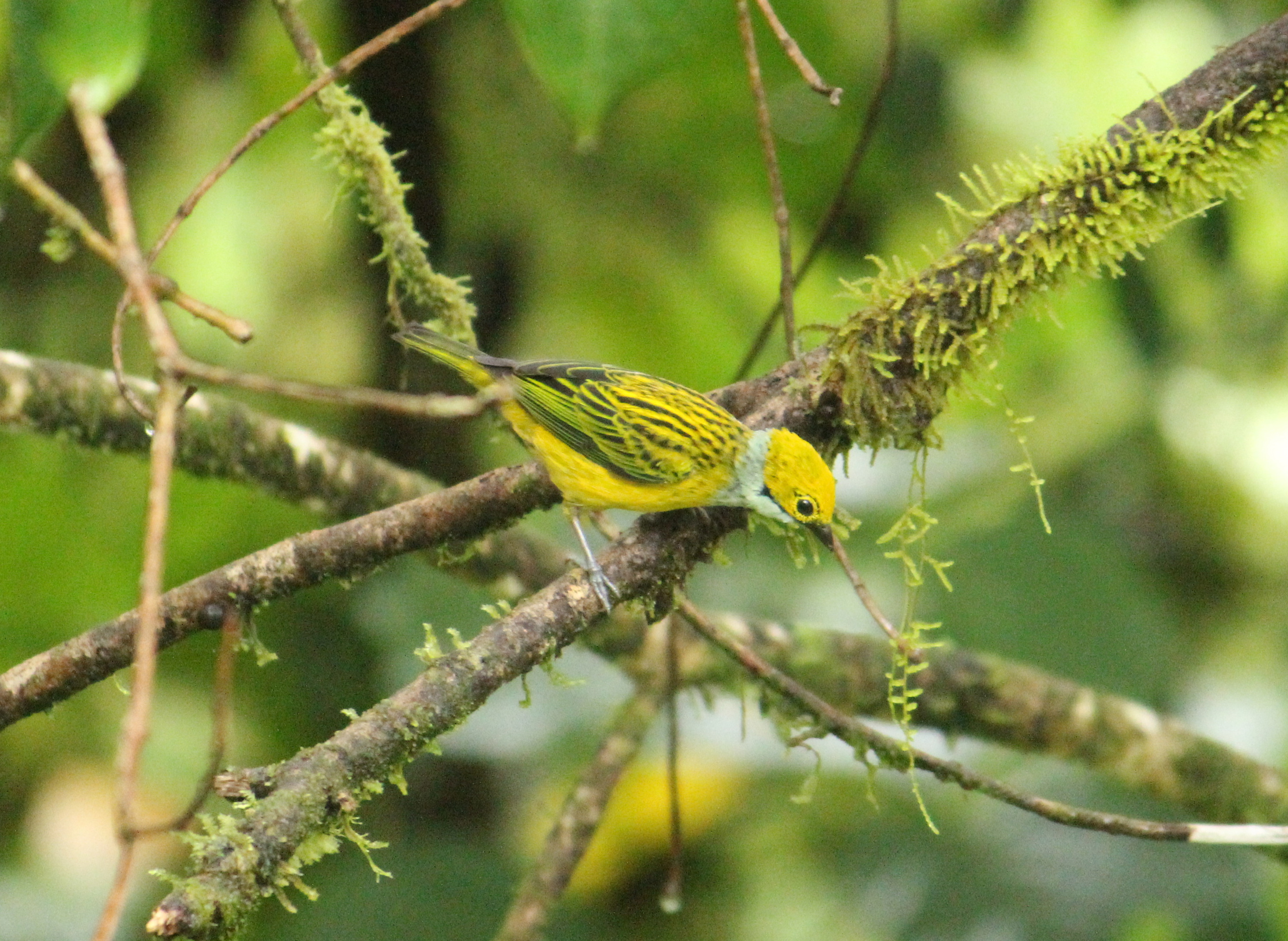
Talking of acrobatic, the Rufous-throated Tanager probably gets the award for the least fearless insect-grabber of the lot. These birds usually stay together as a single species flock and like to forage in the orange tree outside the manager’s bedroom window. They chatter constantly to keep the group together and move slowly through the upper levels of the canopy around the lodge, picking off insects as they go.
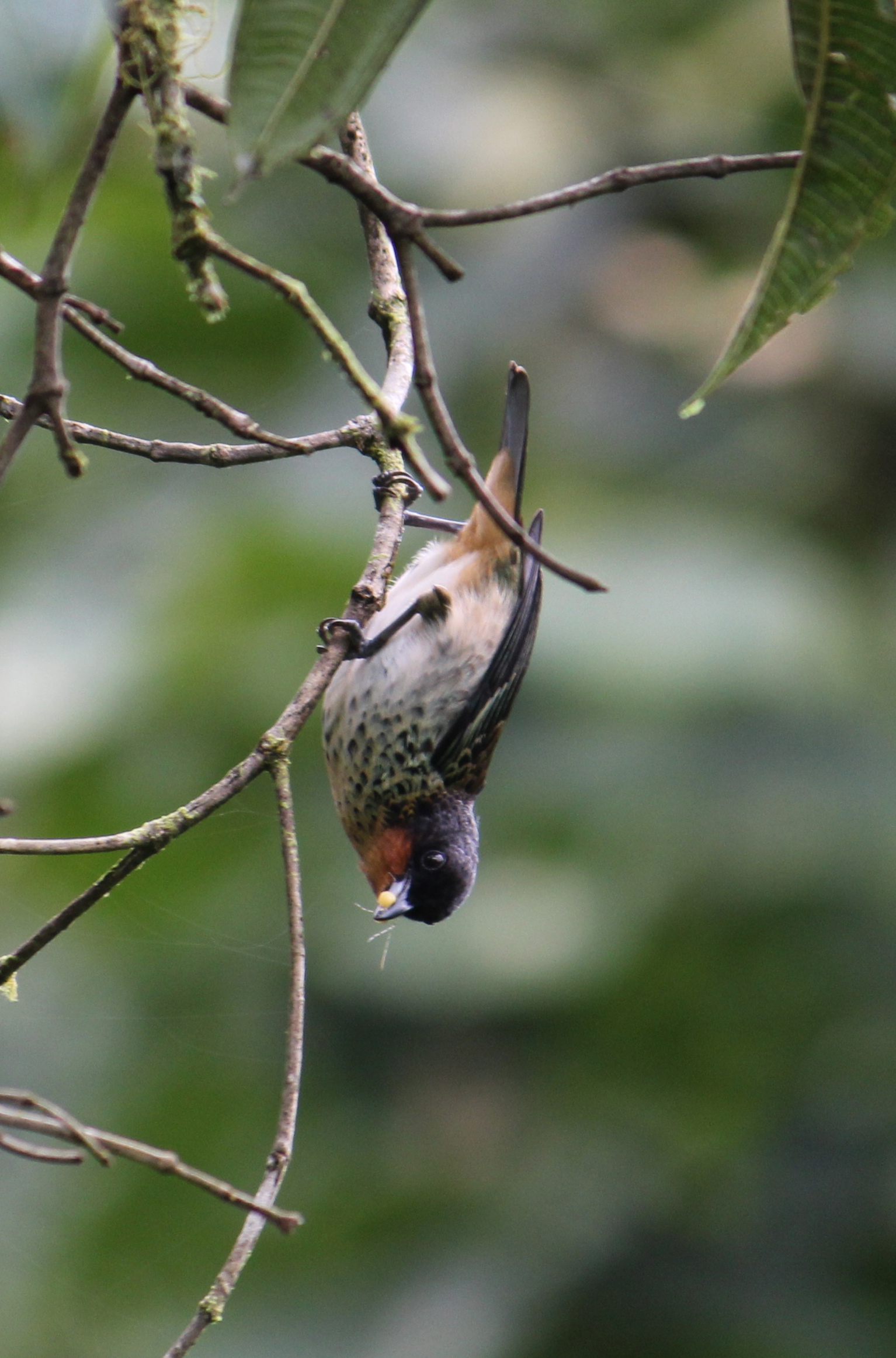
Slowly becoming our favourite Tanager at the reserve, the Palm Tanager is a beautiful, sleek looking bird with an inquisitive character. They are found all over the northern portion of South America and have really started showing themselves at the lodge in recent days. Three birds hang around together and one individual has taken to sitting outside our bedroom admiring his (or her) reflection in the window, gesturing and calling. What started off as quite endearing behavior soon lost its shine as he (or she) is a particularly early riser and will start calling, gesturing and generally being a nuisance outside our window at 5.55am!

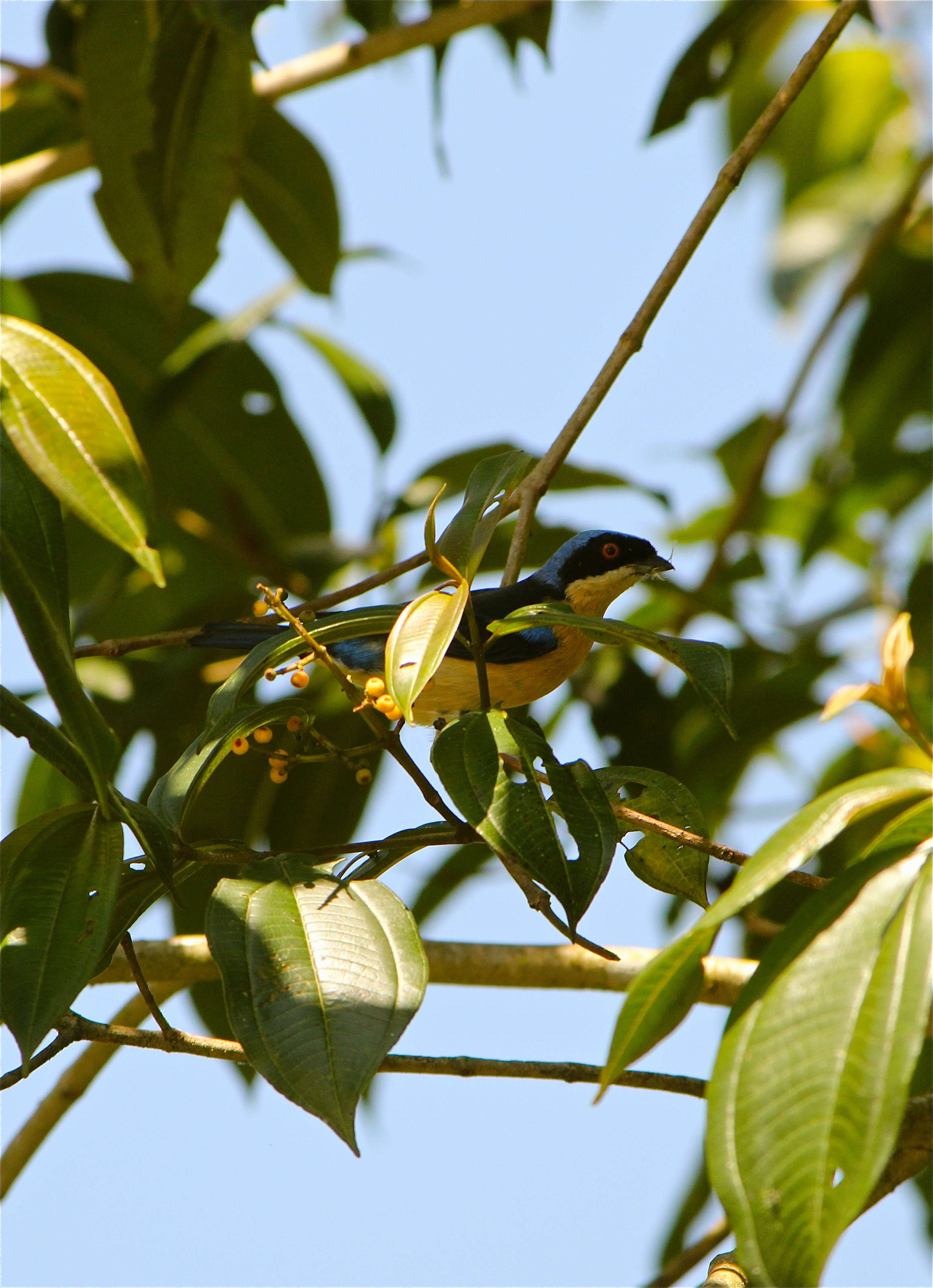
Last but not least on our list is possibly the most beautiful tangager we’ve seen at the reserve to date. Freya was on great photo-form and managed to get this really nice shot of a Fawn-breasted Tanager near the lodge. It was moving in a loose mixed-species flock. We’ve only seen this species once in just over two months, so its great to get such a nice shot and better still to see it in the first place. The red eye ring really stands out in real-life too.
There are plenty more Tanagers to see at Reserva Las Tanagaras as well as almost 300 other species of bird. Of course the best way to do that is to come to the reserve yourself. All the contact details are on the blog site and we’d love to have you, so if you have some time off planned this year, we can’t think of a better place for you to spend it. Spread the word!
Las Tangaras Camera Trap Project
The 20th August 2012 was a momentous day. On this day (my birthday) my wonderful girlfriend and fellow manager at Las Tangaras made the mistake of buying me a remote, night vision, sound-and-video-capturing camera trap. I was overcome and giddy with the range of possibilities that this presented to me. When at home in England I camera-trapped everything that moved with a child-like enthusiasm including girlfriend, house mate hanging out washing, a robin and many foxes all in anticipation of coming to the Ecuadorian cloud forest. What preparation!
The beauty of camera-trapping is that each of these magical little boxes can deliver the equivalent survey effort of a single surveyor, sitting silently in the jungle day and night for 365 days straight, without the need for a bath, loo breaks or mosquito repellent, all on a single set of batteries.
The results so far of the Las Tangaras Camera Trap Project have been encouraging. The first couple of locations are not so far away from the cabin, one on the ‘lawn’ outside the cabin and one on a trail called Sendero de Amor (I’ve not yet discovered why it is named so, but there must be a good reason…).
Our first capture is this male Red Brocket deer (Mazama americana). He’s a big fella and the camera trap location is clearly on his daily rounds. We’ve caught him a few times now and even three times in one day, once in the morning at 02:40, then again at 09:15 and once more at 12:20. The Nambillo river is a short distance away from this location, so he may be crossing the trail to drink.
The next video below is one of our most entertaining yet. We set up a small table feeder in the front garden to see what turned up, and this little fella did. On the first night. This Common Opposum (Didelphis marsupialis) (we think, although facial markings quite strong…any help with that anyone?) is clearly enjoying the papaya we left out – someone has to eat it as we cannot stand the stuff and the nice fruit lady in town keeps on giving us free ones.
Our solitary camera is out there watching all night, every night so there will undoubtedly be many more critters to come, in fact we caught some last night! I will keep you posted!
Visitors and Fungi!
Well, what a first two weeks we’ve had.
Things have gone pretty smoothly so far, touch wood (plenty of it around here) and we’ve eased into life on the reserve. The walk in from Via Cascadas seems to be getting shorter and shorter, partly because we are getting more sure-footed at negotiating Sendero Principal but largely because we are learning to eat lighter food! We bought a large cabbage in the first week. What were we thinking!? 2 kilos of pain!
We’ve had a steady stream of visitors in our first two weeks at the reserve – some in wellies, some in converse trainers and some in socks and sandals! I’ve taken a look at the guestbook, where visitors are invited to leave contact details and thoughts and observations about the place, and have pulled out some figures to give you an idea of who comes here and where they come from.
So far in 2013 we’ve had 49 people visit the reserve from 12 different countries. Over a third of our visitors this year have come from the USA (16). Ecuador, France and Denmark have yielded 5 visitors each and Holland 4 (2 of which were our first guests, Eric and Susie!).
We have had 2 guests from each of Switzerland, Canada, Germany, Belgium, Spain, Australia and, most recently, Estonia.
Everyone loves a list of countries don’t they? Maybe not, but what we found most interesting about all of of our visitors was despite differences in culture language and country of birth they all had something brilliant in common! Everyone who has visited the reserve has been passionately interested in what Las Tangaras has to offer, they have looked for the small things as well as the big and they have all wanted to get ‘off the beaten track’. I suppose anyone who is willing to follow a small sign saying ‘Las Tangaras 2km’ pointing into the jungle and follow it up, down and around valley will all have a certain sense of adventure in them. We look forward to meeting our future guests and for now we will leave you with some of the smaller things we find on Reserva Las Tangaras, which are easy to photograph as they do not run, fly or crawl away.
Next time, we’ll update you on the Las Tangaras Camera Trap Project!


New Reserve Managers- Tom y Freya!
After an swift afternoons induction with Kate and Jeff we are finally here and living on Reserva Las Tangaras! After months of questioning from friends and family as to where we will be living and what type of loin cloth we will be sporting we can safely say that Reserva Las Tangaras is most definitely a wild place, but the loin cloths and tarzan yodels can safely stay in their bags.

The Cabaña is an incredible structure, which you would never imagine to be found at the end of a 2 kilometre track through the Ecuadorian Cloud forest. I most definitely felt guilty for complaining about carrying 20 kilos into the reserve when I saw the amount of work that has been put into making the reserve the most perfect place. We still haven’t asked how they got the oven in there, but I expect there is a broken donkey somewhere about town….
After settling in for all of about 2 hours we were set straight to task with our first paying guests Susie and Erik from Holland. We had met them in Quito as we were about to leave for the reserve so it was really nice they decided to visit us. On Sunday we all took our first visit to the cock of the rock breeding site also known as the Gallos de la peña lek, where we saw at lead 15 birds displaying in full voice for a mate – 2 females turned up and the place went bananas. Susie and Erik forgave us for the 5am start and we all felt we had seen something really special! (We plan to blog about this phenomenon extensively – but need to get some better photos and hopefully a video!)
After this we took a slow walk down the mountain where we spotted this beautiful nest.
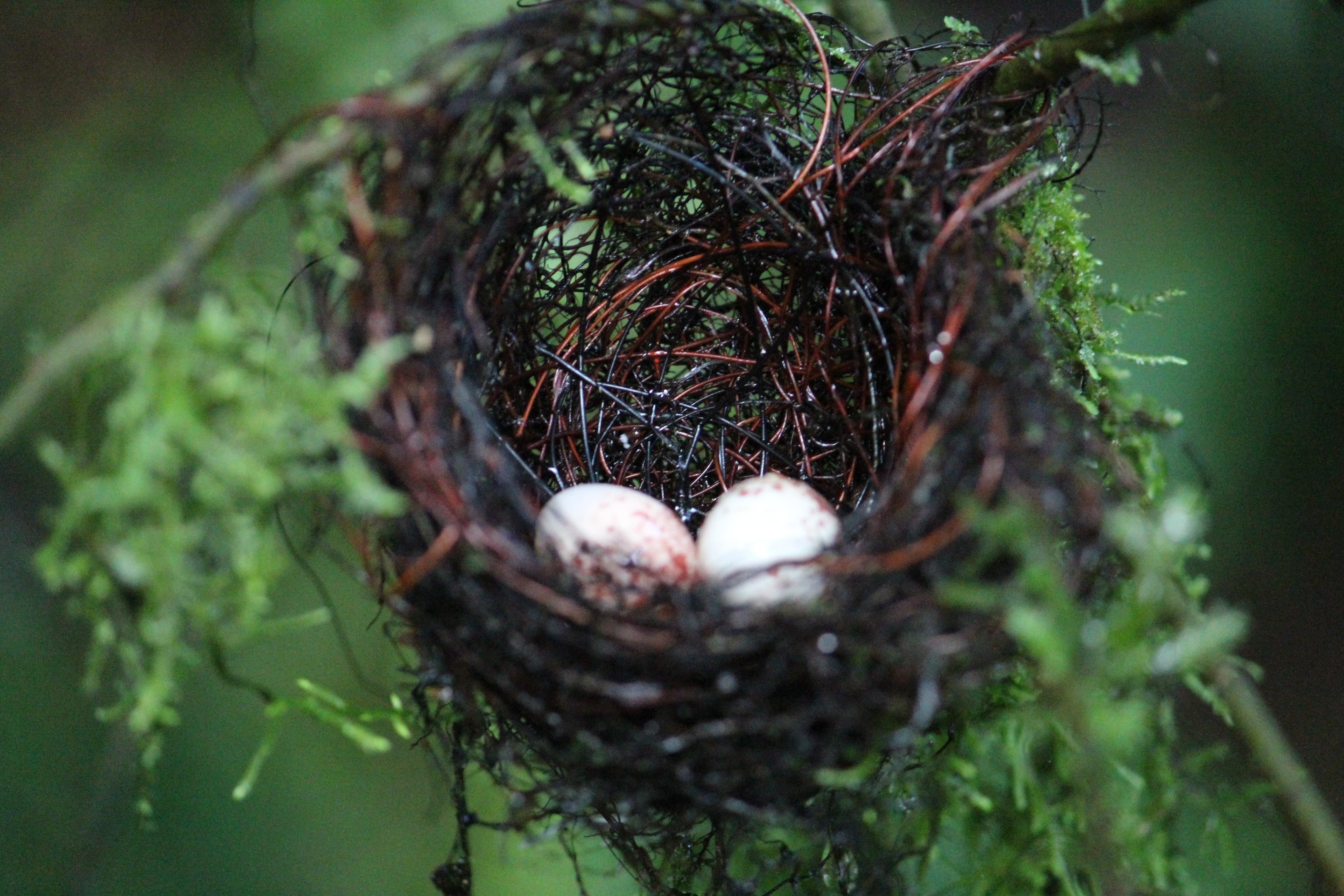
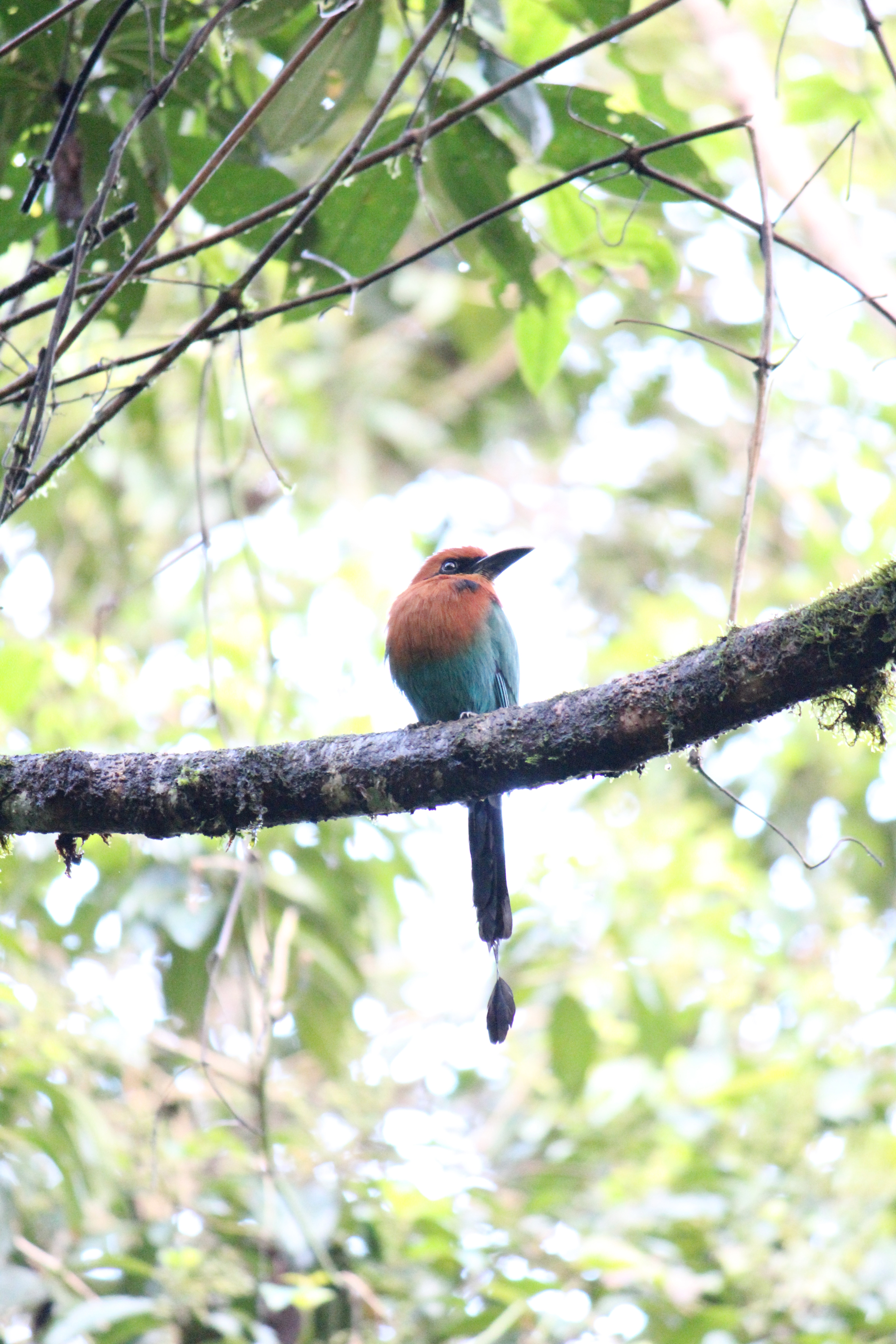
We think it belonged to one of these guys. We are aren’t sure if he is a rufous tailed Mot-mot or a broad billed Mot Mot. These are the types of things we have to think about these days! Maybe one of our readers knows?
Little Cabin in the Big Woods
For our final post on the Las Tangaras blog (nooooo!), we’d like to give a tour of the cabin that we’ve been caring for and living in for the last three months. It’s a lovely spot, and so many visitors are amazed when they arrive at how nice it is.
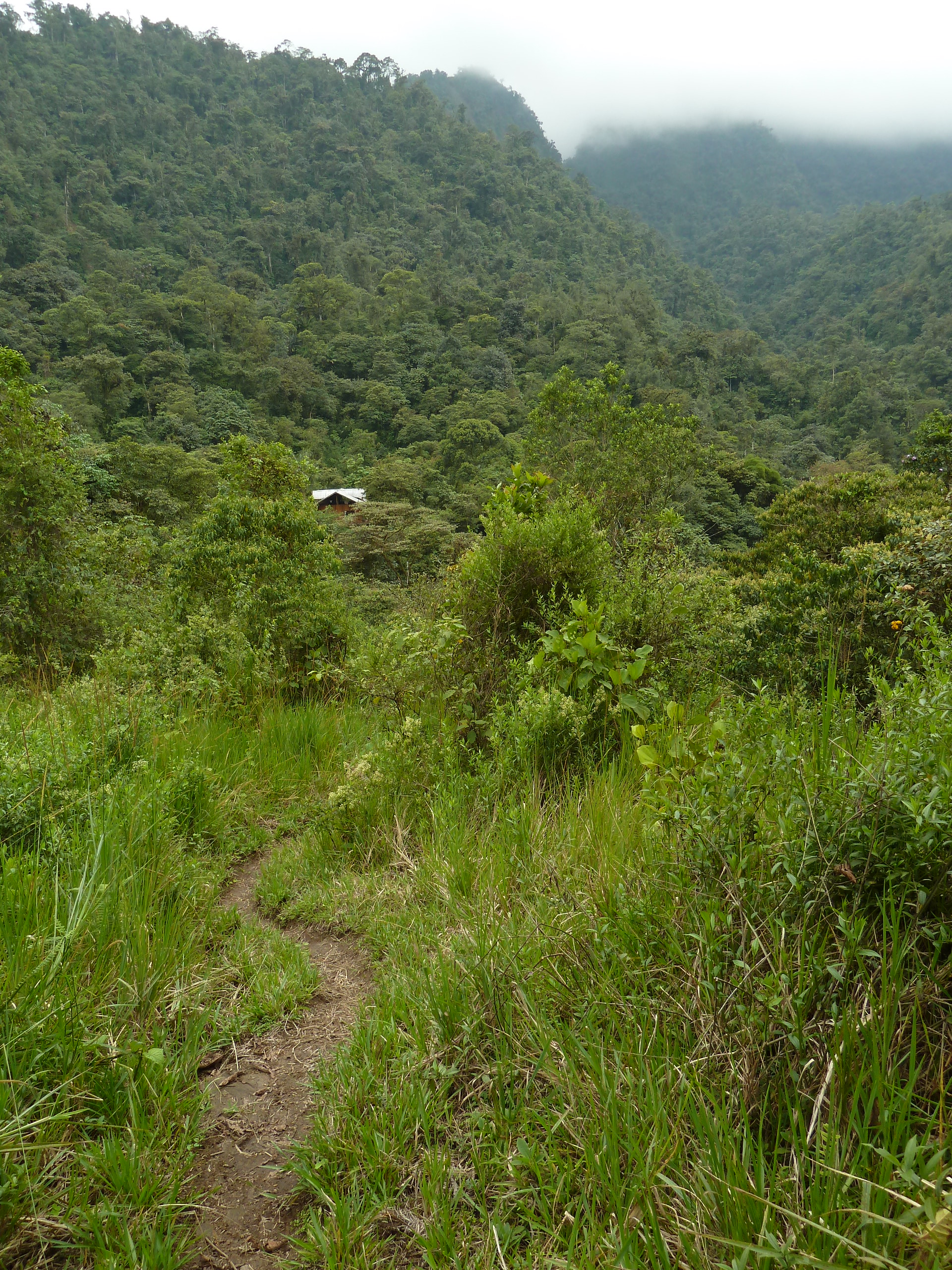
On the trail into the reserve, the first view you get of the cabin is often a welcome sight – you’re almost there!
The cabin is surprisingly large. Photos don’t do it justice, but even when people come to the house itself, they’re often surprised when they walk in the door at just how much space there is.
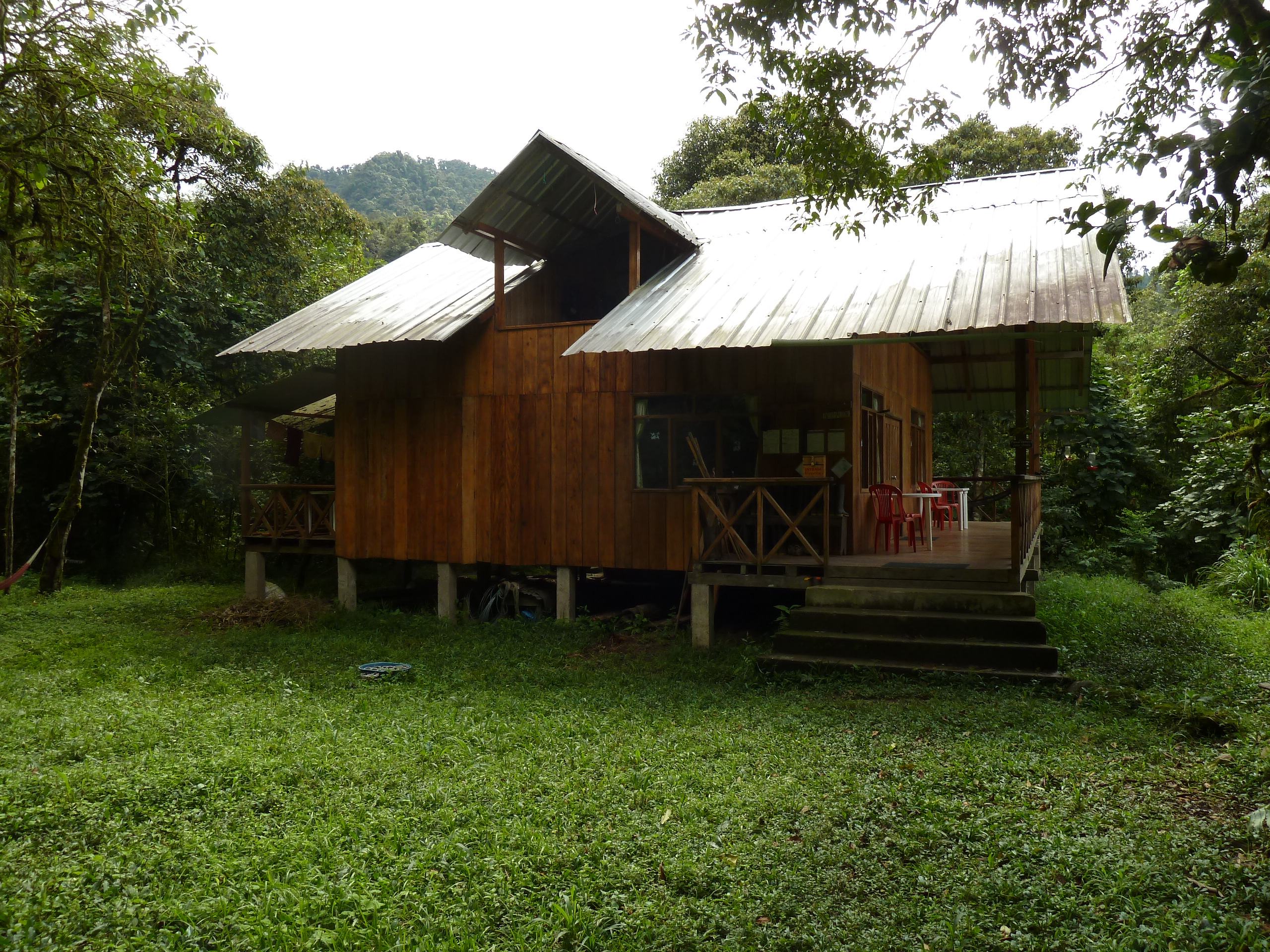
The bottom floor has the kitchen, dining area, living room, and full bath (yup, running water, flush toilet, hot shower – not too bad for the middle of nowhere!). The kitchen is enormous:
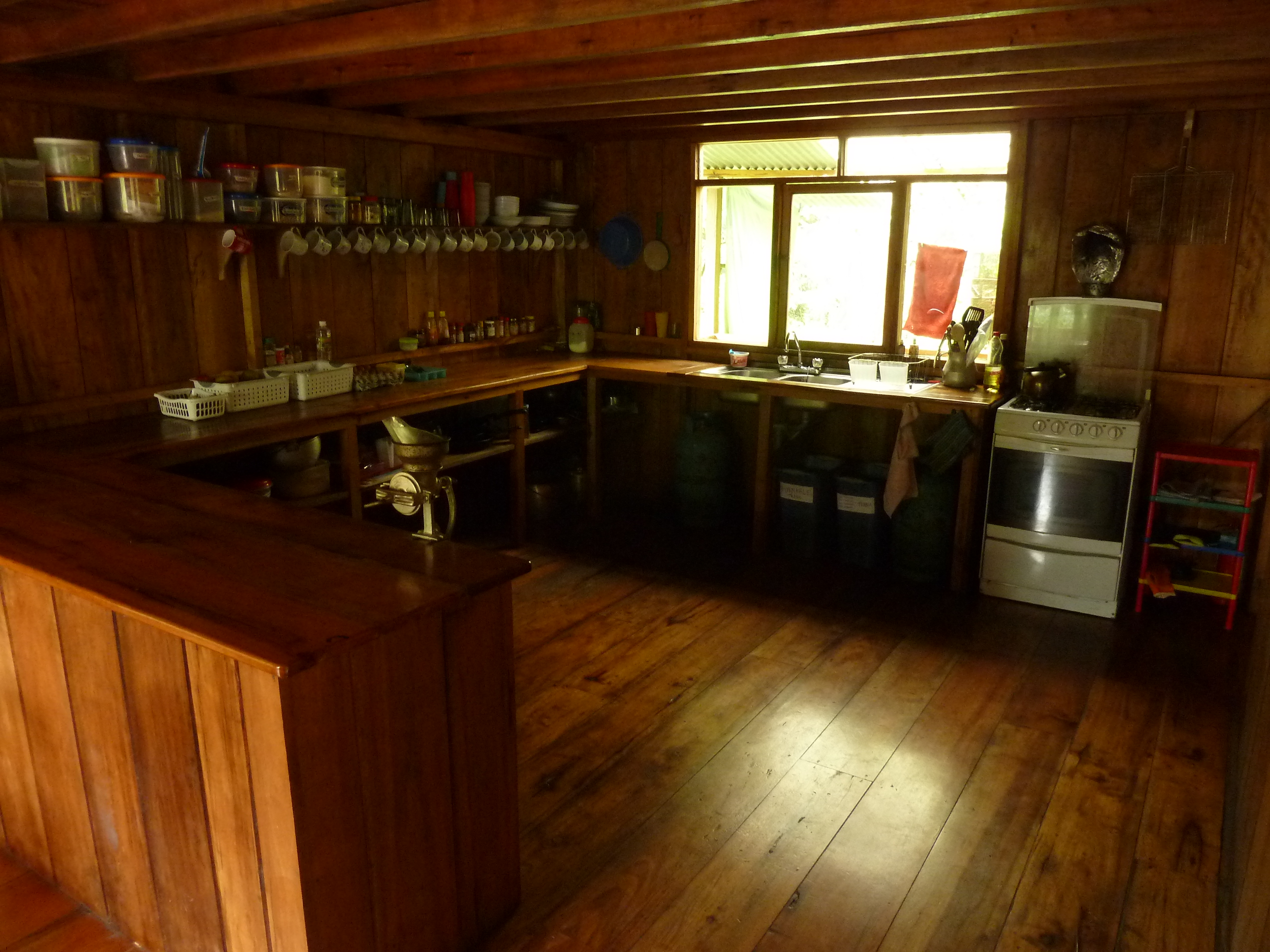
which is helpful when we have overnight visitors use the self-service option and bring their own food – many cooks in the kitchen actually fit here.
The living room has recently been improved, with new furniture, mostly made on-site (carrying a couch down the entry trail was just not an option) – remember the bamboo that we harvested at the beginning of our tenure here?:

Visitors who choose to stay in the lodge have a bed made up for them on the upper floor, which is mostly one big open loft that’s open to outside, as well. A mosquito net, comfortable mattress, sheets and blankets, pillow, and towel are all provided, so just a day pack is enough for a stay here.

The real attraction of Las Tangaras is outside, of course, but inside is pretty nice, too. It has been a wonderful home for our three months in Ecuador, and we hope that the new managers, Tom and Freya, will enjoy it as much as we have.
Thanks to Life Net Nature and Las Tangaras for the opportunity to be here, and we hope many more people will discover the beauty of the reserve!
– Kate and Jeff
Tools of the Trade
Las Tangaras managers wear many hats, and therefore use many tools. There is, of course, the machete:

without which trail maintenance would be pretty tough.

But we have more than just machetes, because we do more than just trail maintenance.
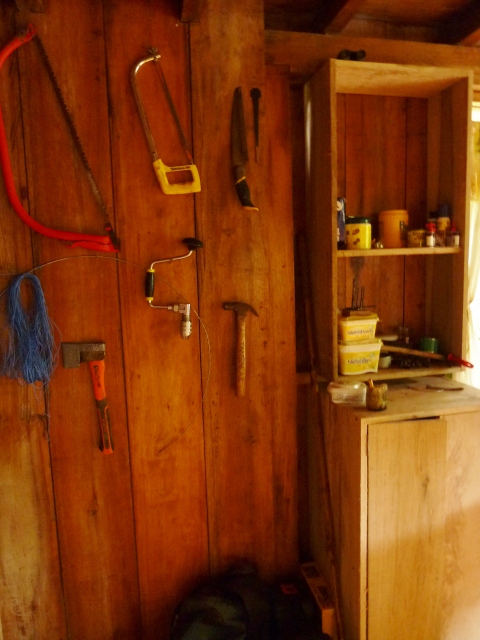
Implements of destruction, and so on
We build things, too, and bamboo can be our friend in this task – but we first have to harvest it. Of the several saws on the reserve, the smallest is the best for this job.

Of course, sometimes our simple hand tools are either less than adequate, or less than exciting. When we needed to replace the cable holding the bridge up, Reserve friend Artemio got very excited that he could borrow a friend’s come-along, a machine used for tensioning cable. Of course, pulleys and muscle could have done the job, but there was a come-along available! And it’s neat! I guess men and their tools are the same in all cultures.

Not all tools are big, heavy things. Some are smelly, like the varnish that we use for signs and the cabin.
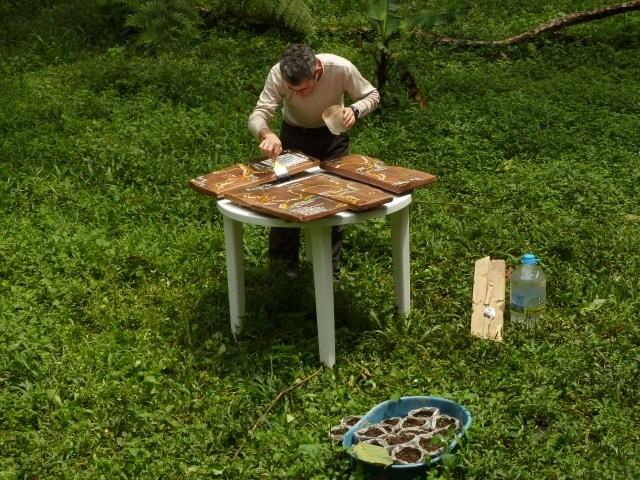
One of the varnish types here is made with nitrocellulose, also known as smokeless gunpowder. That’s certainly not available in the US!
But I always say, don’t underestimate the power of the really, really non-powered tool: the stick. Sticks are unbelievably useful, not least to keep me on my feet in the mud.

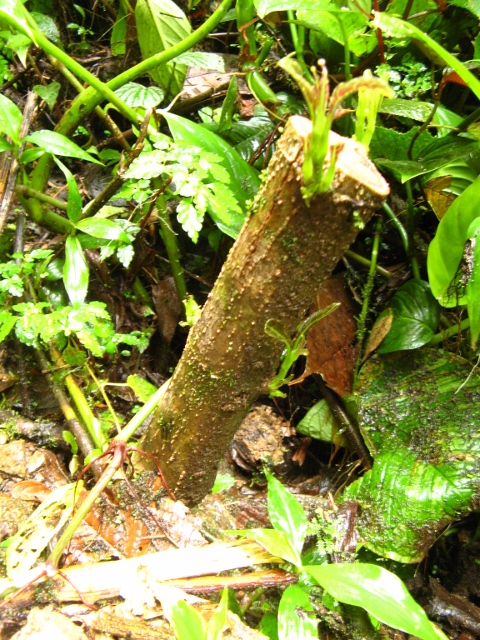
We’ve put sticks to work keeping our trails together, too. Our access trail for the water system is notorious for erosion problems. Jeff, the ecological engineer, asked Artemio, the helpful local guy, which trees would sprout from cuttings, and Artemio pointed one out. Jeff took a few cuttings and put them on the eroded sections of the trail. A few months later, ta-da! Sprouts! We have live stakes becoming trees! Keep your fingers crossed for these little guys:
Not all of our jobs are heavy manual labor, of course. Some of our most important tools are binoculars and paper.
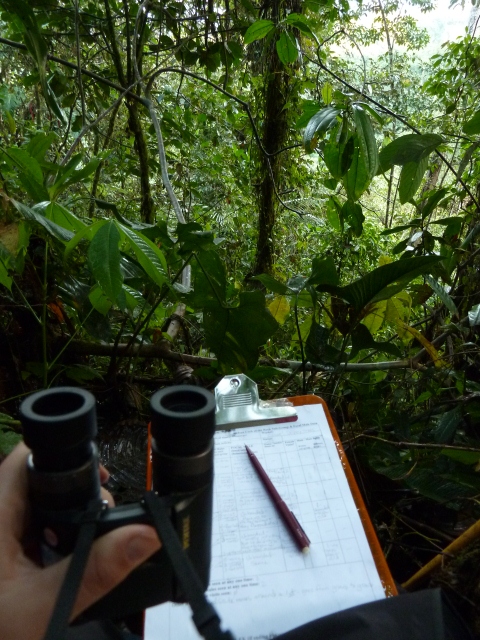
We not only research the Andean Cock of the Rock here, we also keep track of the hummingbirds that come by the feeders, and of any birds we happen to see on the Reserve. This means that we have had to learn to bird for real – which has involved heavy use of this gigantic book:
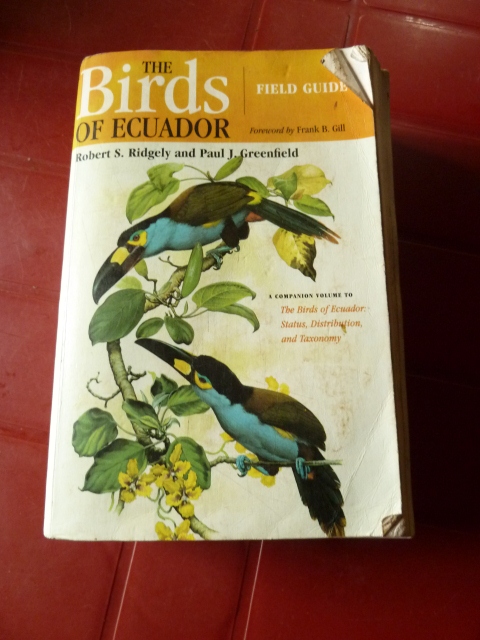
We’re a little more used to studying things like stars, rocks, and plants, which don’t move as much as birds do – so this can also be an important tool:

Of course, there are more relaxed jobs around here, like sewing, which involve a whole new set of tools – fortunately, these tools are typically a lot smaller and easier to pack in.
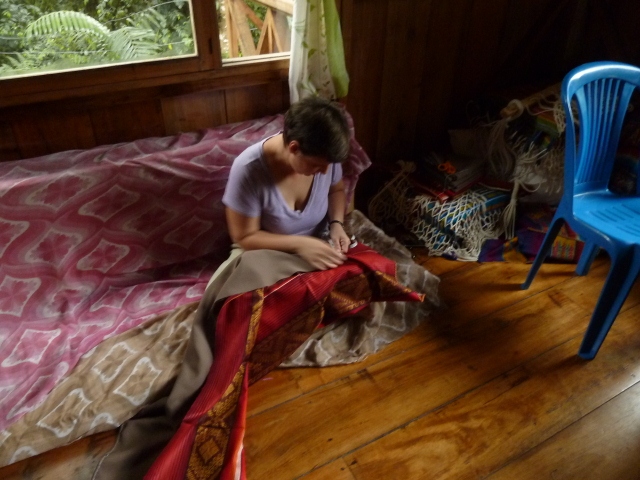
Of course, there’s always this tool:
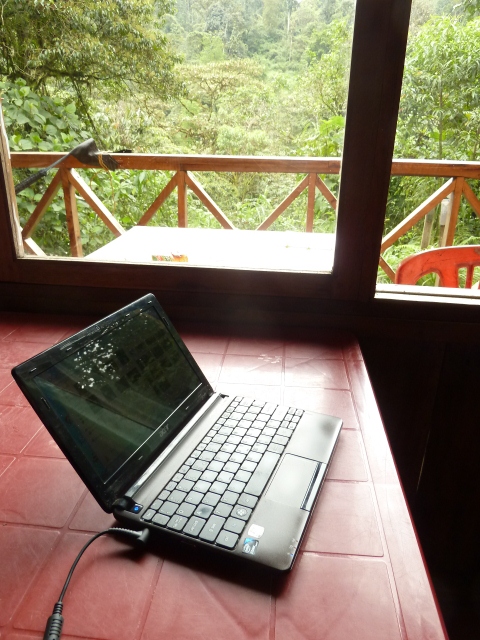
Sigh.
which requires electricity, for which we have a gasoline generator. We don’t run it often, but when we do, it’s serious charging time:

We actually didn’t have that many things to charge this day, only three.
Even with the generator, much of our equipment is unpowered:

Lighting and ambiance, all in one!

Entertainment!
It’s a pretty good life, all around.
Everyone’s favorite topic
We’ve been having some technical difficulties, so we haven’t posted on the blog for a while – but hopefully we’ll make up for that now. We, Jeff and Kate, only have a little less than two weeks left, but we have so much to say! So prepare for a post every few days.
Visitors often ask us how we get food and equipment to the reserve. One common thought is that there is an access road somewhere that we keep hidden – there isn’t. It’s just the single trail through the neighboring ranch property that everything comes down. They also guess that we must have a horse or mule to help us out. We don’t usually, although occasionally we do:

We cook on a propane stove, and have a propane water heater, and those tanks are nearly 50 kg/100 lbs each – so those come in by mule. But for food and most other supplies, we are the mules. Good thing we brought big backpacks!
Sometimes, it can be very dangerous to go to town to get our supplies, as in this last weekend. Carnival had taken over the town, and there were many squirt guns and cans of foam being sprayed all over:
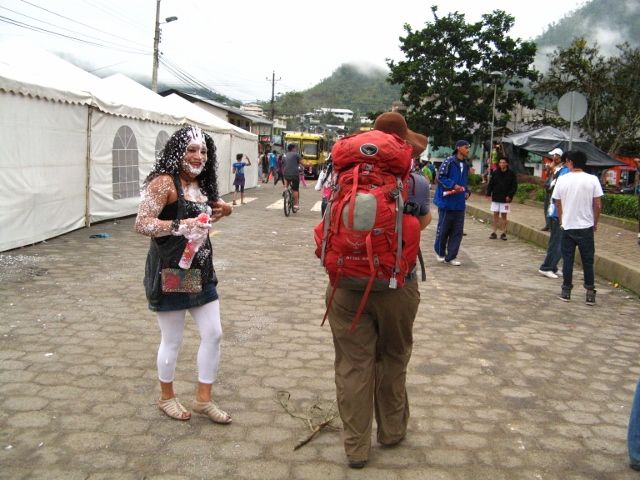
The backpack full of food doubles as a foam guard.
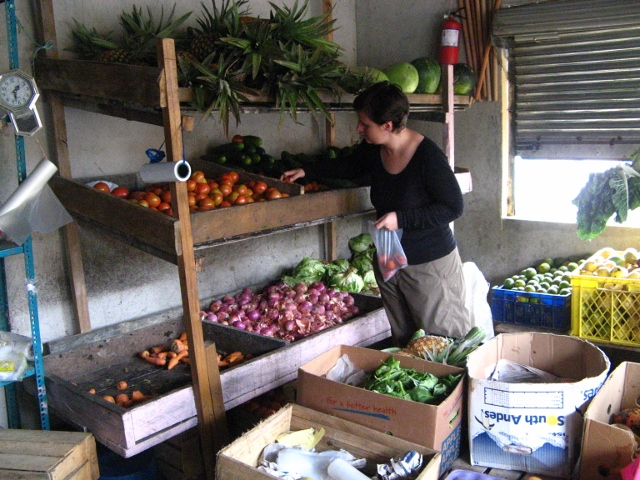
But the “danger” and the hike are worth it when you can get produce like this:

95% of the produce that our veggie lady sells is from Ecuador. With just about every climactic region possible from dry beaches to cloud forest to glaciers, there’s a huge variety of local fruit and veggies, from mangoes and avacadoes to apples and strawberries.
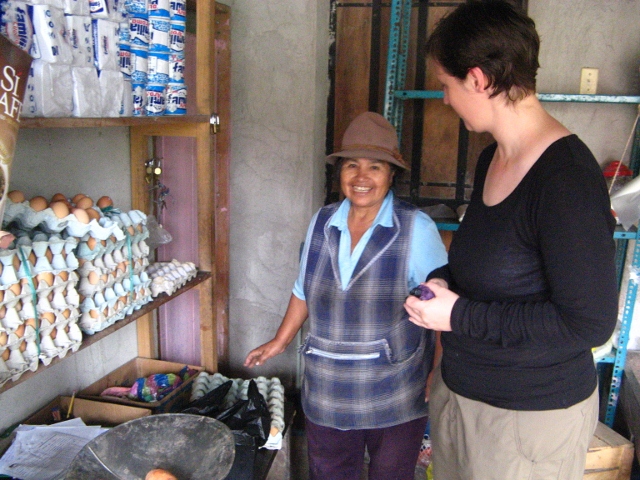
The best part of shopping, though, is that it’s always sold with a smile:
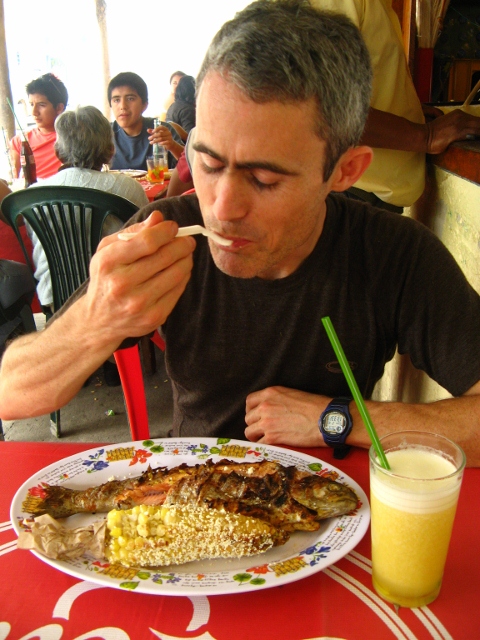
Another good part of going to town is getting a meal that someone else cooked – especially when the cook was Gladys,

and the meal is something like her trout.
Carnival had fun food to offer, as well, including chocolate dipped strawberries:

Energy for the hike!
But really, we don’t do too badly up at the reserve. We love to cook, and with the ingredients we can get, there have been some fantastic meals.

Mexican style tamale filled with beans and cheese, homemade corn chips and guacamole, black beans, and a tomato-tree tomato-cheese salad.
It’s not always so healthy as that – Jeff loves his pancakes, especially with bananas and chocolate in them.

We got a hand grinder for the reserve, which we can use to make masa from corn for tortillas and tamales:
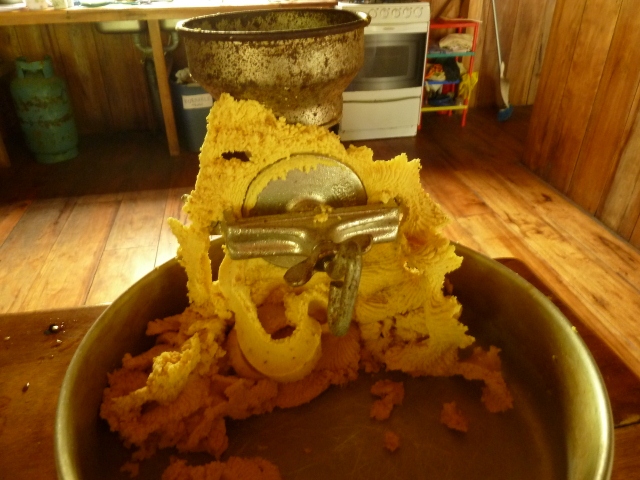
But, of course, it can be used for other things – locally roasted, fresh ground coffee, for example. Of course, with Jeff’s sweet tooth, there’s been much chocolate making:
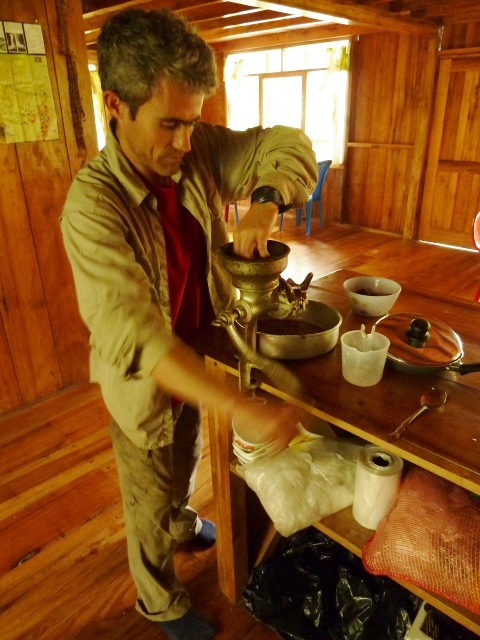

And he’s even been offering chocolate making workshops to visitors. Be warned – it’s a bit messy!

Messy, yes, but cleaning the wayward chocolate off of your hands is not the worst job in the world.
Gifts the rains bring
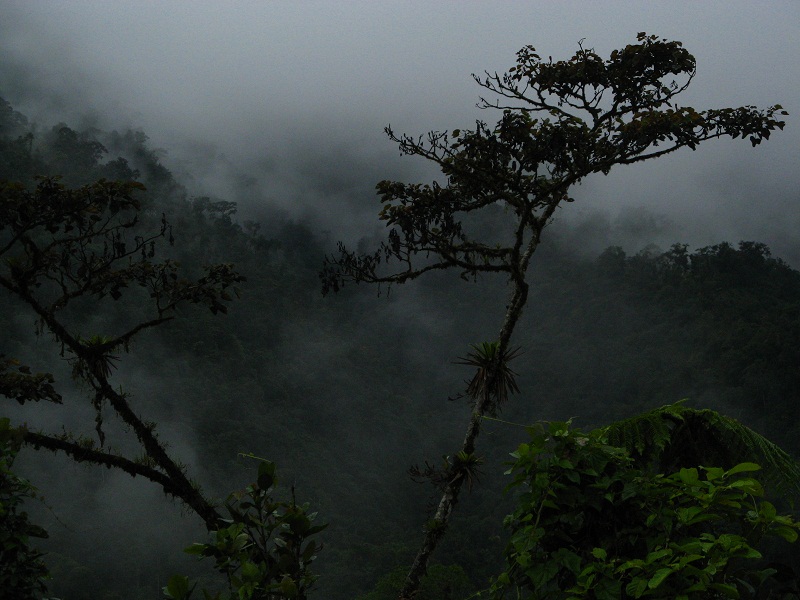
view of the reserve from the entry trail
Rain drips from leaves and hanging mosses, trickles off our metal roof, pours down the trails amd rumbles in the the stream valley below us. The rainy season is here in Las Tangaras, and everything is wet.
Twice a week, we hike the 2 kilometer trail in and out of the reserve to pick up groceries keep in touch with the outside world. We usually end up hiking back through rain
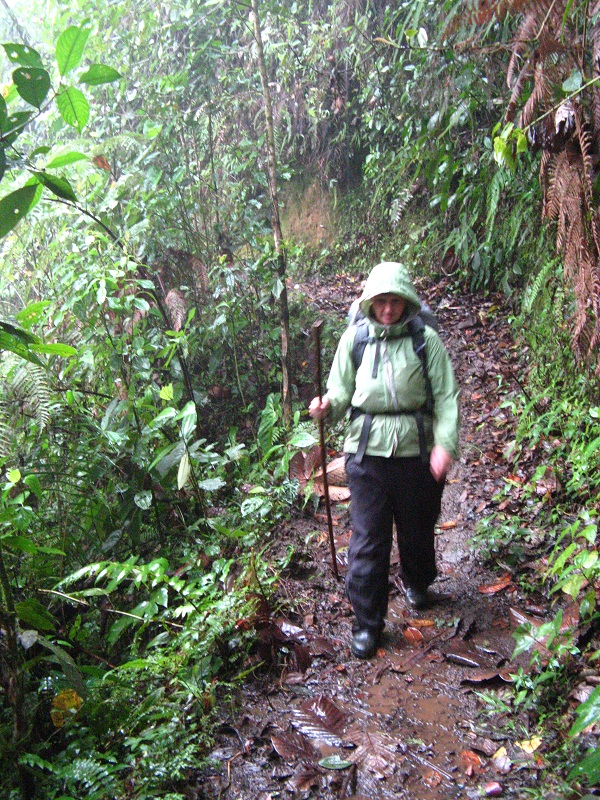
Kate with a backpack full of groceries
and lots of mud

Only the entry trail is this muddy due to horse and cattle traffic
Mudslides and fallen trees and branches are a daily occurance on our trails
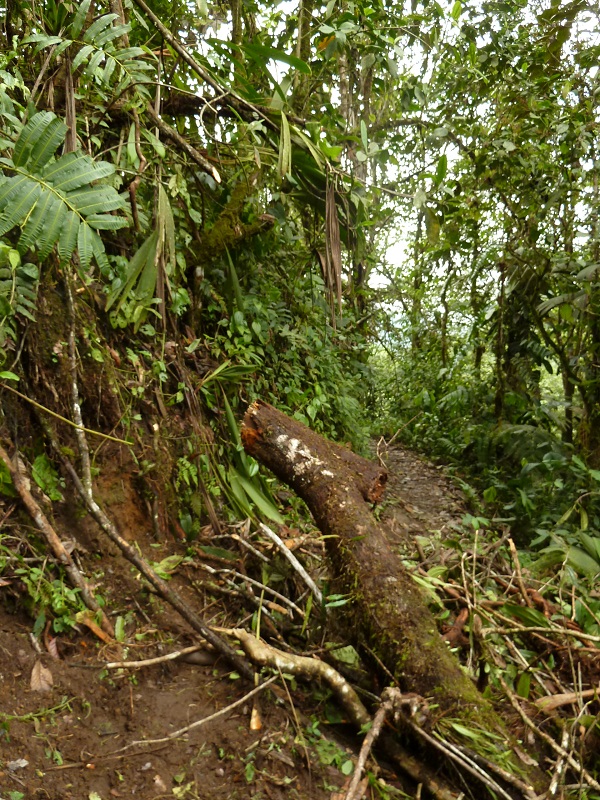
Tree fall and slide on the entry trail
Steady rain means steady employment in trail maintainance. Standard gear for the job is boots, a pair of rain pants, and a machete to clear the downfall.
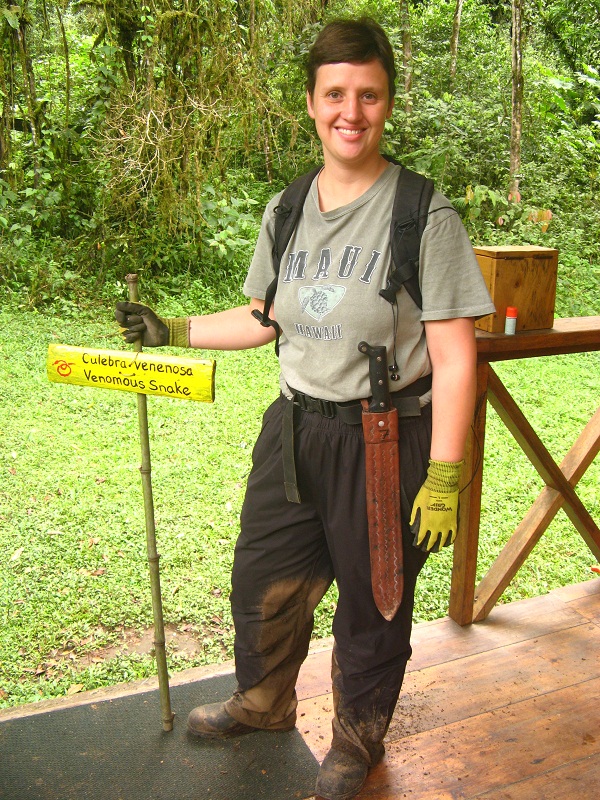
Kate goes out to update trail signs
Epiphytes thrive in the constant rain. Literally plants living on the surface of other plants, epiphytes hang from trees, passing brigades of raindrops from leaf to leaf in descending order to the ground.
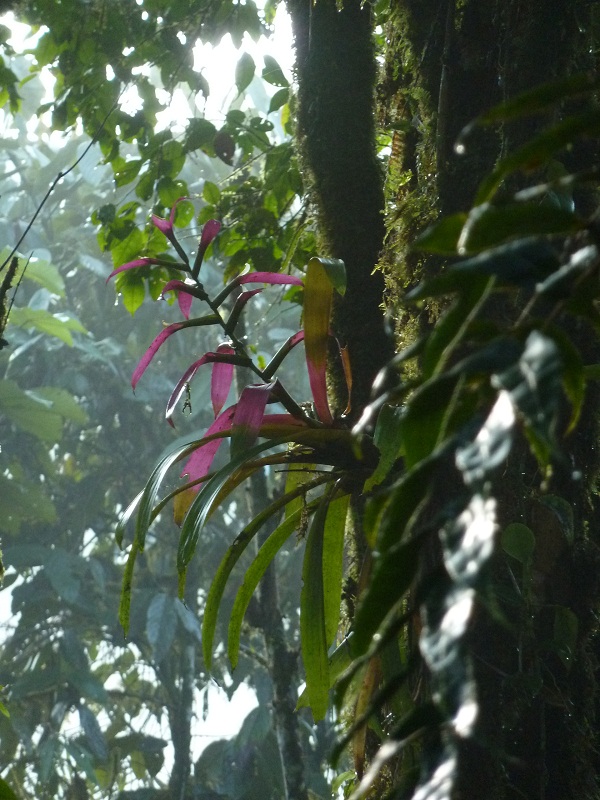
flowering bromeliad
There are hanging orchids

epiphytic orchid
clinging bromeliads
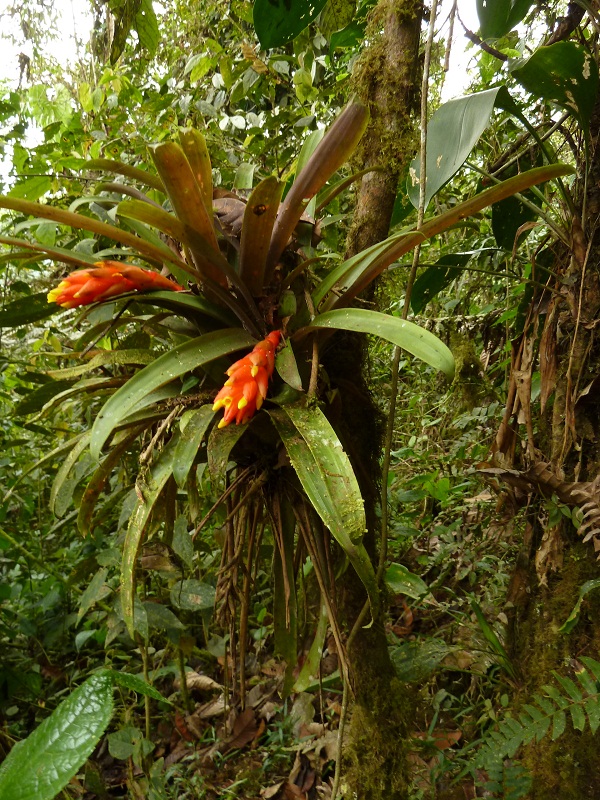
More bromeliads

And a number of plants that use red-tipped leaves to guide their hummingbird pollinators to small flowers hidden below.

Hummingbird-attracting plant
And then there are fungi. Of course, when it takes nearly a week for your hand-washed clothes to dry, fungi are pervasive in clothing, backpacks, beds, and everything in and out of the house. But they are also beautiful in their native habitat. Fungi pixie cups catch the rain.

fungi cups catching rain
brightly colored fungi brighten up the mossy slopes

sulfur-colored mushrooms
And then there is my favorite, glowing fungi. When we hike in the early morning to visit the cocks of the rock, the damp trail is lined with fireflies, glow worms, and glowing fungi. What looks just like a rotten stick or log by daylight is woven with luminescent threads in the pre-dawn darkness.

Glowing fungus on sticks at night, from a long exposure using only natural light
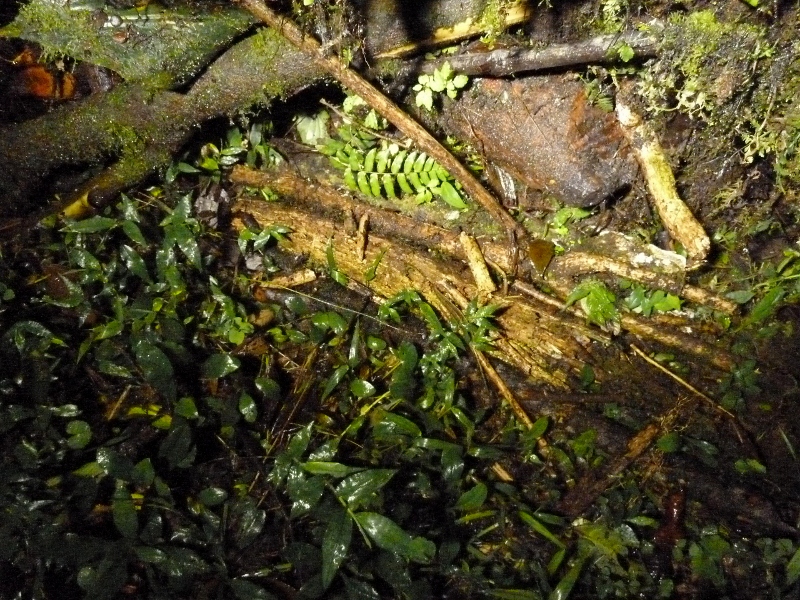
The same view of the same sticks using light from our flashlight
The rain and mud has not stopped visitors. We still have day trippers and overnighters visit us from countries around the world. We’ve had people from Colombia, Holland, France, Denmark, Switzerland, USA, Germany, and Canada. We also had one water-loving visitor seek shelter on our couch on an especially rainy night.

Until next time, we will be here at Reserva Las Tangaras, hosting visitors and enjoying the weather. Hasta Luego!
Things that make you go hummmmmmmmm
Hummingbirds are a huge part of daily life for us, and a huge part of a visitor’s experience when they come here to Las Tangaras. Since a blog post has not been dedicated to these crazy little beasts for over a year, here goes nothing!
Every morning, we feed the hummers, and they are always waiting for us in droves:
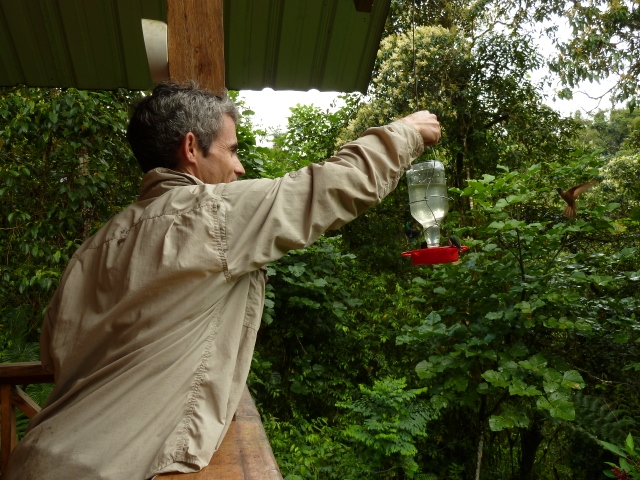
Note the birds already on the feeder before Jeff lets go.
This is so much fun for us, that we have to share the experience with our visitors:
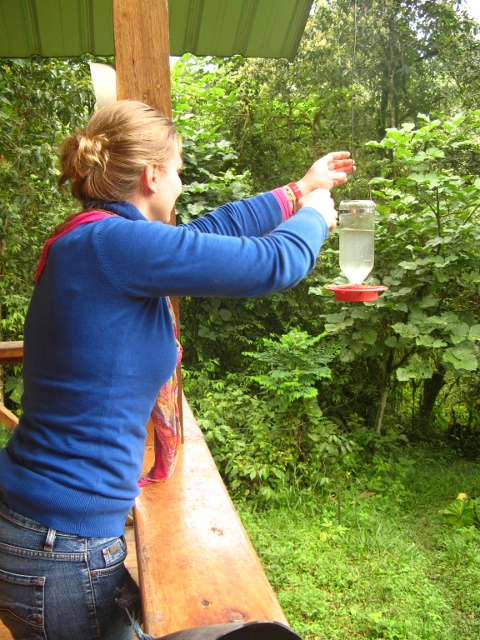
Nicolien puts out the feeders.
…and they do take advantage of it!
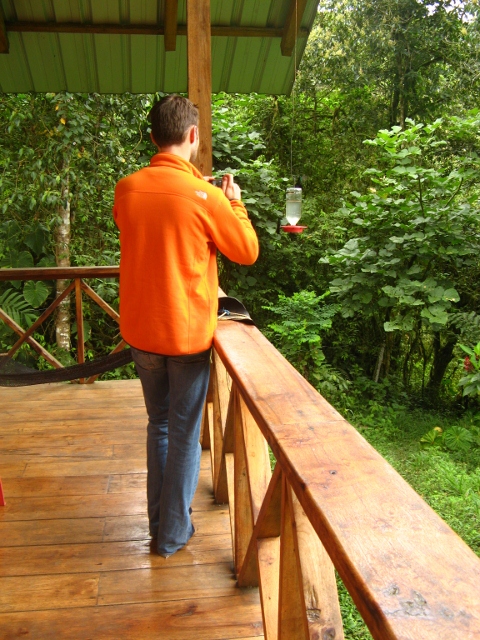
Mike takes pictures.
This time of year, our feeders attract a huge amount of birds, and they go through 2 cups of sugar easily in a day. They sit in all their colorful glory:
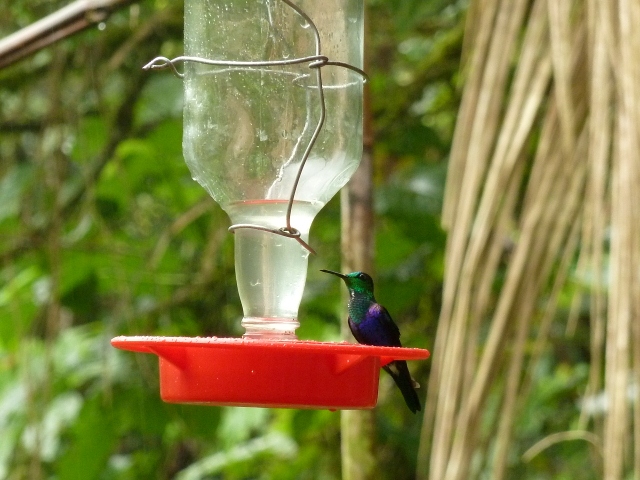
A green-crowned woodnymph.
They show off as best they can that which nature gave them:

A violet-tailed sylph.
…you’d think that tail would be an evolutionary disadvantage, but he seems to like it.
They’re not all flashy:

A fawn-breasted brilliant.
But, whatever does the job, right?
They do sometimes share the feeders:
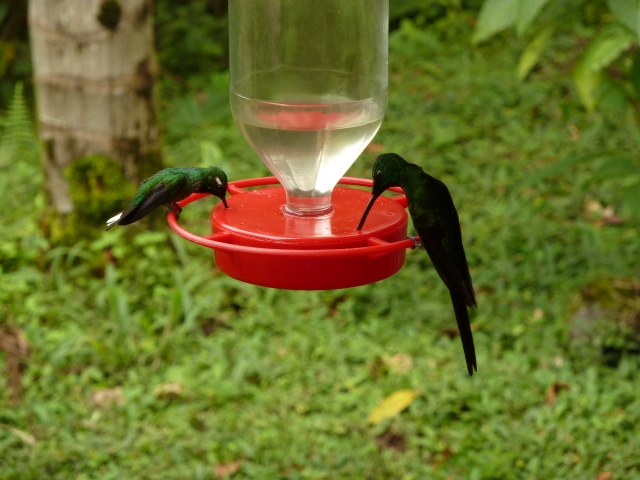
The little and the big: the purple-bibbed whitetip and the empress brilliant
Although they don’t always share it well:
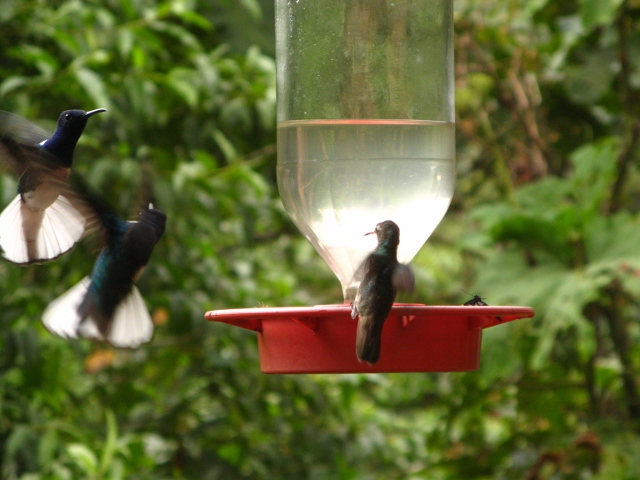
Two white-necked jacobins fight, and a purple-bibbed whitetip female is a bit alarmed.
But food always wins.
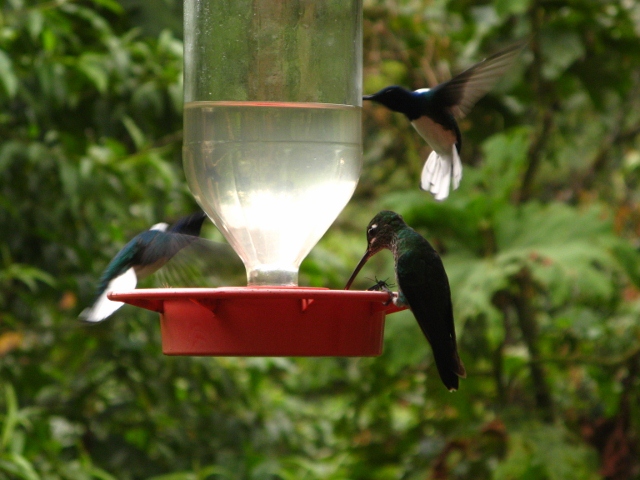
The purple-bibbed whitetip goes back to eating, and ignores those silly boys.
The fights can be quite spetacular, with a lot of aerial acrobatics and high speed chasing. Some species are real fighters, like the white-necked jacobin, the rufous-tailed hummingbird, and the violet-tailed sylph. Others just let the madness pass them by.
Sometimes, they do get along all right, and it’s party time at the feeders:
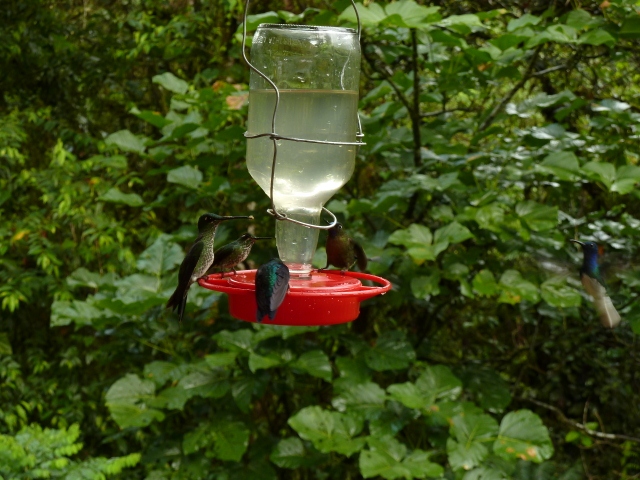
Dude – who brought the sugar water?
Jeff made a pretty awesome little video of some of the wild times, starring my favorite hummingbird, the purple-bibbed whitetip:
Unfortunately, because we have a house on the property and the house has windows, we sometimes get window hits. We haven’t had any fatalities in our month here yet, and usually it gives us the opportunity to get up close and personal with these guys. We offer them sugar water to revive them, which generally does the trick.

Jeff spoon feeds a rufous-tailed hummingbird.
They aren’t always completely appreciative of the gesture, though, and try to make themselves look tough by fluffing up.
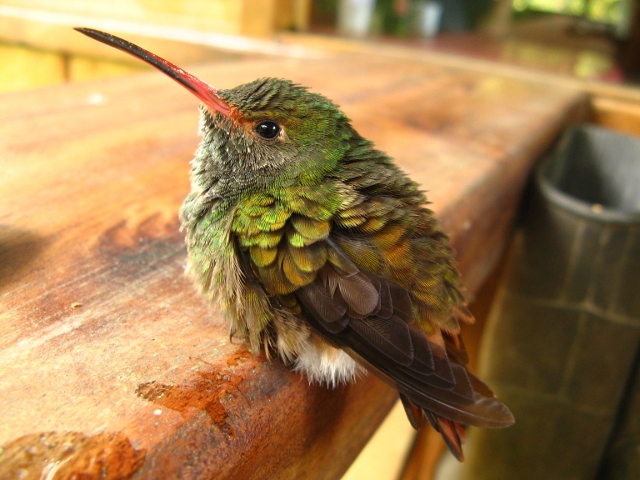
I don’t think he looks all that tough.
When Jaime and Micah were leaving, they told us we would quickly learn all of the hummingbirds we regularly see. We thought they were crazy – we’ve seen up to 15 species in a day, and they move fast. But these little guys stole our hearts and proved them right! A Las Tangaras morning wouldn’t be complete without them.
Bridging the gap
Here we are, finally, at Las Tangaras! We are Jeff and Kate, the new managers for the next three months. We’ve been working as National Park rangers during the summertime and doing international work during the off season. And now, we’ve been busy getting our feet wet in the all the workings of Las Tangaras, some routine, some extraordinary. Here’s a quick overview of our first three weeks here.
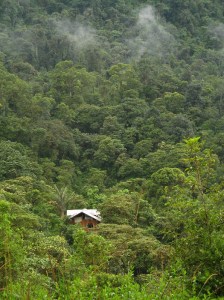
A little cabin in the big jungle
Previous managers Jaime, Micah, and Never helped us get acquainted with the reserve during our first two days. They’ve done a huge amount of work here and have left us with an overwhelming amount of information. The most exciting news perhaps is that Micah upgraded the water system with better connections, easier access, and an intake filter that should reduce clogs from sediment. Thanks! Dusti, our boss, was also here for a our first day and it was great to go with her to the cock of the rock lek and get a little birding lesson.
9:00am on our second day, Jaime, Micah, and Never left and it was just Kate and Jeff, brand new managers, and a couple campers in the reserve. We proudly finished our first hummingbird identification session on our own.
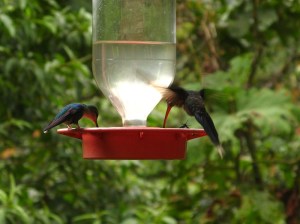
Our little friends enjoying their daily fix
11:00am, a couple hours into our managerdom, a camper runs up to us and says “the bridge just broke!” So much for our first peaceful morning. Did Jami and Micah’s protective spell break when they left? Whatever strange cosmic coincidence may have caused this mishap, we may never understand. But we went down to look, and yes, indeed, one of the cables of the cable suspension bridge had snapped and left the floor of the bridge hanging somewhat precariously.
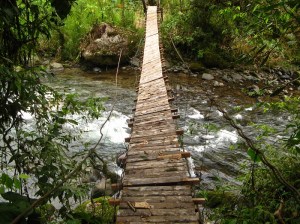
Oops! Glad nobody was hurt!
Good thing the water system and other things were in order, because it would take us the next three weeks to talk with locals, look for suppliers, investigate other hanging bridges and cable structures, meet with cable experts (zip line tours are big here), and ultimately make a trip to Quito to purchase 130 meters of new cable and connection hardware to replace all of the cable in the bridge. Jeff claims that he crossed from the southern hemisphere into the northern hemisphere and back again, 8 times in one day, just to get that new cable. Happily, with good planning, it only took 2 days of labor to get the cable replaced. We hired locals Artemio and his son to help make it happen.
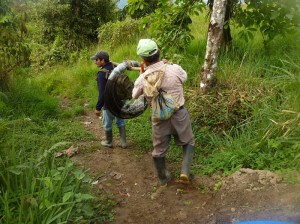
Carrying 150 pounds of cable
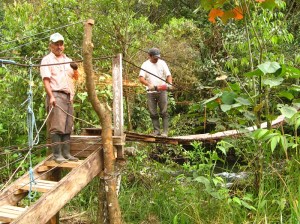
Cutting the old bridge cables from below the newly placed cables
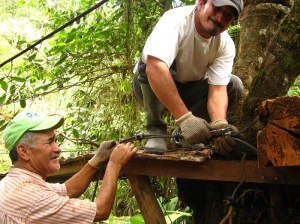
Securing the cable clamps around the trees
Oh, and maybe the magic spells didn’t all break after all, as we went an entire week without rain–the first drops fell the evening after we finished all the hard work on the bridge. Lots of work still remains to be done on the bridge, but at least it is standing and it feels a lot stronger than before.
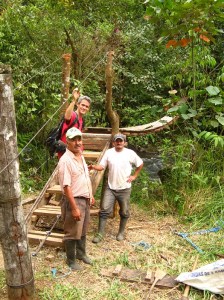
Construction workers at bridge with new cables
Otherwise, life is filled with the daily jobs of being here: long hikes into town for food and supplies, waiting many days for laundry to dry, and feeding lots of crazy hummingbirds that are addicted to their daily fix of sucrose. Kate has been working on harvesting and drying bamboo to make some furniture and shelving in the cabin.
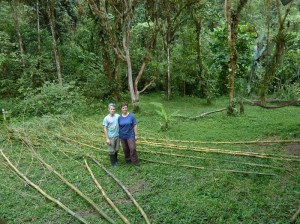
Tired after cutting and dragging lots of bamboo
We also took advantage of the transport for the cable delivery to buy a backup water storage tank. That way, if there are ever problems with the water system, we have water for a few days to hold us over. The hardest part was getting the tank the last two kilometers to the reserve.
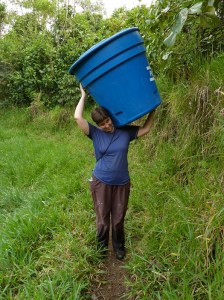
This is how everything gets to the reserve
We’ve been loving the amazing plants and wildlife here. Lots of cool bugs, of course.
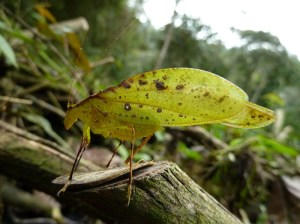
camouflaged leaf hopper/katydid
But the reserve is especially about the birds, and we hope to have more time to sit and identify some of them, now that things have settled down a little. We’re not hard-core birders, but the little bit of bird knowledge we have led to an interesting deja-vu experience. One of our first mornings we woke up to a very familiar sound. We had only been learning bird songs back at home for the past year or so, so it’s still a novelty to identify bird songs–we usually second-guess ourselves. But one of our first mornings we hear the unmistakable song of Swainson’s thrushes. We feel like we’re back in the North Cascades with pine trees towering overhead . Is that possible? We rush downstairs to check the bird list for Las Tangaras. Yes, Swainson’s thrush is on the list. A little more perseverance with the binoculars, and we get a clear visual ID of the guy. Did they migrate down here, too, just like us, to spend the winter at Las Tangaras? Thank you for sharing that familiar sound, welcoming us to our new home!
We’ll be back soon with more pictures and more stories. In the mean time, Merry Christmas, Happy New Years, and happy holidays to all from Las Tangaras–Adios for now!
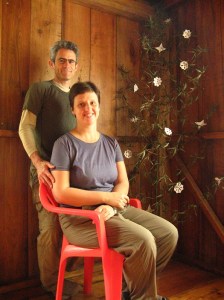
Our Christmas picture with a bamboo tree


