Gifts the rains bring
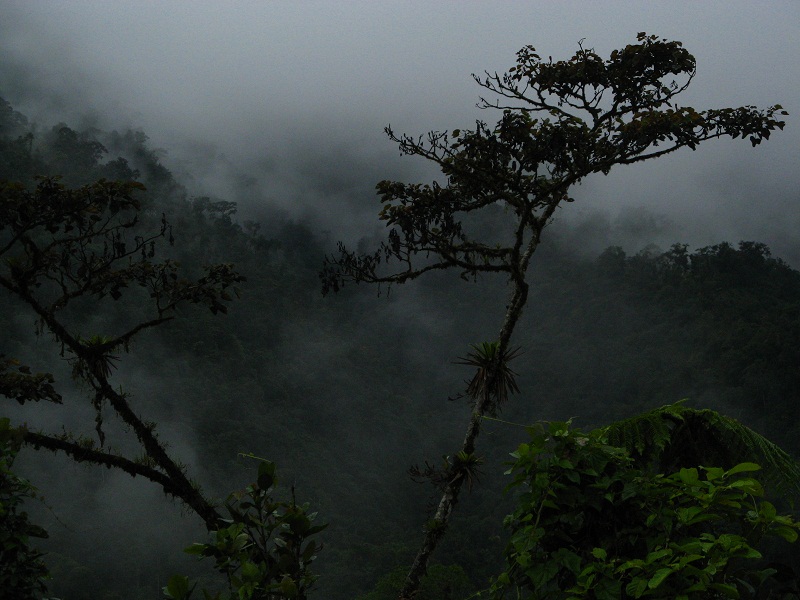
view of the reserve from the entry trail
Rain drips from leaves and hanging mosses, trickles off our metal roof, pours down the trails amd rumbles in the the stream valley below us. The rainy season is here in Las Tangaras, and everything is wet.
Twice a week, we hike the 2 kilometer trail in and out of the reserve to pick up groceries keep in touch with the outside world. We usually end up hiking back through rain
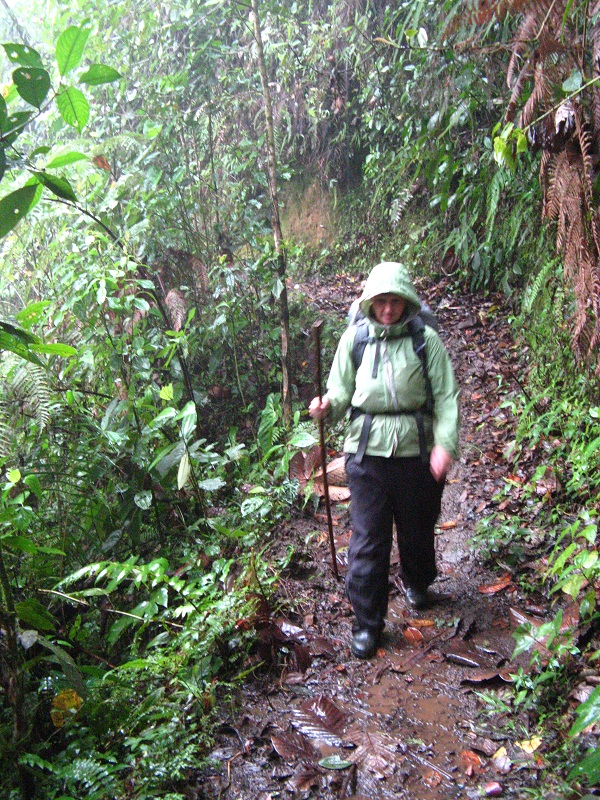
Kate with a backpack full of groceries
and lots of mud

Only the entry trail is this muddy due to horse and cattle traffic
Mudslides and fallen trees and branches are a daily occurance on our trails
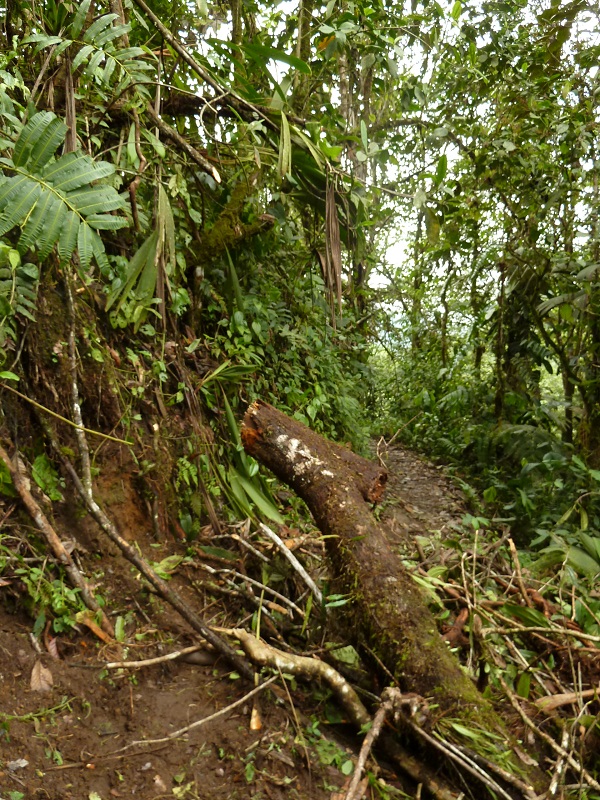
Tree fall and slide on the entry trail
Steady rain means steady employment in trail maintainance. Standard gear for the job is boots, a pair of rain pants, and a machete to clear the downfall.
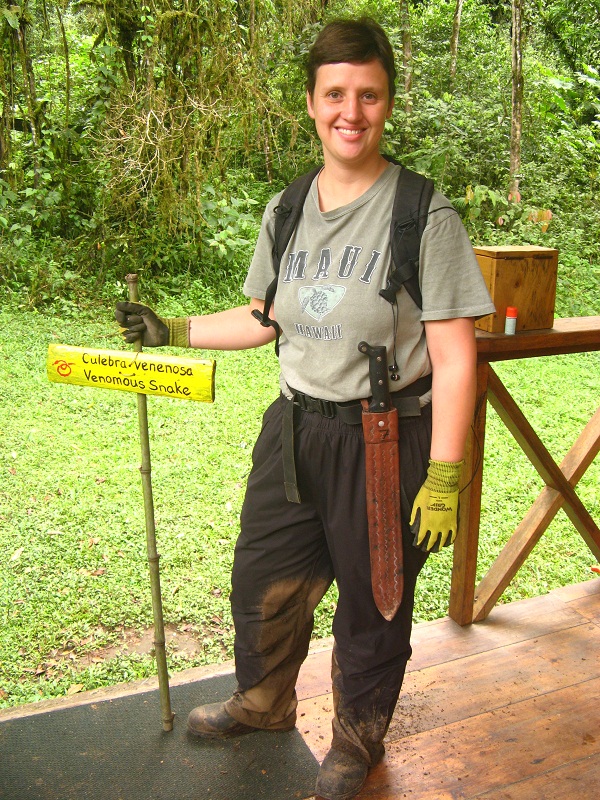
Kate goes out to update trail signs
Epiphytes thrive in the constant rain. Literally plants living on the surface of other plants, epiphytes hang from trees, passing brigades of raindrops from leaf to leaf in descending order to the ground.
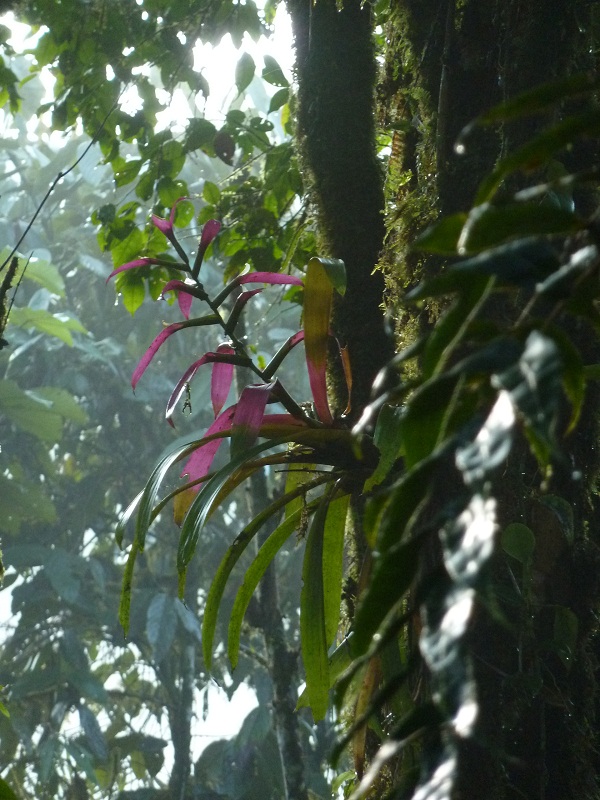
flowering bromeliad
There are hanging orchids

epiphytic orchid
clinging bromeliads
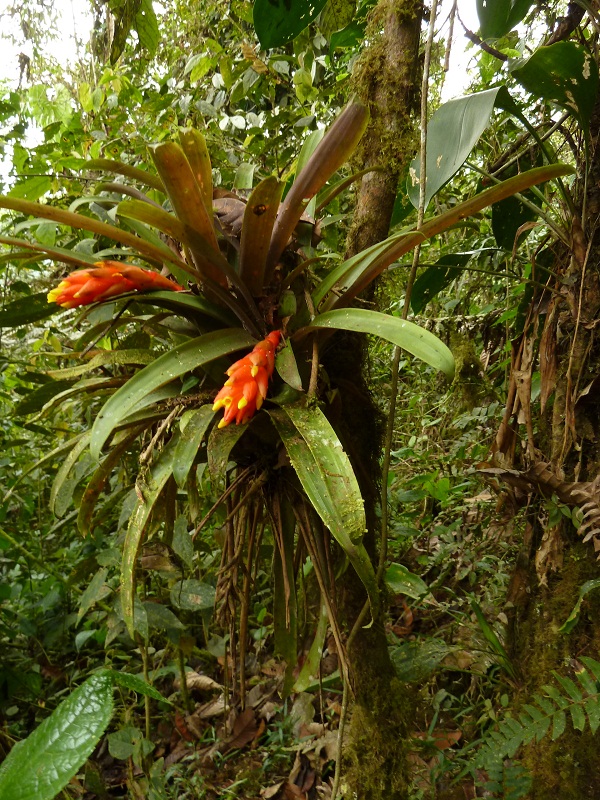
More bromeliads

And a number of plants that use red-tipped leaves to guide their hummingbird pollinators to small flowers hidden below.

Hummingbird-attracting plant
And then there are fungi. Of course, when it takes nearly a week for your hand-washed clothes to dry, fungi are pervasive in clothing, backpacks, beds, and everything in and out of the house. But they are also beautiful in their native habitat. Fungi pixie cups catch the rain.

fungi cups catching rain
brightly colored fungi brighten up the mossy slopes

sulfur-colored mushrooms
And then there is my favorite, glowing fungi. When we hike in the early morning to visit the cocks of the rock, the damp trail is lined with fireflies, glow worms, and glowing fungi. What looks just like a rotten stick or log by daylight is woven with luminescent threads in the pre-dawn darkness.

Glowing fungus on sticks at night, from a long exposure using only natural light
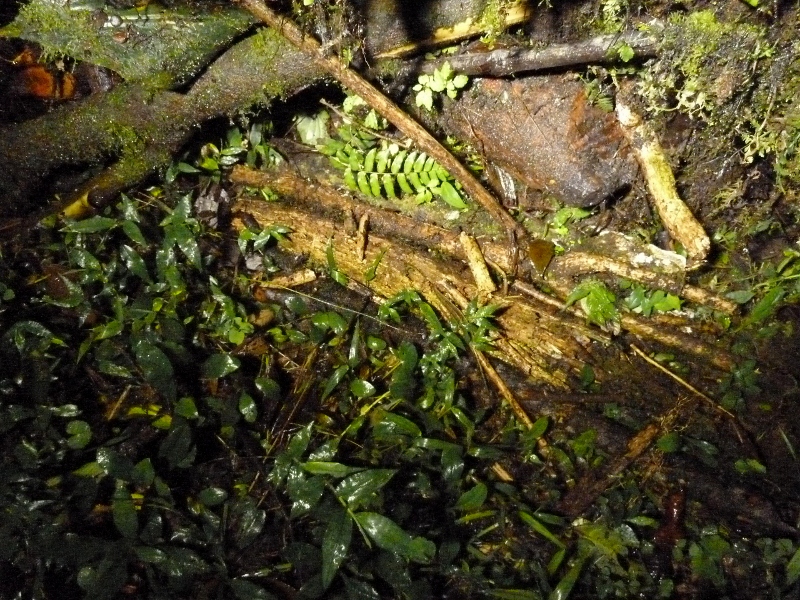
The same view of the same sticks using light from our flashlight
The rain and mud has not stopped visitors. We still have day trippers and overnighters visit us from countries around the world. We’ve had people from Colombia, Holland, France, Denmark, Switzerland, USA, Germany, and Canada. We also had one water-loving visitor seek shelter on our couch on an especially rainy night.

Until next time, we will be here at Reserva Las Tangaras, hosting visitors and enjoying the weather. Hasta Luego!
Things that make you go hummmmmmmmm
Hummingbirds are a huge part of daily life for us, and a huge part of a visitor’s experience when they come here to Las Tangaras. Since a blog post has not been dedicated to these crazy little beasts for over a year, here goes nothing!
Every morning, we feed the hummers, and they are always waiting for us in droves:
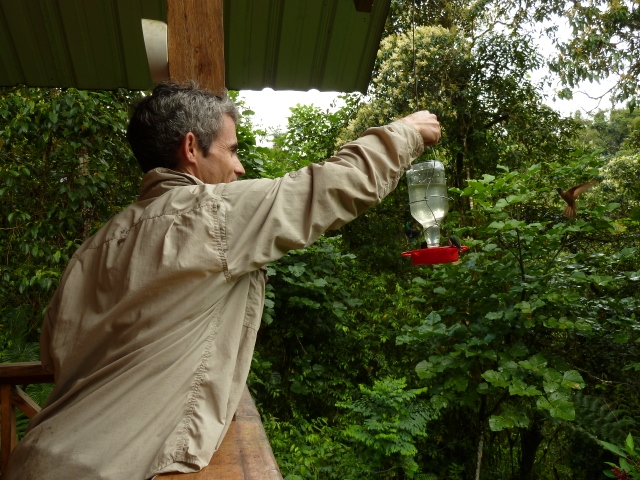
Note the birds already on the feeder before Jeff lets go.
This is so much fun for us, that we have to share the experience with our visitors:
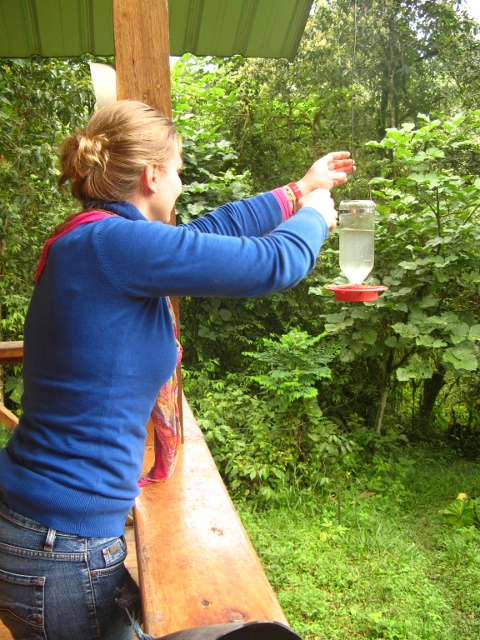
Nicolien puts out the feeders.
…and they do take advantage of it!
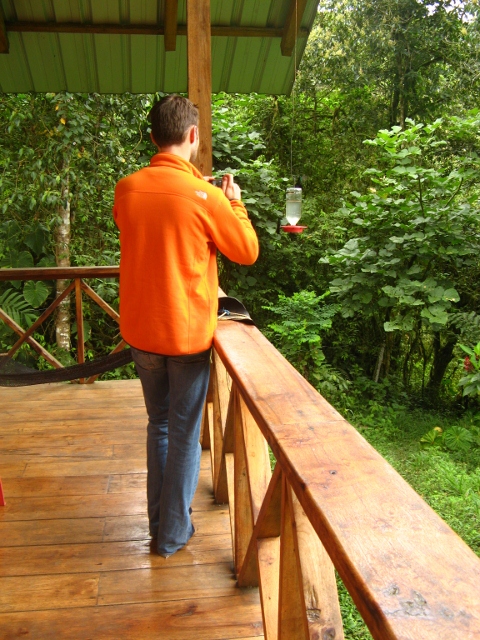
Mike takes pictures.
This time of year, our feeders attract a huge amount of birds, and they go through 2 cups of sugar easily in a day. They sit in all their colorful glory:
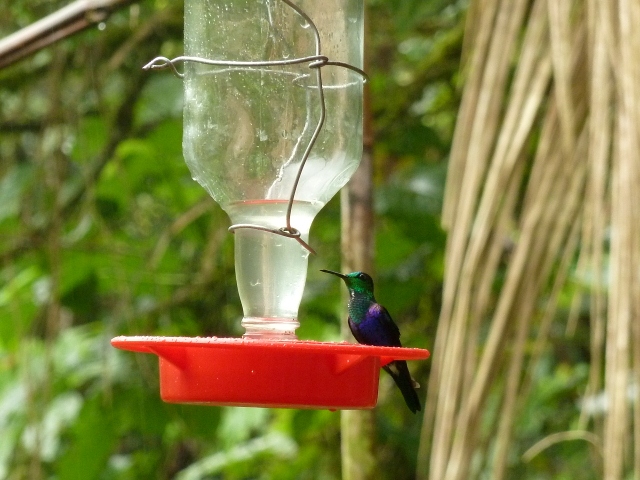
A green-crowned woodnymph.
They show off as best they can that which nature gave them:

A violet-tailed sylph.
…you’d think that tail would be an evolutionary disadvantage, but he seems to like it.
They’re not all flashy:

A fawn-breasted brilliant.
But, whatever does the job, right?
They do sometimes share the feeders:
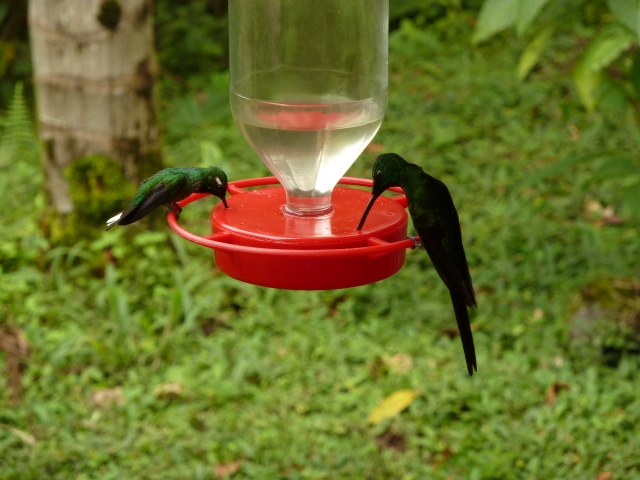
The little and the big: the purple-bibbed whitetip and the empress brilliant
Although they don’t always share it well:
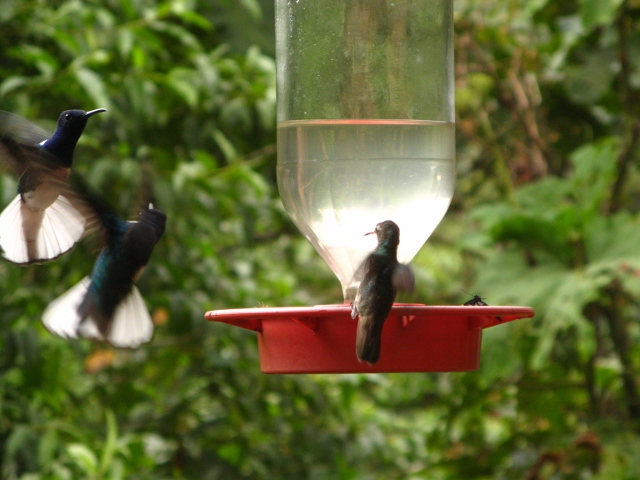
Two white-necked jacobins fight, and a purple-bibbed whitetip female is a bit alarmed.
But food always wins.
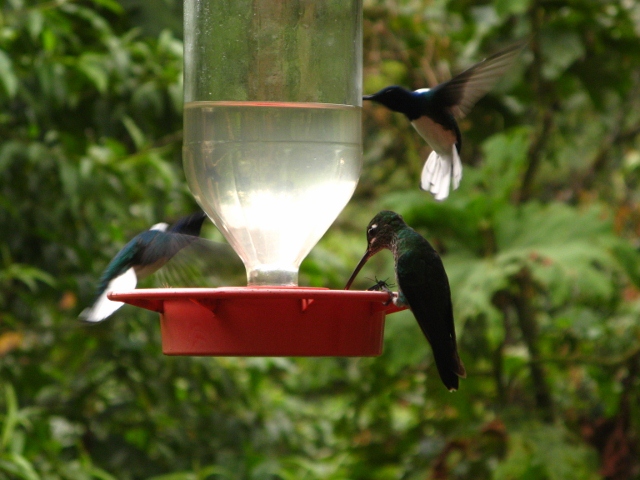
The purple-bibbed whitetip goes back to eating, and ignores those silly boys.
The fights can be quite spetacular, with a lot of aerial acrobatics and high speed chasing. Some species are real fighters, like the white-necked jacobin, the rufous-tailed hummingbird, and the violet-tailed sylph. Others just let the madness pass them by.
Sometimes, they do get along all right, and it’s party time at the feeders:
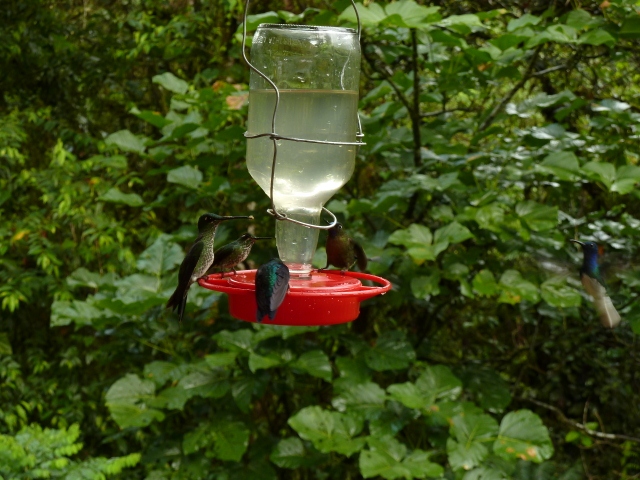
Dude – who brought the sugar water?
Jeff made a pretty awesome little video of some of the wild times, starring my favorite hummingbird, the purple-bibbed whitetip:
Unfortunately, because we have a house on the property and the house has windows, we sometimes get window hits. We haven’t had any fatalities in our month here yet, and usually it gives us the opportunity to get up close and personal with these guys. We offer them sugar water to revive them, which generally does the trick.

Jeff spoon feeds a rufous-tailed hummingbird.
They aren’t always completely appreciative of the gesture, though, and try to make themselves look tough by fluffing up.
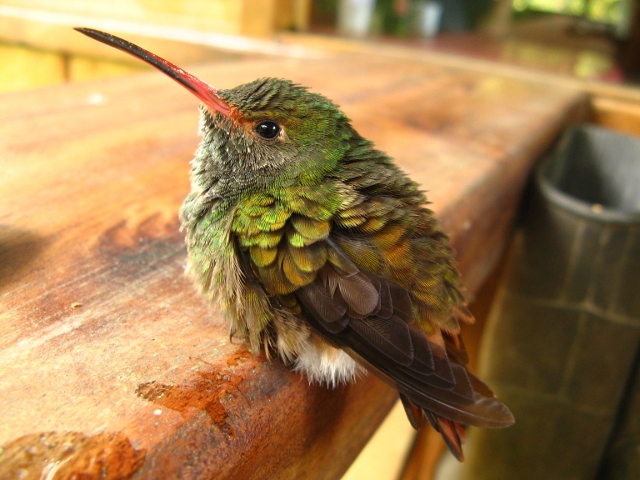
I don’t think he looks all that tough.
When Jaime and Micah were leaving, they told us we would quickly learn all of the hummingbirds we regularly see. We thought they were crazy – we’ve seen up to 15 species in a day, and they move fast. But these little guys stole our hearts and proved them right! A Las Tangaras morning wouldn’t be complete without them.
Bridging the gap
Here we are, finally, at Las Tangaras! We are Jeff and Kate, the new managers for the next three months. We’ve been working as National Park rangers during the summertime and doing international work during the off season. And now, we’ve been busy getting our feet wet in the all the workings of Las Tangaras, some routine, some extraordinary. Here’s a quick overview of our first three weeks here.
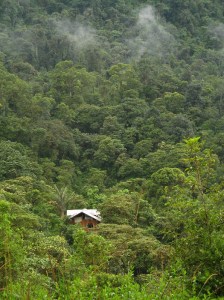
A little cabin in the big jungle
Previous managers Jaime, Micah, and Never helped us get acquainted with the reserve during our first two days. They’ve done a huge amount of work here and have left us with an overwhelming amount of information. The most exciting news perhaps is that Micah upgraded the water system with better connections, easier access, and an intake filter that should reduce clogs from sediment. Thanks! Dusti, our boss, was also here for a our first day and it was great to go with her to the cock of the rock lek and get a little birding lesson.
9:00am on our second day, Jaime, Micah, and Never left and it was just Kate and Jeff, brand new managers, and a couple campers in the reserve. We proudly finished our first hummingbird identification session on our own.
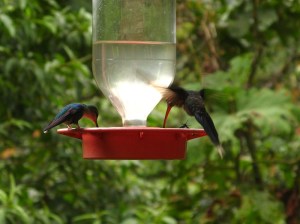
Our little friends enjoying their daily fix
11:00am, a couple hours into our managerdom, a camper runs up to us and says “the bridge just broke!” So much for our first peaceful morning. Did Jami and Micah’s protective spell break when they left? Whatever strange cosmic coincidence may have caused this mishap, we may never understand. But we went down to look, and yes, indeed, one of the cables of the cable suspension bridge had snapped and left the floor of the bridge hanging somewhat precariously.
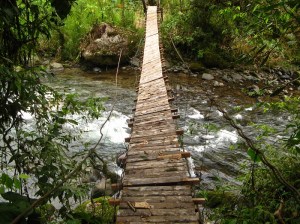
Oops! Glad nobody was hurt!
Good thing the water system and other things were in order, because it would take us the next three weeks to talk with locals, look for suppliers, investigate other hanging bridges and cable structures, meet with cable experts (zip line tours are big here), and ultimately make a trip to Quito to purchase 130 meters of new cable and connection hardware to replace all of the cable in the bridge. Jeff claims that he crossed from the southern hemisphere into the northern hemisphere and back again, 8 times in one day, just to get that new cable. Happily, with good planning, it only took 2 days of labor to get the cable replaced. We hired locals Artemio and his son to help make it happen.
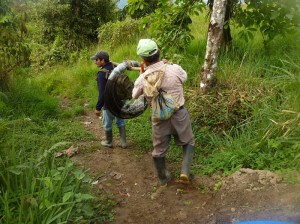
Carrying 150 pounds of cable
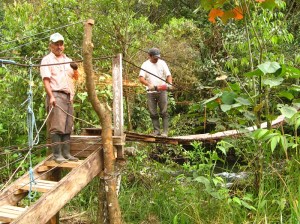
Cutting the old bridge cables from below the newly placed cables
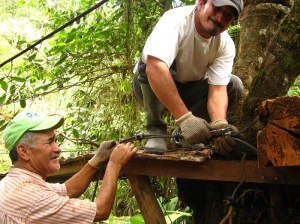
Securing the cable clamps around the trees
Oh, and maybe the magic spells didn’t all break after all, as we went an entire week without rain–the first drops fell the evening after we finished all the hard work on the bridge. Lots of work still remains to be done on the bridge, but at least it is standing and it feels a lot stronger than before.
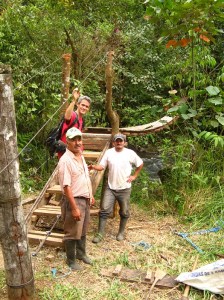
Construction workers at bridge with new cables
Otherwise, life is filled with the daily jobs of being here: long hikes into town for food and supplies, waiting many days for laundry to dry, and feeding lots of crazy hummingbirds that are addicted to their daily fix of sucrose. Kate has been working on harvesting and drying bamboo to make some furniture and shelving in the cabin.
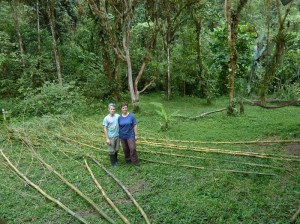
Tired after cutting and dragging lots of bamboo
We also took advantage of the transport for the cable delivery to buy a backup water storage tank. That way, if there are ever problems with the water system, we have water for a few days to hold us over. The hardest part was getting the tank the last two kilometers to the reserve.
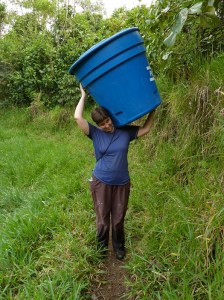
This is how everything gets to the reserve
We’ve been loving the amazing plants and wildlife here. Lots of cool bugs, of course.
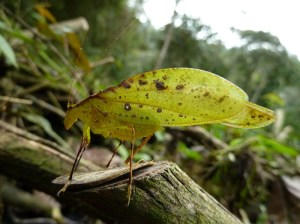
camouflaged leaf hopper/katydid
But the reserve is especially about the birds, and we hope to have more time to sit and identify some of them, now that things have settled down a little. We’re not hard-core birders, but the little bit of bird knowledge we have led to an interesting deja-vu experience. One of our first mornings we woke up to a very familiar sound. We had only been learning bird songs back at home for the past year or so, so it’s still a novelty to identify bird songs–we usually second-guess ourselves. But one of our first mornings we hear the unmistakable song of Swainson’s thrushes. We feel like we’re back in the North Cascades with pine trees towering overhead . Is that possible? We rush downstairs to check the bird list for Las Tangaras. Yes, Swainson’s thrush is on the list. A little more perseverance with the binoculars, and we get a clear visual ID of the guy. Did they migrate down here, too, just like us, to spend the winter at Las Tangaras? Thank you for sharing that familiar sound, welcoming us to our new home!
We’ll be back soon with more pictures and more stories. In the mean time, Merry Christmas, Happy New Years, and happy holidays to all from Las Tangaras–Adios for now!
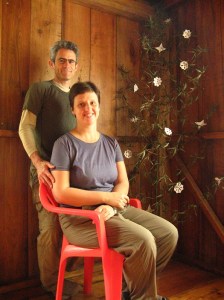
Our Christmas picture with a bamboo tree
Improvements at the Reserve
November has been a busy month at the reserve and many improvements have been made. Here are some of the new things here at the reserve.
The first improvement you will see will be right as you enter the reserve. Micah has replaced all of the wood on the suspension bridge and built new stairs and platforms for getting on and off the bridge. The old bridge was really cool looking with all the moss and epiphytes growing on it but it was a little rickety, slippery and somewhat scary. When Micah removed the old boards he found many that were rotten through. It was definitely time to give it a face lift. The new bridge is a little sturdier although still a little bouncy. It is a suspension bridge after all.
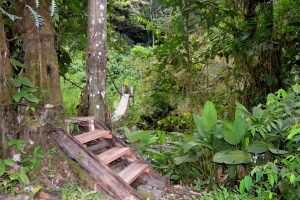
New Stairs
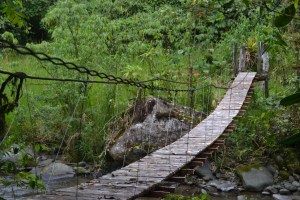
New Bridge

Old Bridge
Micah also replaced the table at the campsite. The old one was made out of a recycled aluminum sign. The new one matches the bench which is made from Chonta, a type of palm.

New table at the campsite made with chonta
Micah also finished the bookshelf inside the cabin so that the shelving goes all the way to the floor. He also included some doors to create cabinets that can be closed and locked.
 There was some wood leftover from the shelves so we used that to create a new sign at the trailhead on the road. The old sign was painted on an aluminum sheet and was starting to fade a peel a bit. We thought a wood sign wood reflect the lodge a little better. Unfortunately neither of us are artists so we could not include any pretty birds. It was a lot just for Jaime to paint the letters freehand and not look like a child painted it. Well maybe one of the future managers will be more artistic and can add some artwork to the sign. But for now we think the sign looks a little better than the old one and definitely fresher.
![IMG_1138[1]](https://reservalastangaras.com/wp-content/uploads/2012/12/img_11381.jpg?w=300&h=225)
New Sign
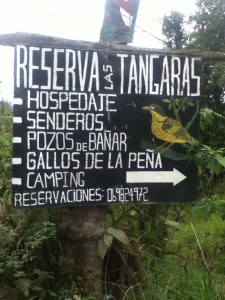
Old aluminum sign
It has been fun giving the reserve a facelift. Now we are focusing on getting it ready to hand over to the new managers. We look forward to meeting Kate and Jeff this week. Adios for now!
A Boy in the Jungle
 This week we celebrated Never’s birthday. He turned 3 years old!A friend of Nev’s, Negue, lives in town and his birthday is the day before Nev’s. So we joined celebrations and had a double birthday party. There were several kids there and they all had a good time with face painting, piñata, food and cake.

In honor of Nev we thought we would post a blog about Nev’s experience living at the reserve. It has been a really awesome experience for us to be here at the reserve with Nev. He really enjoys this place too. He has grown so much and learned a lot during our time here.
Here are some of his favorite things about the reserve:
playing at the river and throwing rocks into the water

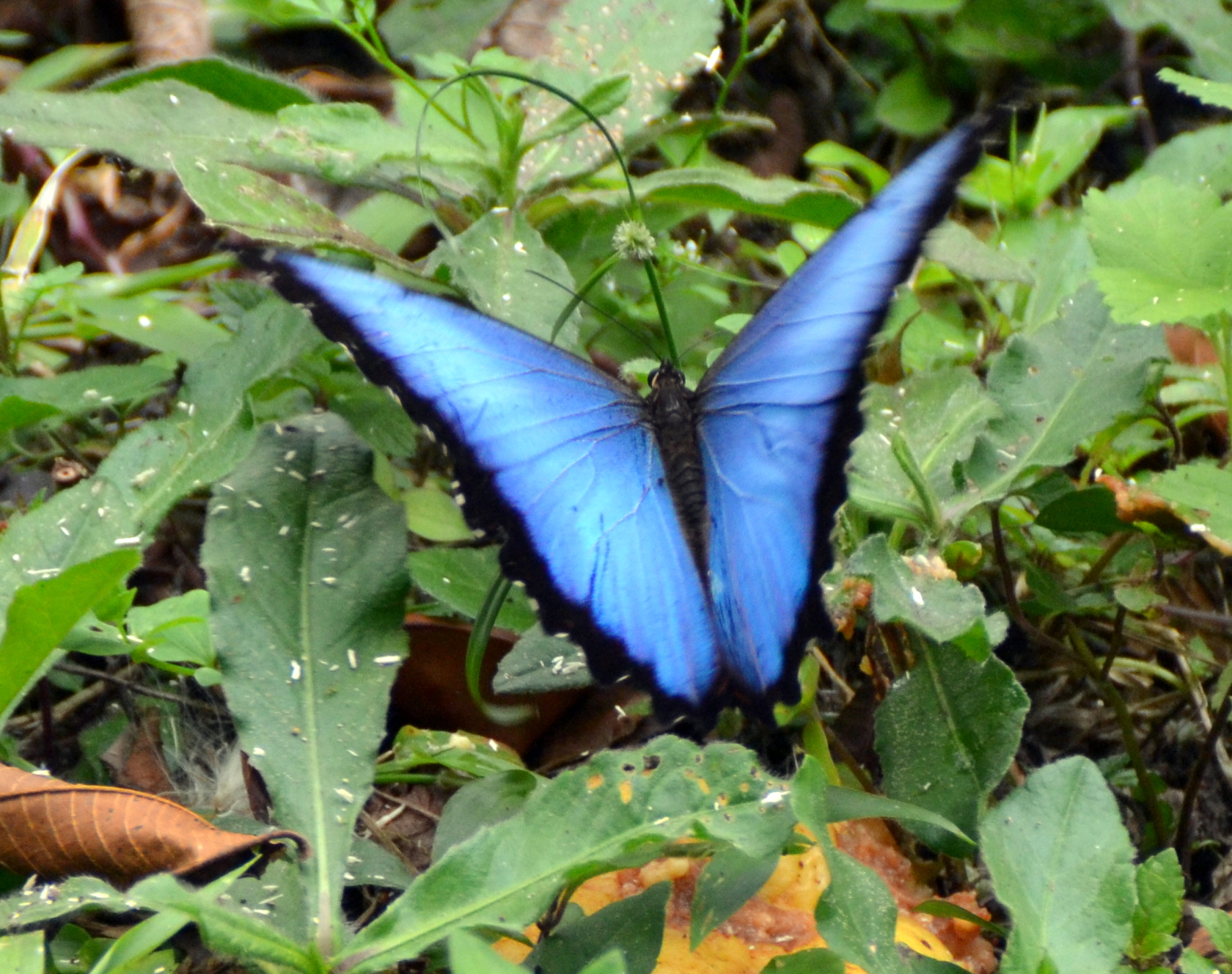
chasing butterflies and finding cool new “buggies”
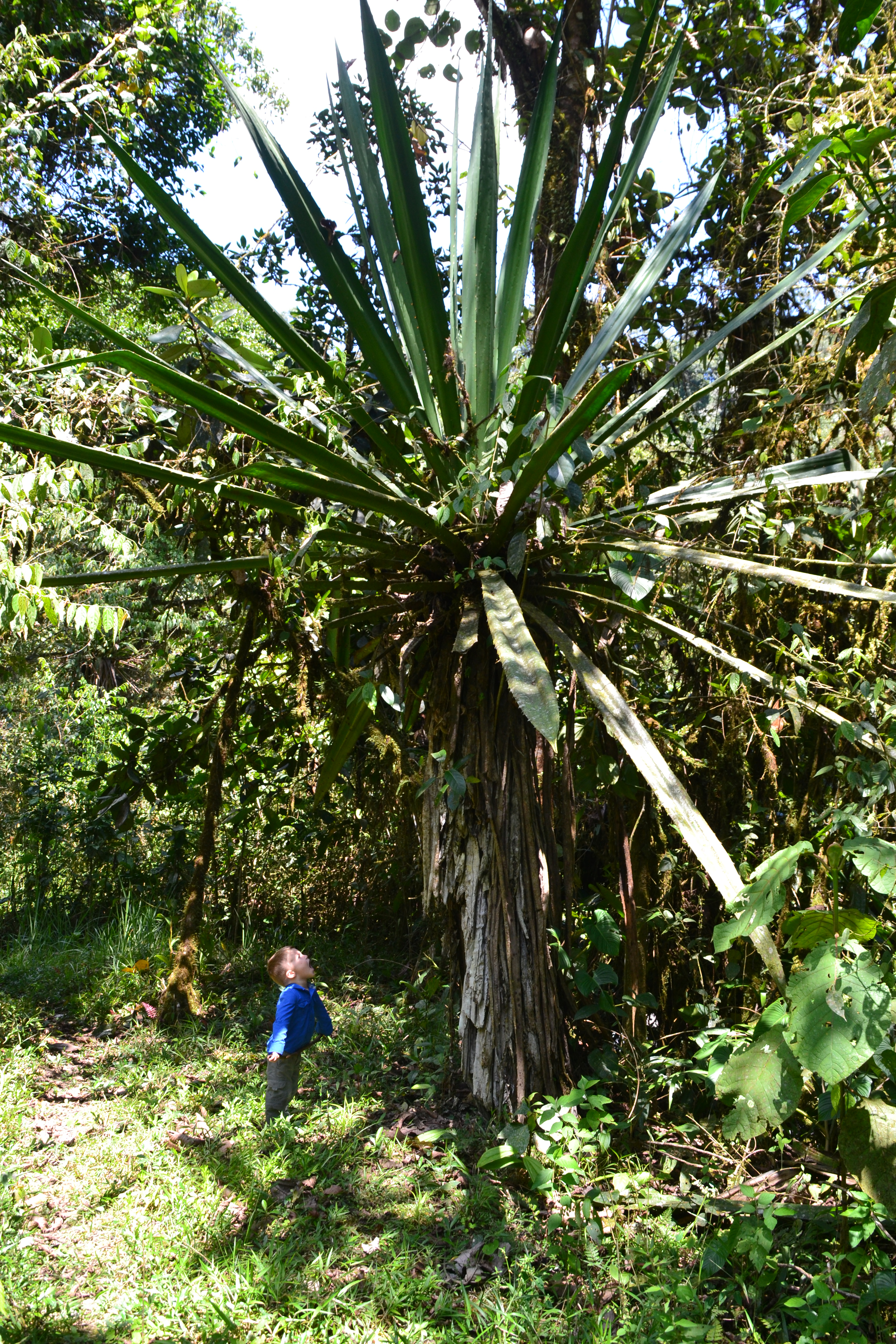
looking at all the beautiful flowers and crazy plants
working in the garden
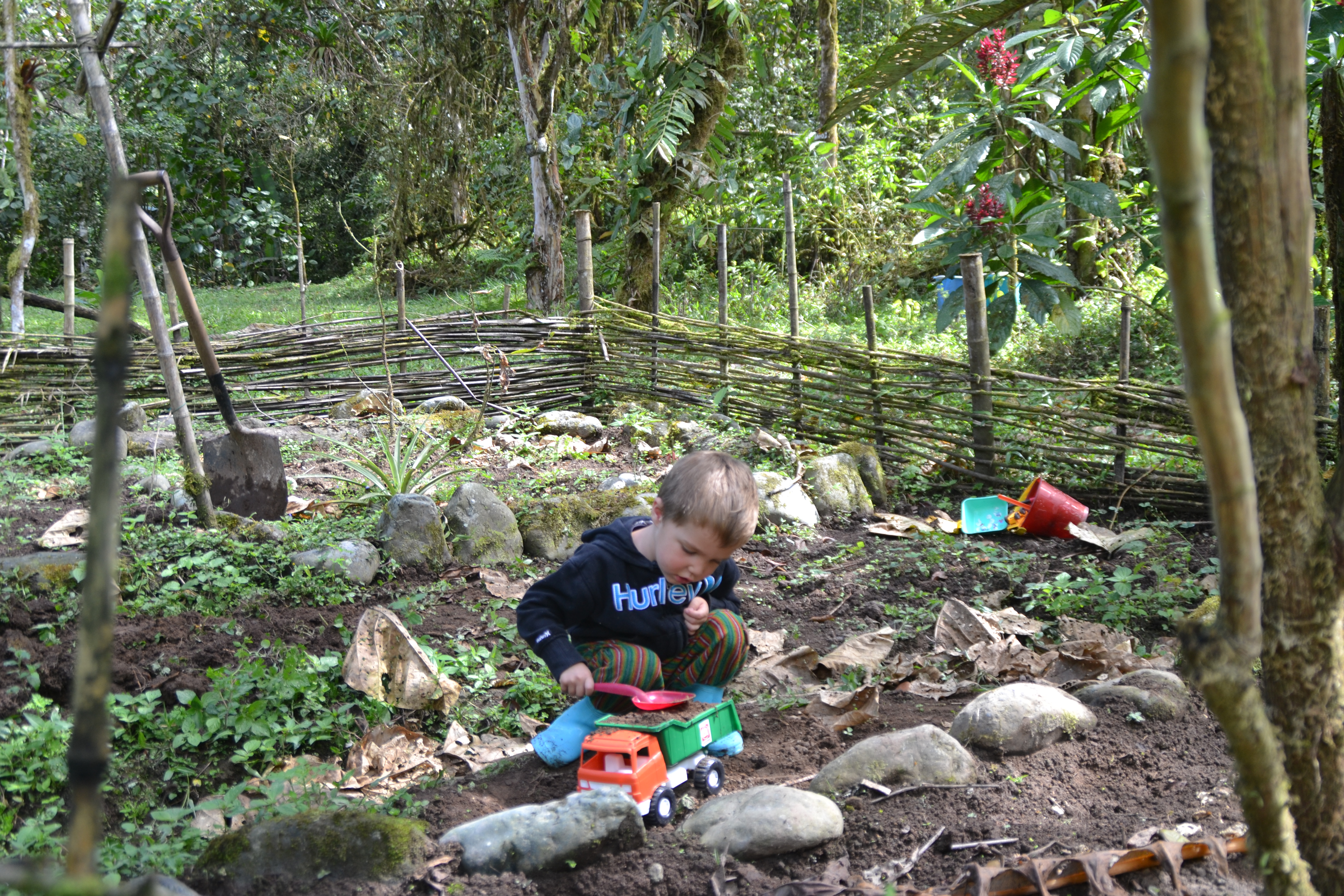
helping with chores around the reserve like sweeping and laundry (i.e. water play time).
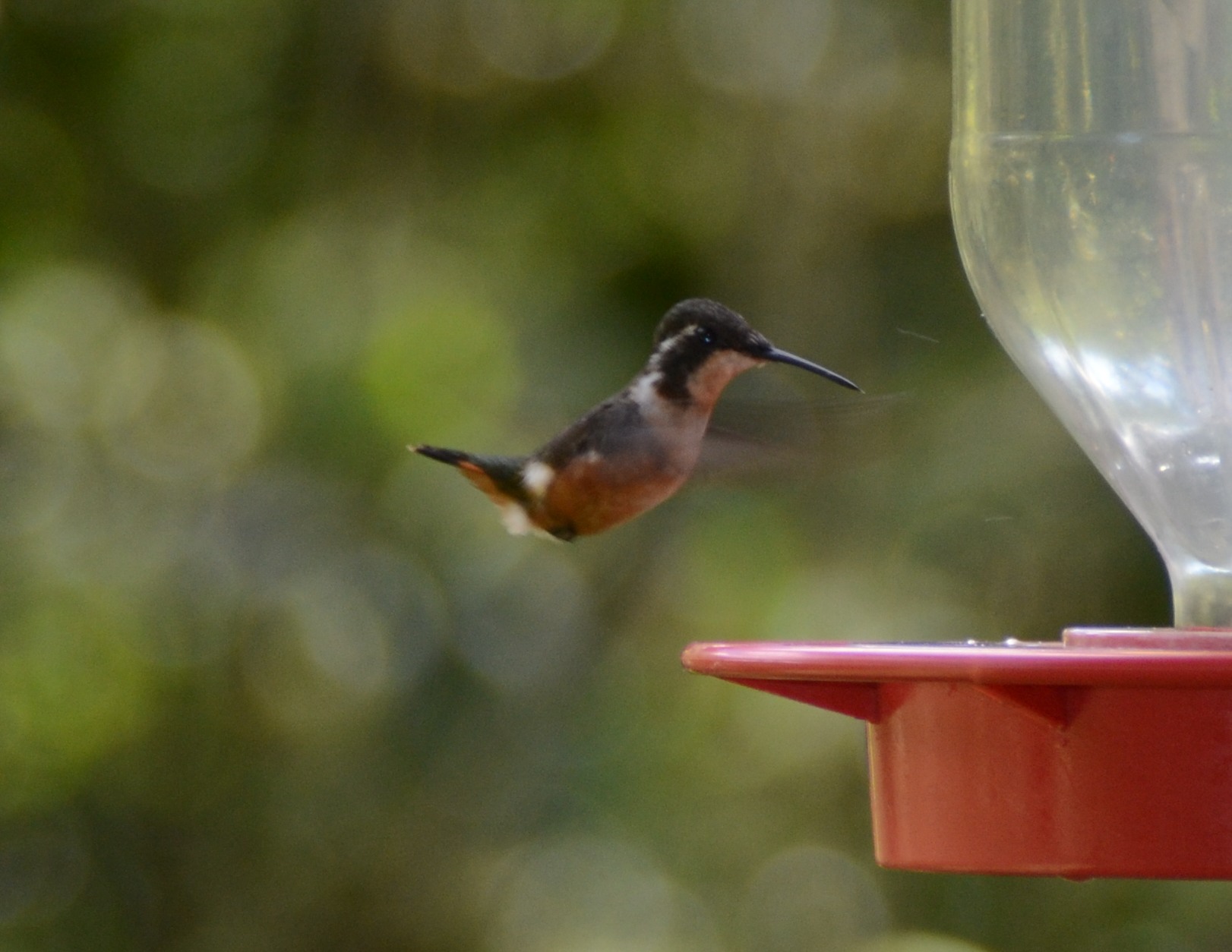
He is learning about the birds just as we are. He always asks the names of the hummers that come to the feeders. Although his favorite we just call the “bumblebee” because it sounds like a bumblebee (Purple-throated woodstar).
Nev also really loves when we have visitors at the reserve. He has wrangled pretty much everyone who has come here into playing cars and trains with him or watching a movie. His favorite movie right now is The Lorax. All of the visitors have been great with him and he is always sad to see our “friends” leave.
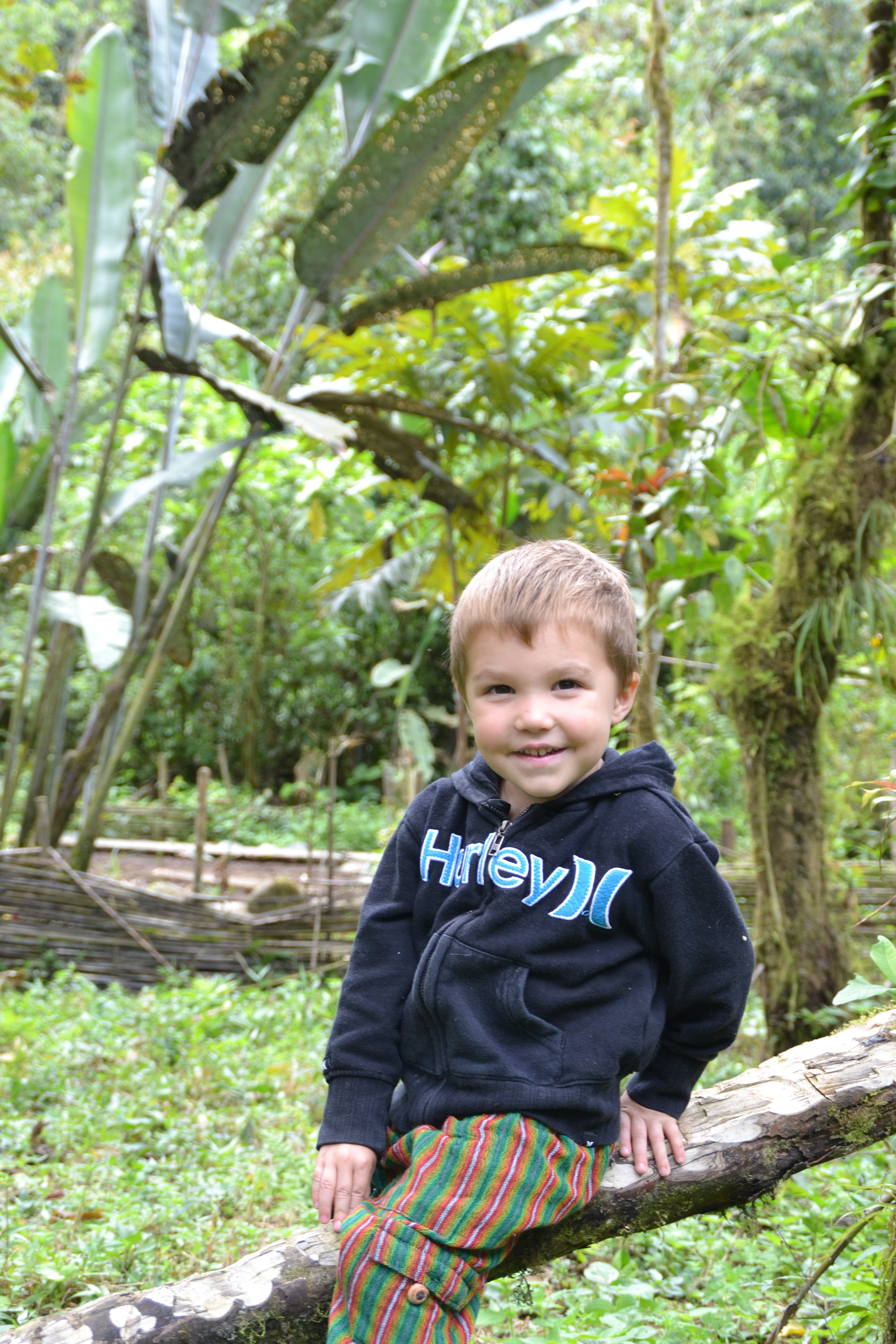
He definitely really enjoys this place and what a cool place it is for a 3 year old to spend time exploring. We think he will be just a sad as us when our time here is over and we have to leave this beautiful sanctuary. But hopefully we can return here with him when he is older or when he is an adult and off on his own adventures.

Rivers and Creeks

Nambillo River
When you first get to Reserva Las Tangaras the first thing you see is the Nambillo River. It is the sound that dominates the cabaña. When it enters the property it is in a narrow gorge and meets a little creek where the Bonito pool can be found before it drops 25 meters into the abyss above the gorge. As the river flows along the property there are two swimming holes before it meets the confluence of the Fuente Creek at the west end of the reserve. The creek winds its way down from a 10m waterfall and a sheer cliff.
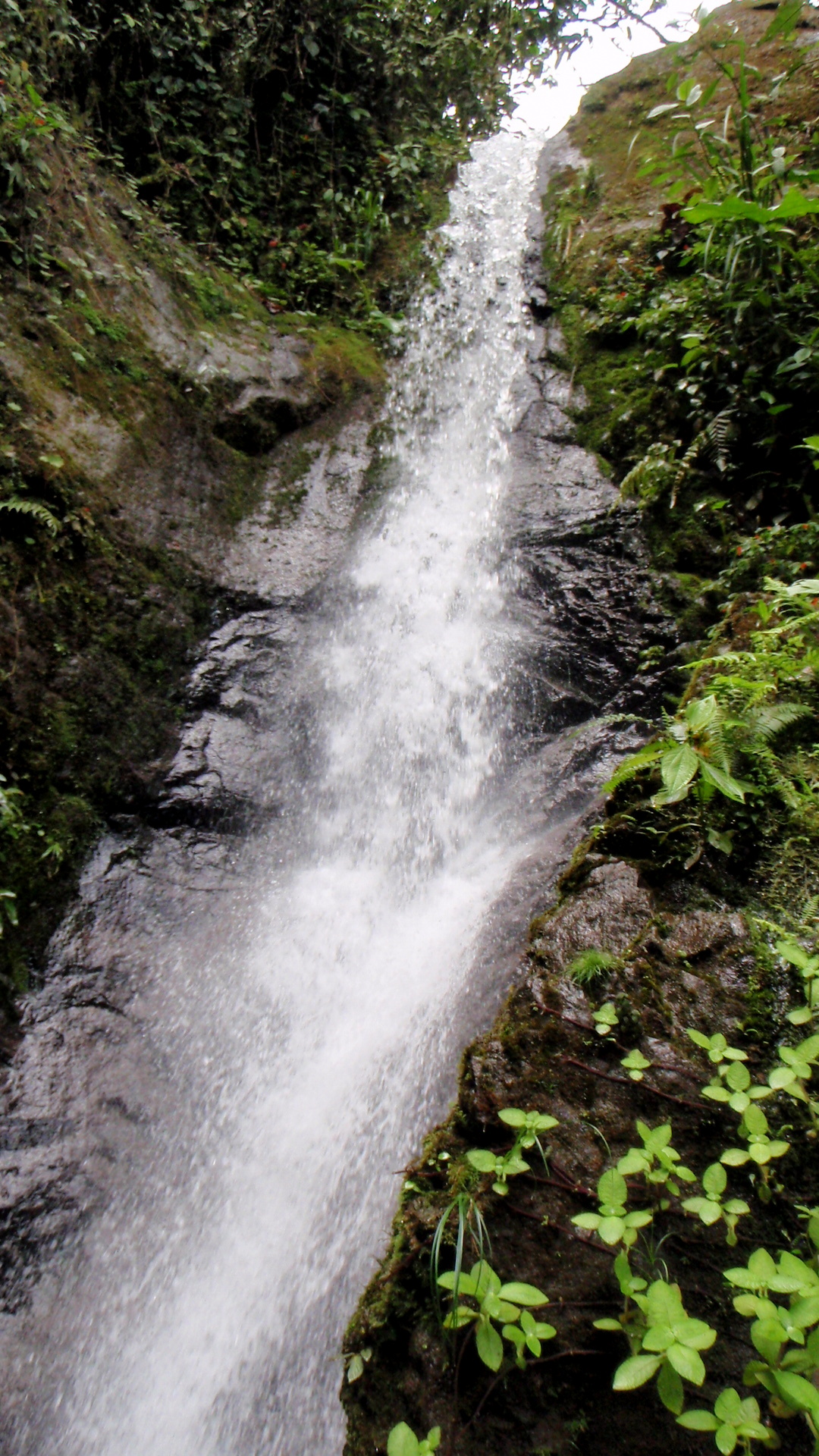
Fuente Creek Falls
The newest trail at the reserve follows the Nambillo river down from the campground to just above the confluence with the Fuente Creek. At lower water levels it is possible, with some bouldering, to walk up the creek to the waterfalls. Along the way the creek bed is in constant change and has a dozen beautiful pools.
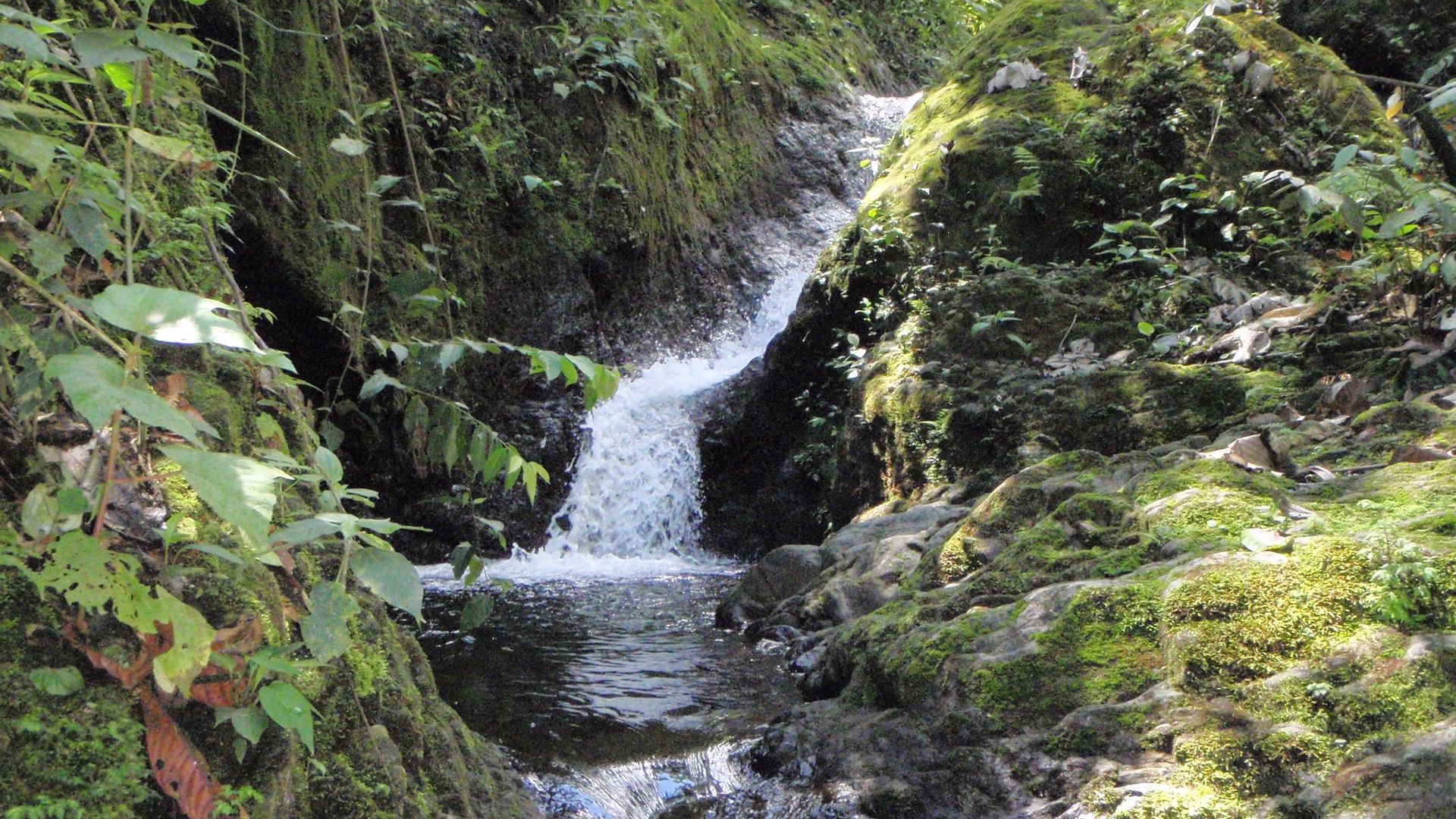
Lower Fuente Creek
If you bring a mask or goggles you can see the catfish that live in the deeper pools. If you are quiet you might see the basilisk, the Torrent Duck family or the fasciated tiger-heron. Water dominates all here at the reserve. Though we have had the most beautiful weather this last week, we know the next rain is always near.
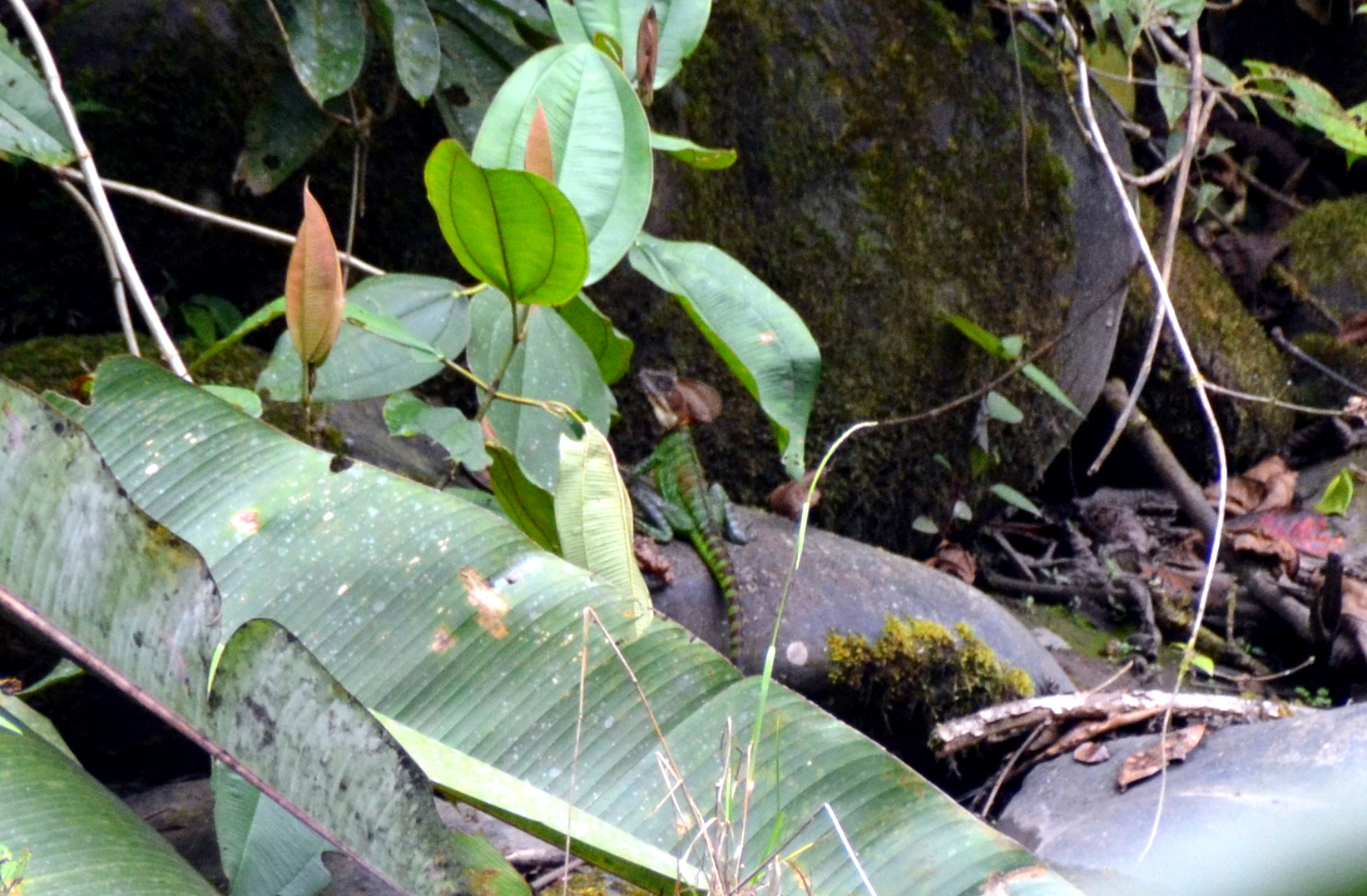
Basilisk
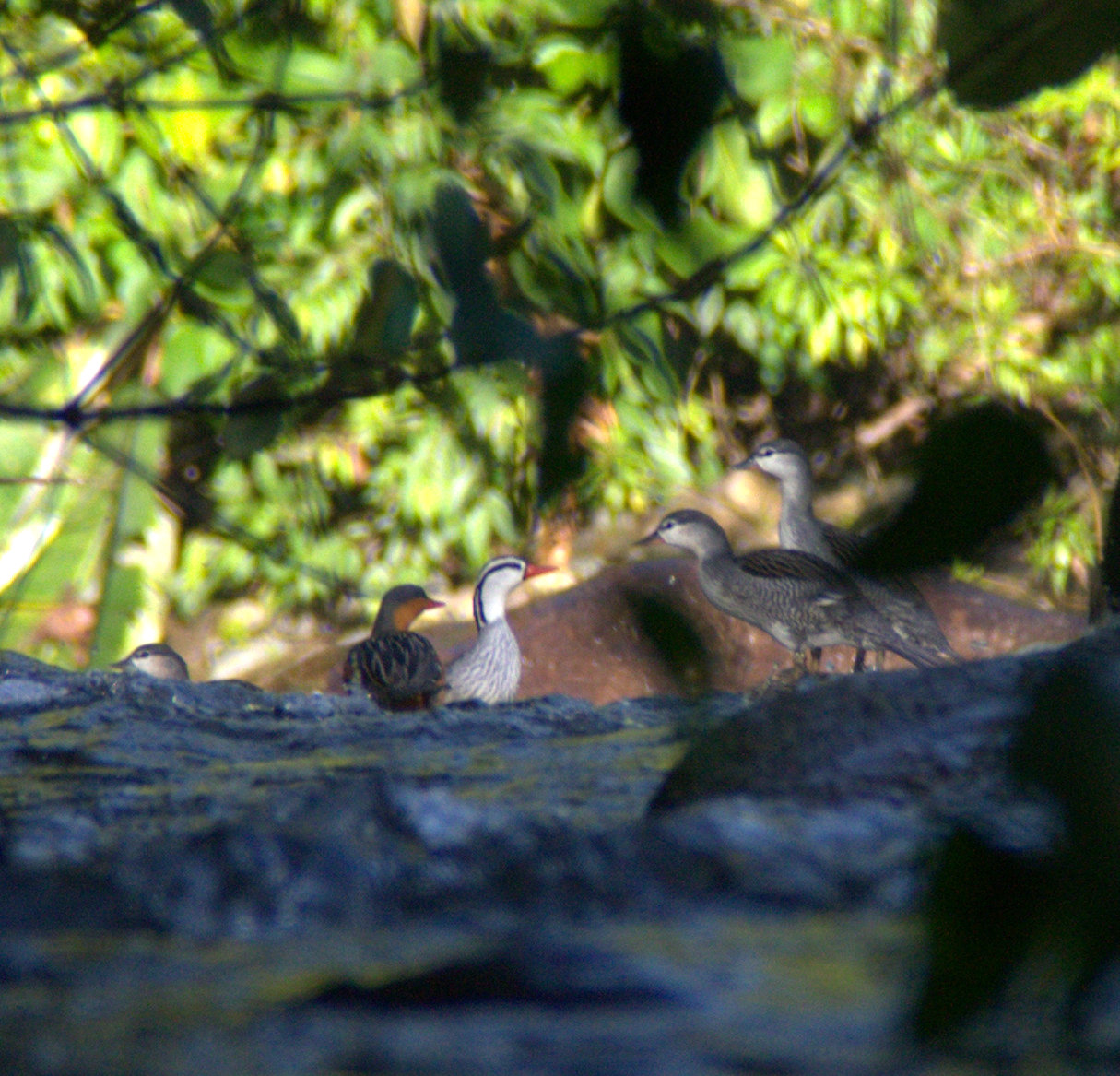
Torrent Duck Family
Work on the Agua de Fuente trail continues. With all the time spent on it we have seen Andean cock of the rock, a family of guans, Basilisks, a red Brockett deer, a heron, toucans and more. We hope to get it open for visitors in the dry season to complete the Fuente loop through some of the more Rugged parts of the reserve.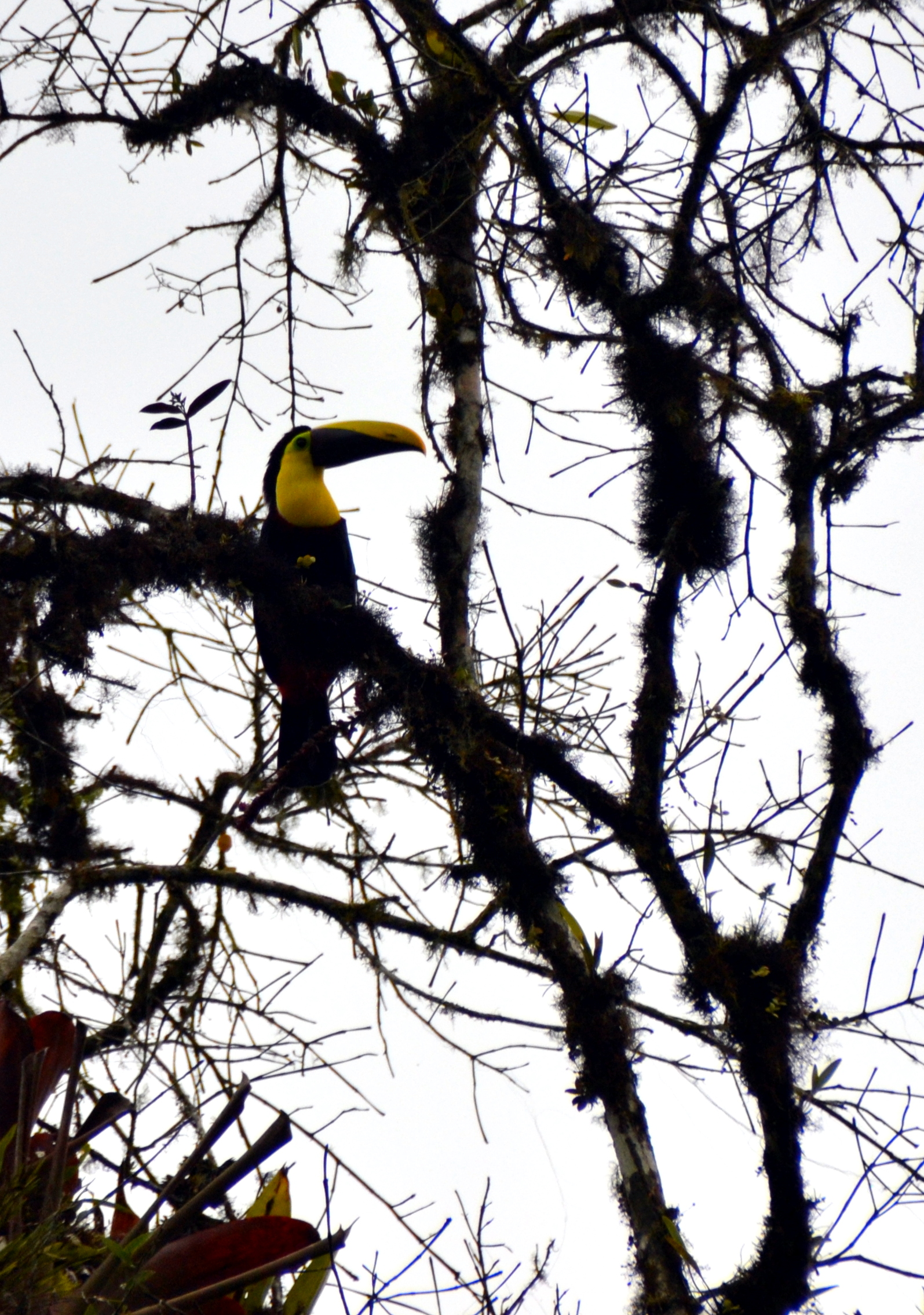
And to other news on the reserve, the orchard is doing great with the perfect mix of rain and sun. And with a steady diet of compost the garden is coming around. We’ve managed to get some onions and potatoes beyond sprouts.
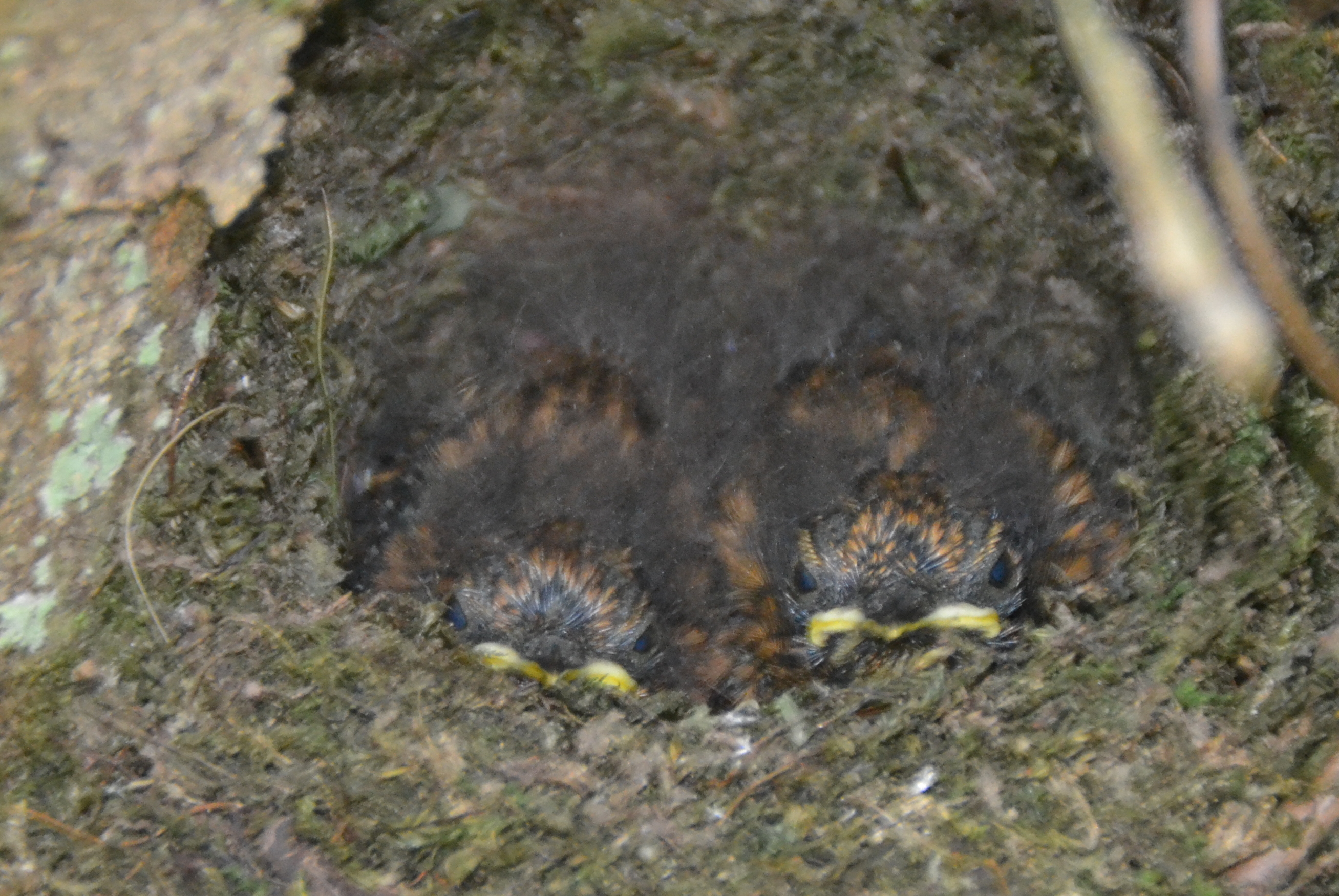
 There are two nests on the entry trail that we have been watching for a few weeks. The moms fly off so quickly we can’t get good looks at them. However, both have had two eggs in them and one now has hatchlings that are growing extremely fast! It has been such a joy to watch them every time we hike out. The fer-de-lance is still around. We have posted warning signs on the trail where we see it every day. It has recently shed its skin and looks very beautiful right now.

Since our last post we have had about 20 visitors from several countries including, USA, Germany, Netherlands, Australia, and Ecuador. We have enjoyed meeting all the visitors and thank them for their support for the reserve.
A Family in the Cloud Forest
Hola! After a smooth transition, Amanda and Shyama left for their travels. They were super helpful getting us up to speed with what is happening at the reserve. We are Micah, Jaime and Never. Jaime is an ecologist, Micah is a carpenter and an all-around handy kind of guy and Never is our 2, almost 3, year old son. Before the reserve we lived in Oregon and this last year in Hawaii. We left Hawaii in July to do our own travelling. We started in Puerto Vallarta, Mexico and travelled southward to Nicaragua. From there we flew to Quito for our first taste of South America. We are so happy to be here and looking forward to settling in for a few months after being on the road for two.

Micah, Jaime and Never
The reserve is everything we imagined and more! The weather has been perfect! Cool nights and perfect during the day. It is much like the spring time in the Pacific Northwest but we know that we will be heading into a lot more rain in the time to come. But for now the weather is pleasant and dry giving us great access to the reserve trails.
Around the reserve it has been wild watching and getting to know the 16 hummingbird species that have been visiting the feeders at the lodge, experiencing the chaos that occurs in the early mornings at the Andean Cock of the Rock lek and becoming familiar with the resident Fer-de-lance the area on the Amor trail it seems to inhabit.
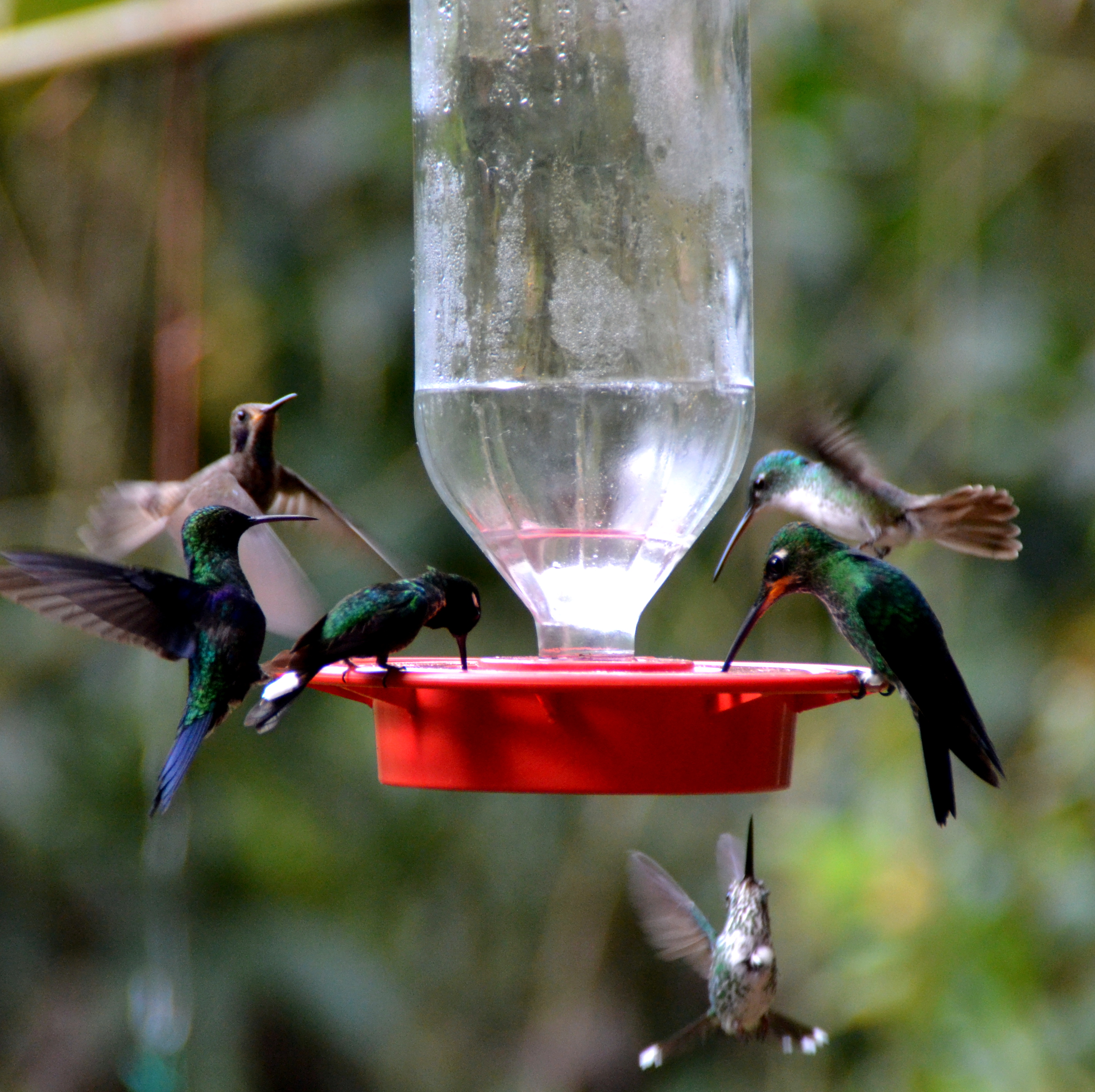
Some of the many hummingbirds we see every day

A banded Andean Cock of the Rock seen at the lek
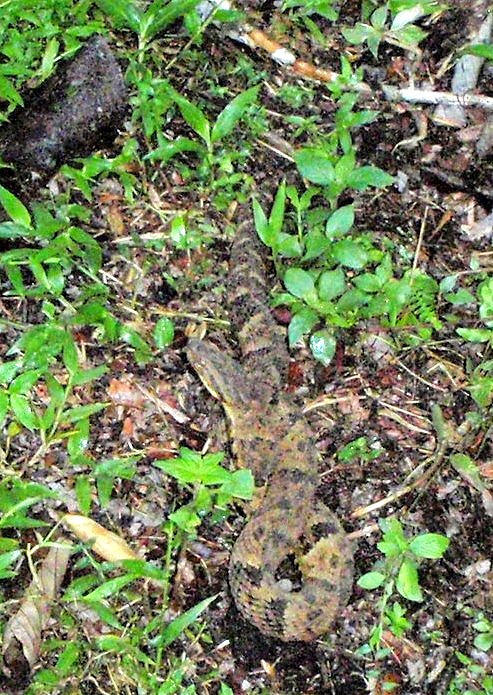
Our resident Fer-de-lance
We are attempting a small crop in the garden. It seems the success in the garden has been limited so we are starting out small. However, the young orchard planted this summer is coming along great.
While we are getting to know the reserve, its trail and the wildlife surrounding us we are also enjoying the records from previous managers that are now into their second year. It is interesting to see what has been going on, who has been visiting and what people were up to for the last few years. So many people have contributed to this place and their hard work shows. We are honored to be able to contribute to this special place together as a family .
We would also like to thank our first (and so far only) guests to the reserve, Nicole and Ryan. They camped at the reserve and joined Jaime at the lek early in the morning. They were great to have around and we appreciate their support for the reserve.
Hasta Luego
Well, we´ve come to the end of our term here at Las Tangaras and its a bittersweet feeling. We are sad to be leaving the little cabaña in the forest, but are also excited to begin our travels. Some days it feels as if the months have flown by, and other times we feel we´ve been here for years. Its impossible to put so much time and effort into such lovely surroundings without leaving a bit of yourself there, but we´ll also be taking a piece with us.
Now we hand over our responsibilities to the new managers, Micah and Jaime, and hope they enjoy their time here as much as we have. Thank you to all who have shared our experiences through this blog, we strongly encourage you to visit Reserva Las Tangaras, its even more impressive in person. We leave you with a few recent pictures and some of our favorites from the last 3 months.

View from the new picnic area on the Bosque Trail.
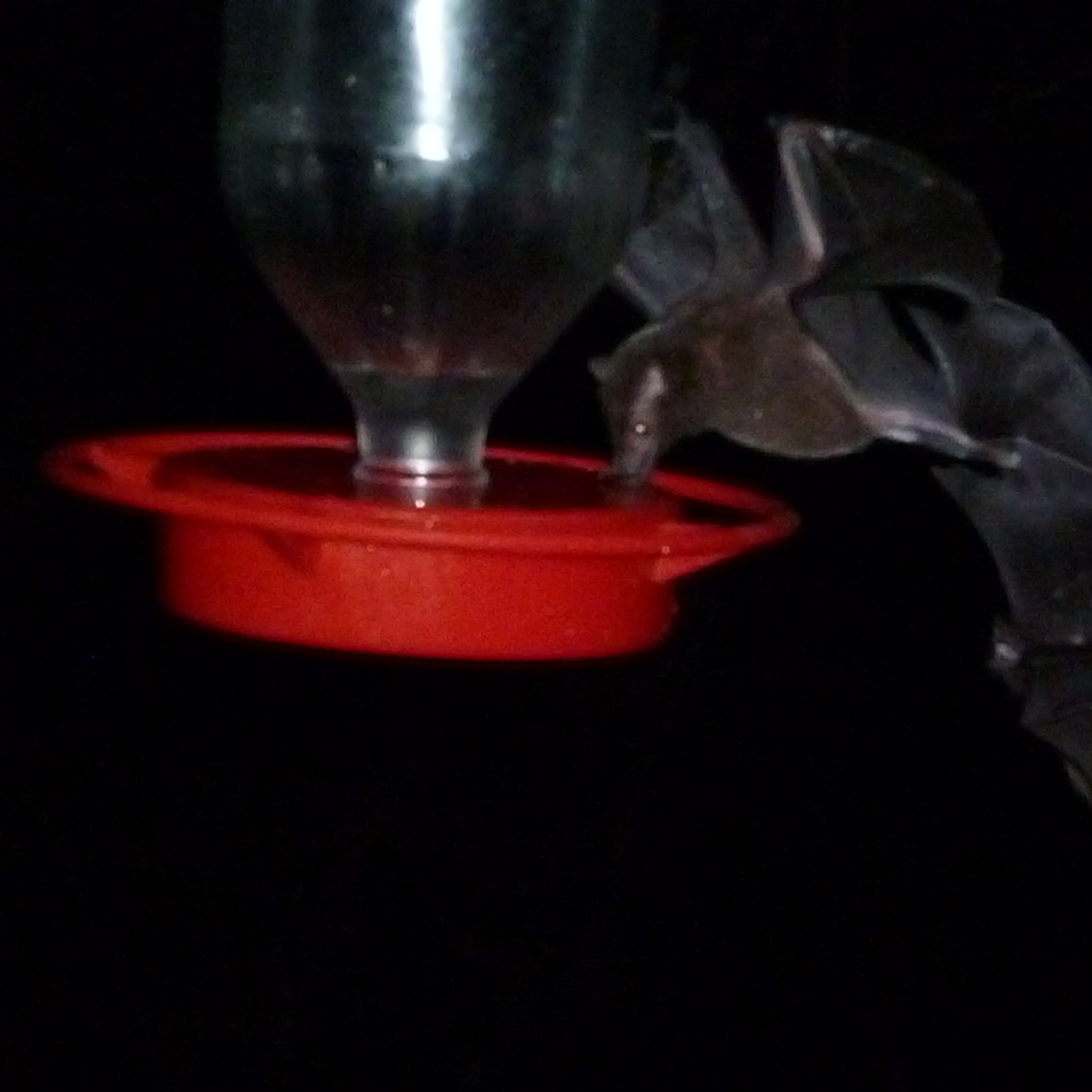
So thats why the feeders are empty in the morning!
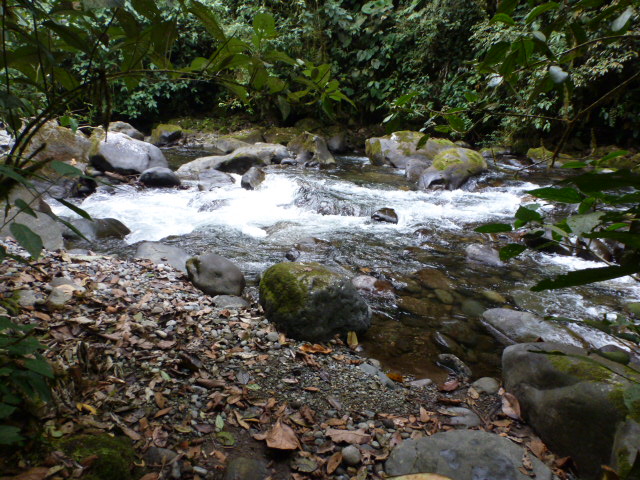
View from the other new picnic area on Rio Nambillo.
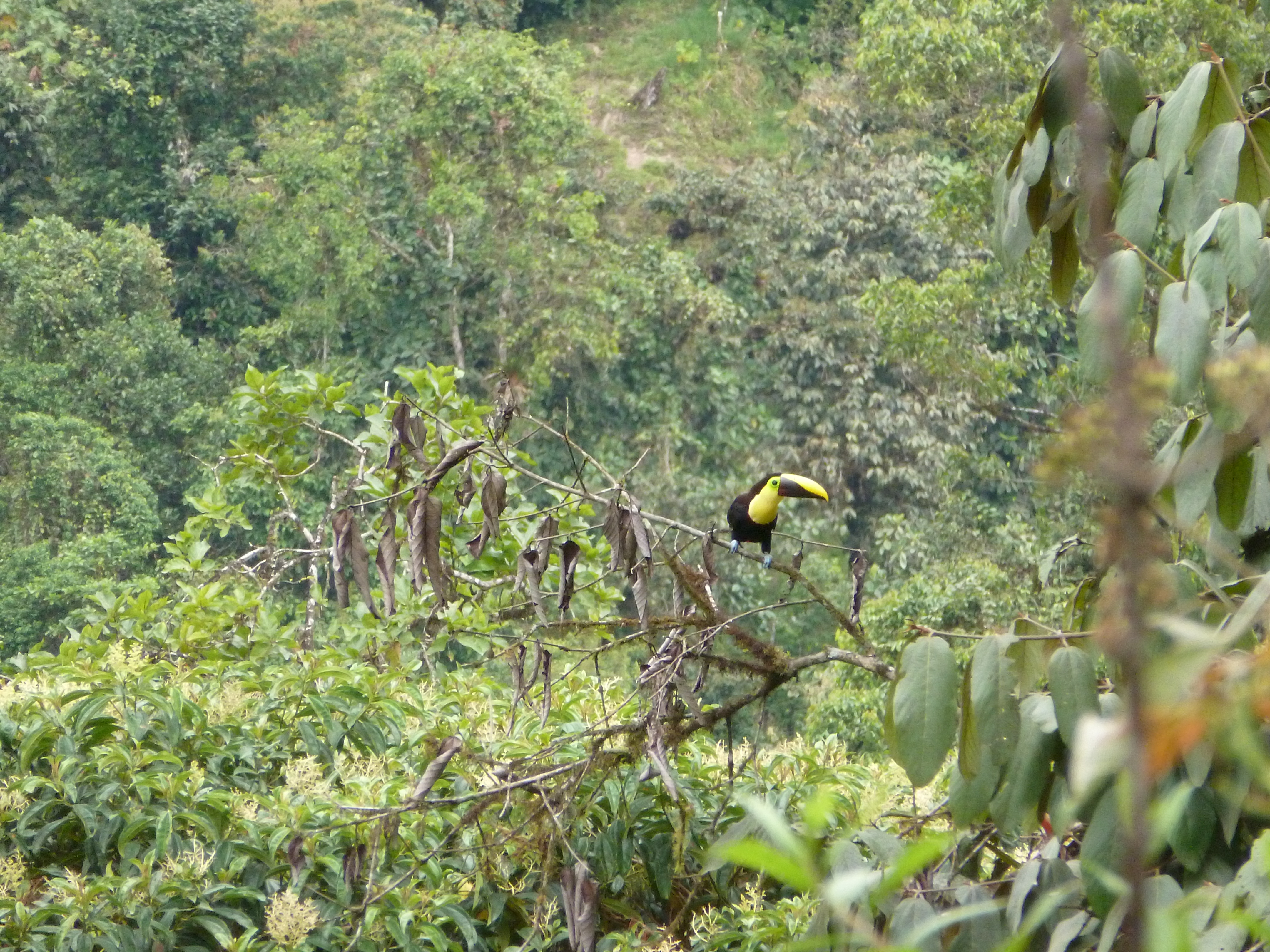
Choco Toucan taking a break in the forest.

Beautiful… This is one of our favorite views on the reserve.

Bye for now… Shyama and Amanda
Wildlife II
As our time at Las Tangaras draws to an end, we continue to enjoy the abundant wildlife that surrounds us. Our most frequent visitors are the variety of hummingbird species that drink from the cabin´s feeders everyday. In the last month we´ve witnessed an increase in both the number of species and the amount of daily activity. Food and the need to reproduce lead to combative fighting and colorful displays of territoriality.

Hummingbird wars!
Another fleet footed resident of the reserve is the basilisk. These lizards are so quick that we´d only caught brief glimpses of them scurrying out of sight, until a recent warm morning along the river, when we came across one sunning itself on a rock. As soon as it caught sight of us, we were rewarded with it´s trademark run over water as it headed for cover. It performed the feat twice more before coming to rest on a log, when we were finally able to snap a photo.

The Basilisk is in the center of the photo, above the heart shaped leaf.
One day, while clearing Sendero Bonito and checking on the new steps we´d built, Shyama let out a yell when he nearly bisected a masked trogan that came flying out of a hollow tree stump and only avoided his machete´s momentum by a few inches. These birds are known to nest in cavities of dead trees, fairly low to the ground. Our suspicion that this bird was guarding or building a nest was confirmed later that week, when we returned for a closer look.
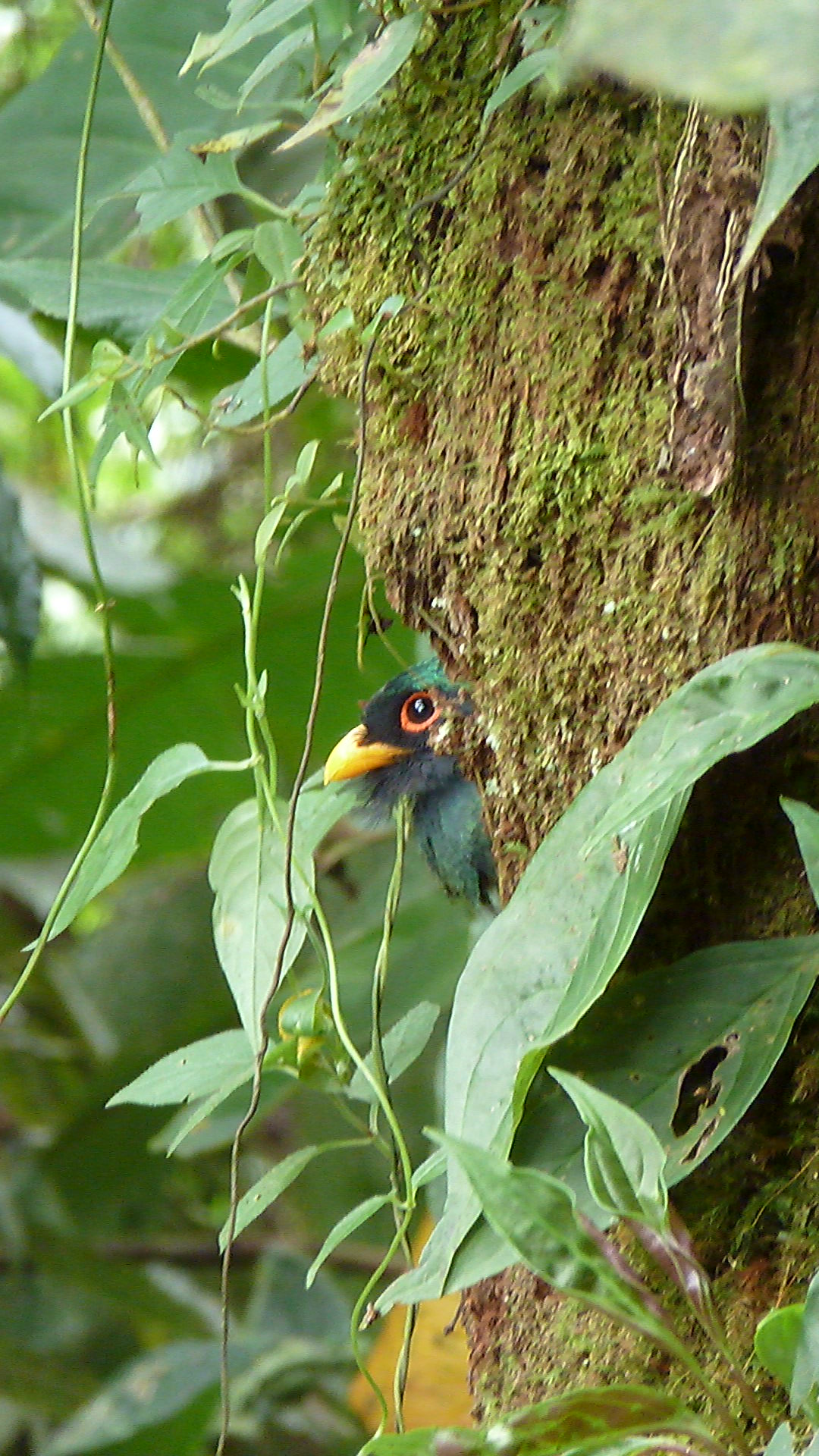
Masked Trogan guarding the nest.
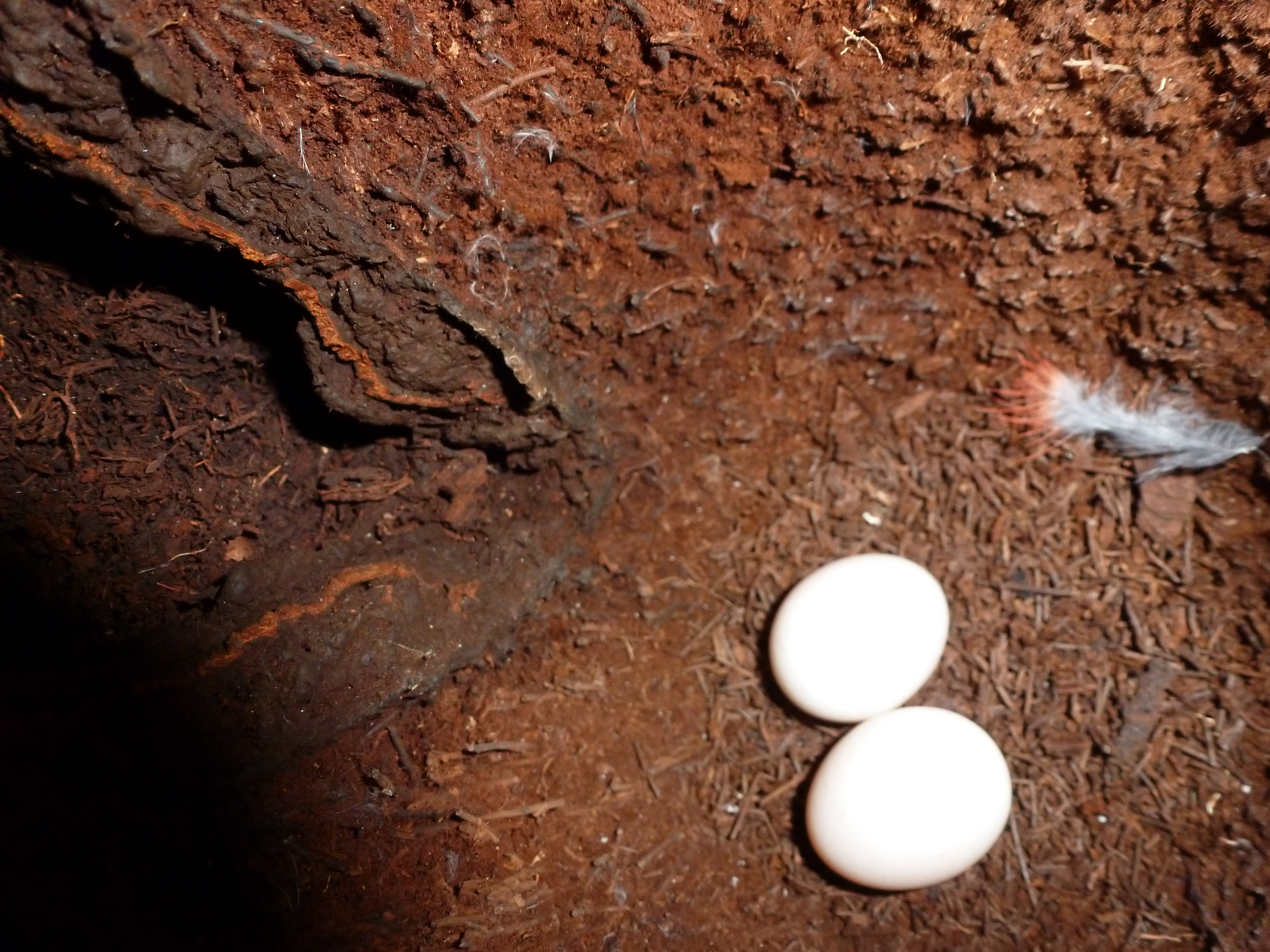
Our next sighting actually occurred in Mindo, but we feel that it was unique enough to warrant it´s inclusion here. Amanda spotted this anolis fraseri in the grass of Mindo´s central park, on our way to find some almuerzo. She tried to catch this colorful, foot long lizard, but it quickly escaped up a tree and out of reach. Luckily we were able to get some good pictures.

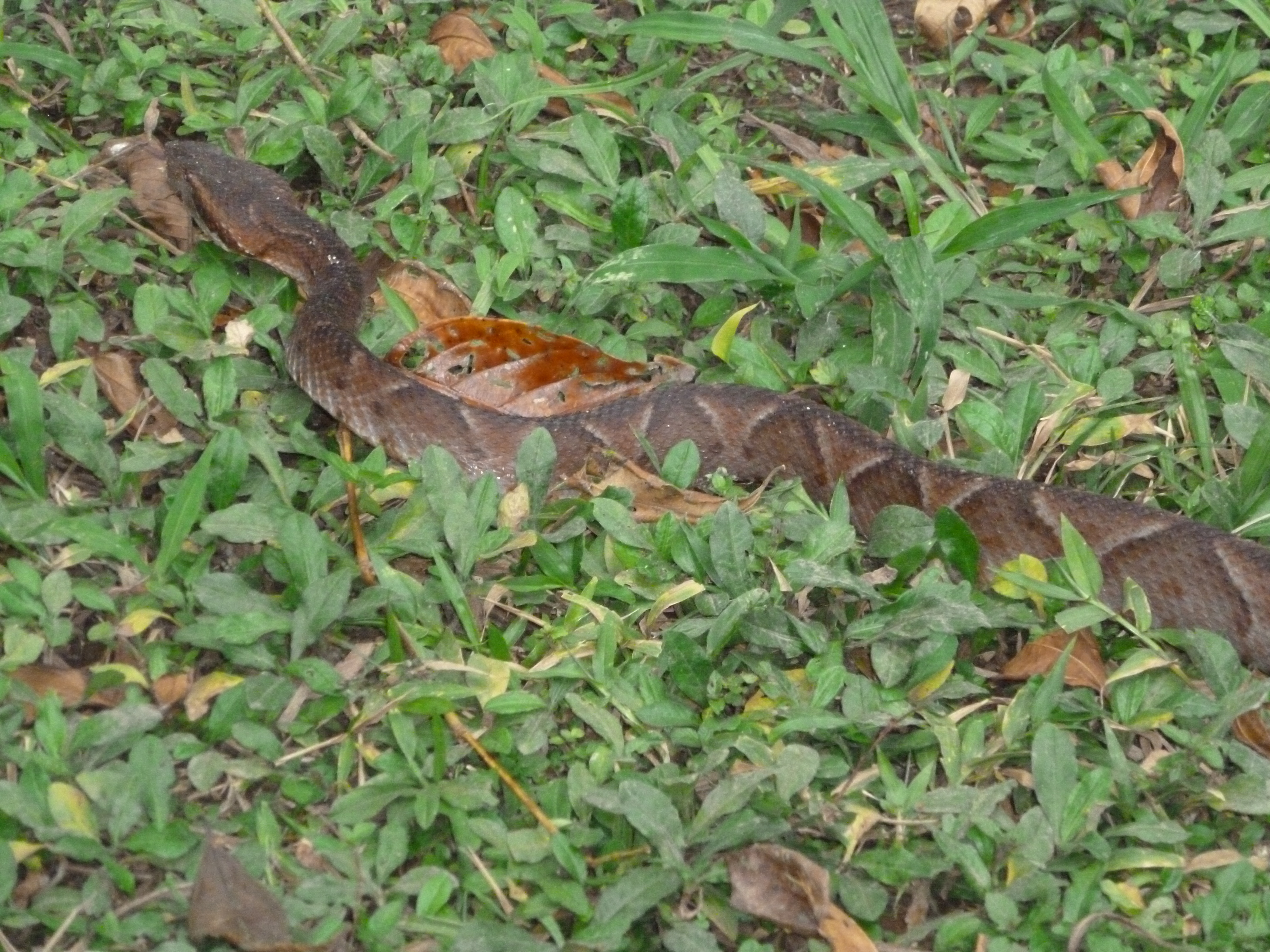
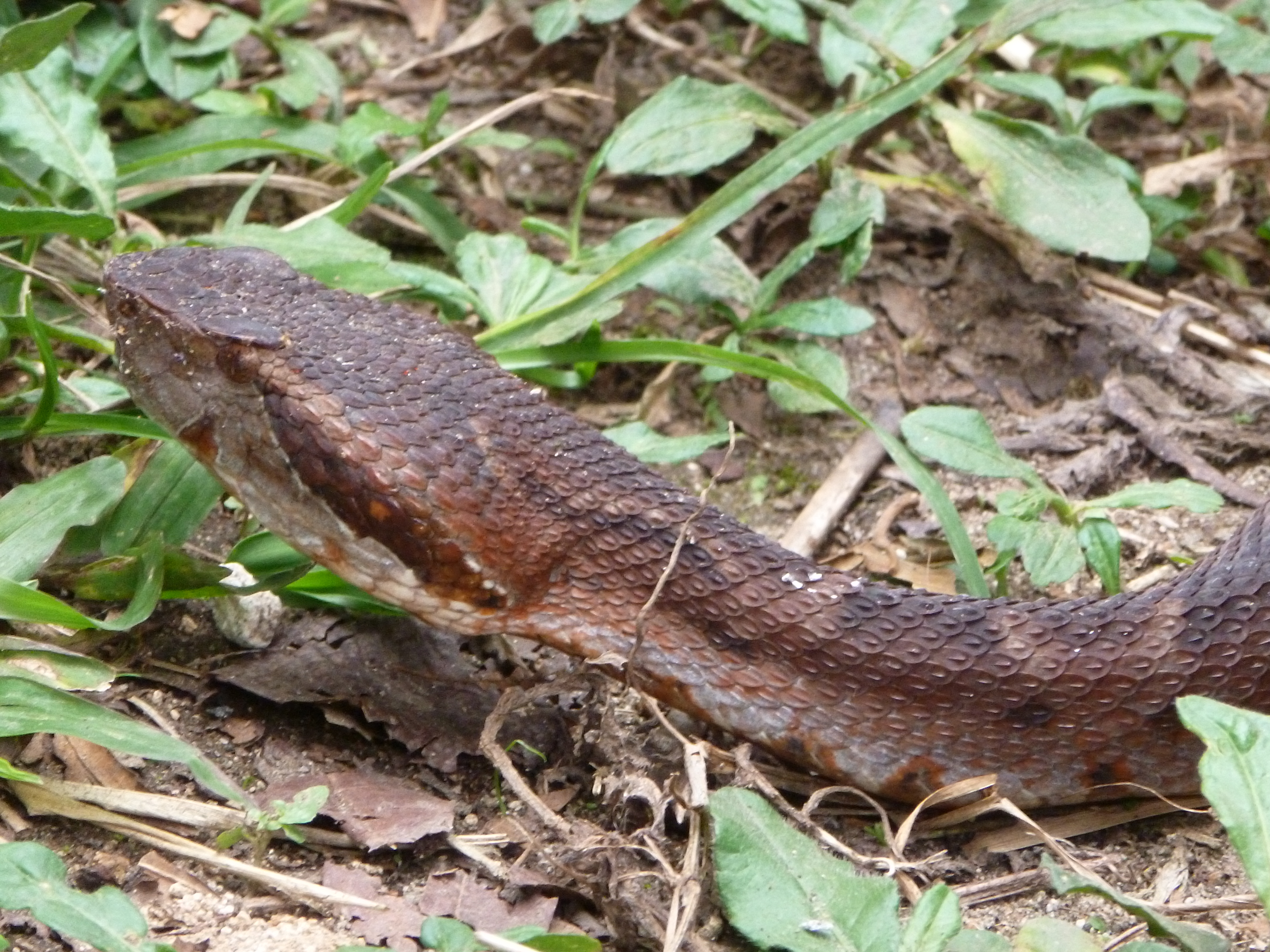
Well, we´ve saved the best for last.Our most jaw dropping (and heart-rate elevating) sighting has surely been the fer de lance. We´ve known that these highly venomous snakes inhabit this area, yet, though they are diurnal, they are rarely seen. We returned to the cabin one afternoon, after a day of erosion control at the Gallo de la Peña lek, to find this one coiled beside the front steps. We´ve seen several snakes over the months, but this fer de lance, at 1 meter long and thick in it´s midsection, was definitely the largest. As lethal as these snakes are, this one was content to rest in it´s coils while Amanda enthusiastically snapped photos and Shyama stood well back pondering his mortality. After an hour or so, we watched it make it´s was slowly off into the forest, and were able to appreciate it´s full size and beauty.
Wildlife
While the abundance of birdlife is the biggest draw for visitors to Las Tangaras, they are by no means the only wildlife roaming the hills of the reserve. Large mammal sightings tend to be rare, but several other creatures are commonly seen, and at least one mammal, the armadillo, turns up quite frequently.
Pablo
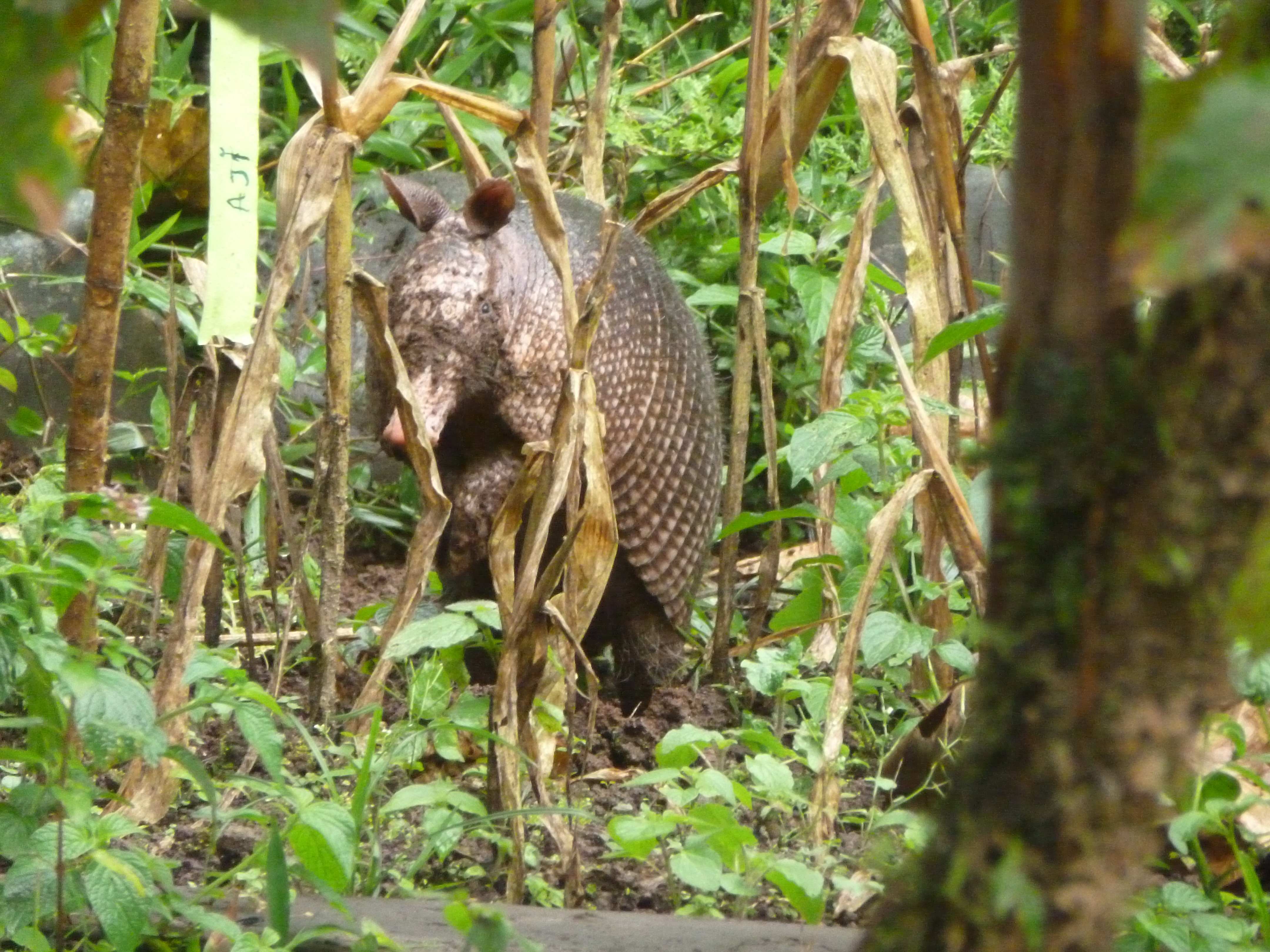
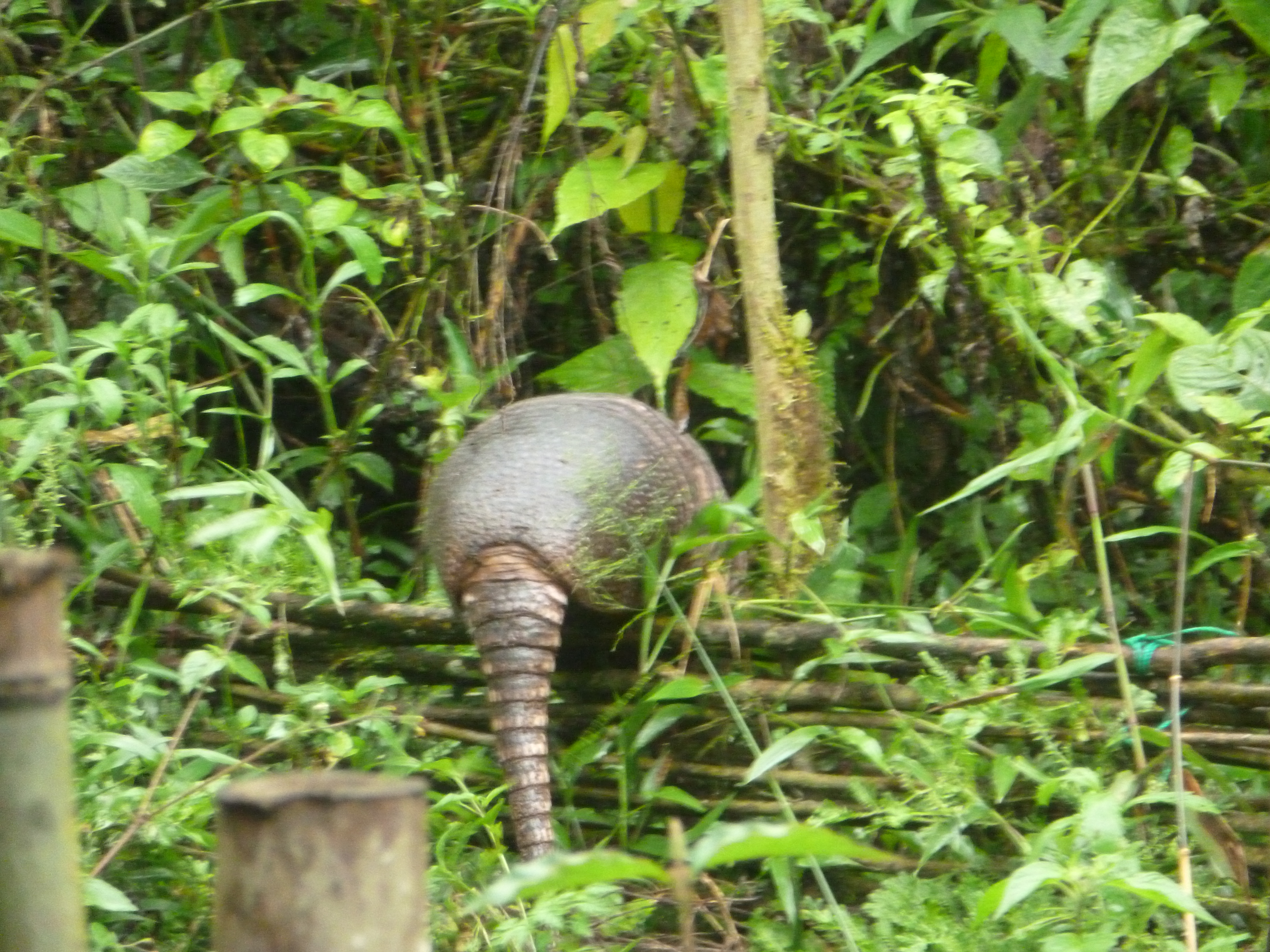
After much anticipation, and nearly 6 weeks of waiting, we finally had our first visit from the 9 banded armadillo with battle scars, dubbed ´Pablo´ by previous managers. We had read much about Pablo in the managers´ journal, and seen fresh evidence of armadillo activity nearly every day, but our first actual glimpse came as a pleasant surprise. He nosed around the garden for a few minutes, unmindful of us, before climbing nimbly over the fence that was built to keep him out.
Although squirrels are a common site in the states, we had quite an uncommon experience with a red tailed squirrel here at the reserve. We came into the care of a young squirrel after it was abandoned by its mother during the installation of a fruit tree grove. For the next 3 weeks we acted as foster parents for this squirrel; weaning it off milk, introducing solid food and encouraging it to climb and forage.
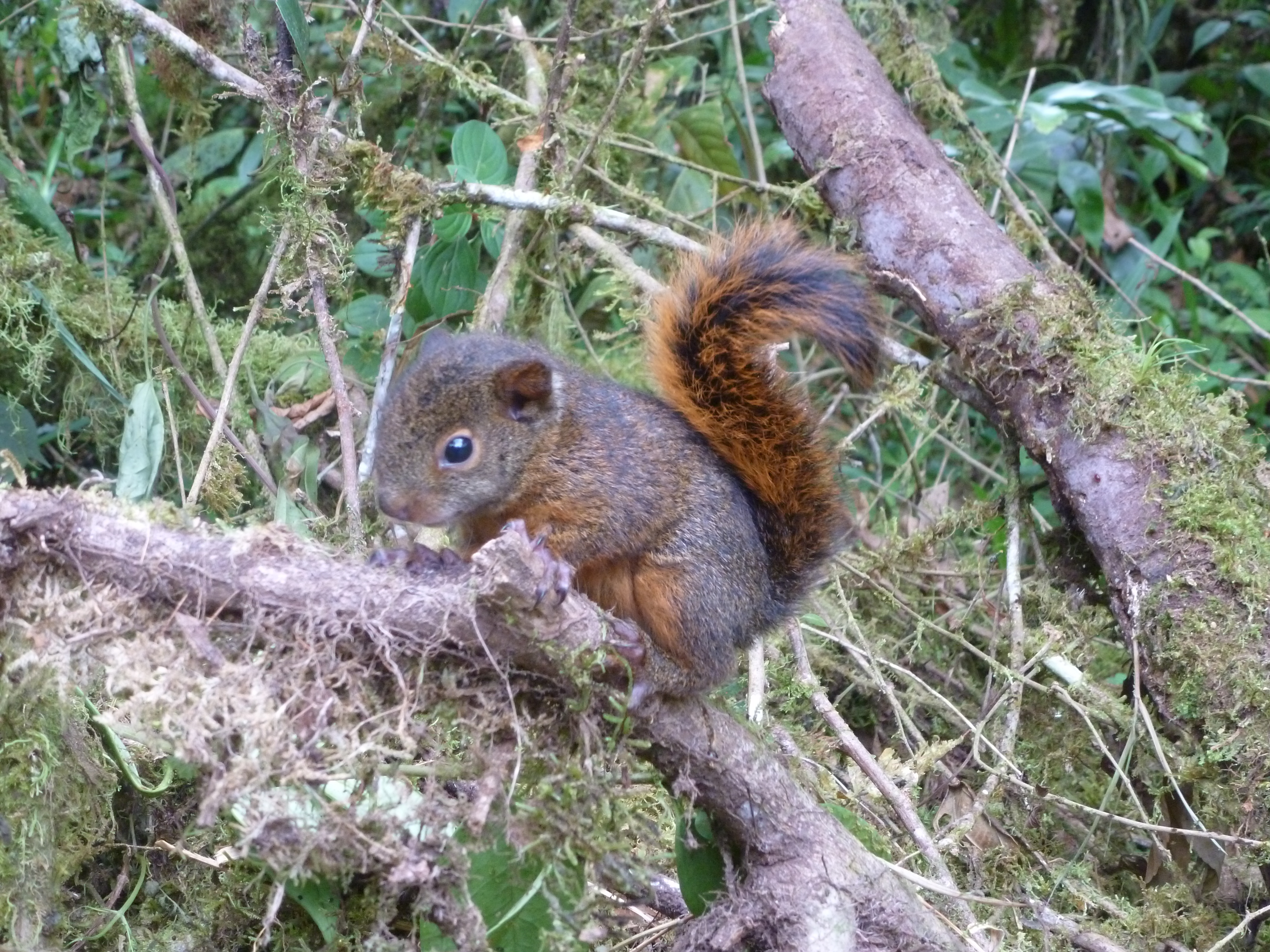
Squirrely climbing lesson
The last few nights it stayed with us, we kept its makeshift burrow outside, hoping it would leave on its own. Unfortunately it had grown accustomed to our high class cabin lifestyle, and wasn´t keen on venturing far from human care. We would solidly ignore it for hours on end, busying ourselves inside the cabin with doors shut to keep it out, only to find it snoozing contentedly in the sun atop one of our sweaty, drying work shirts.
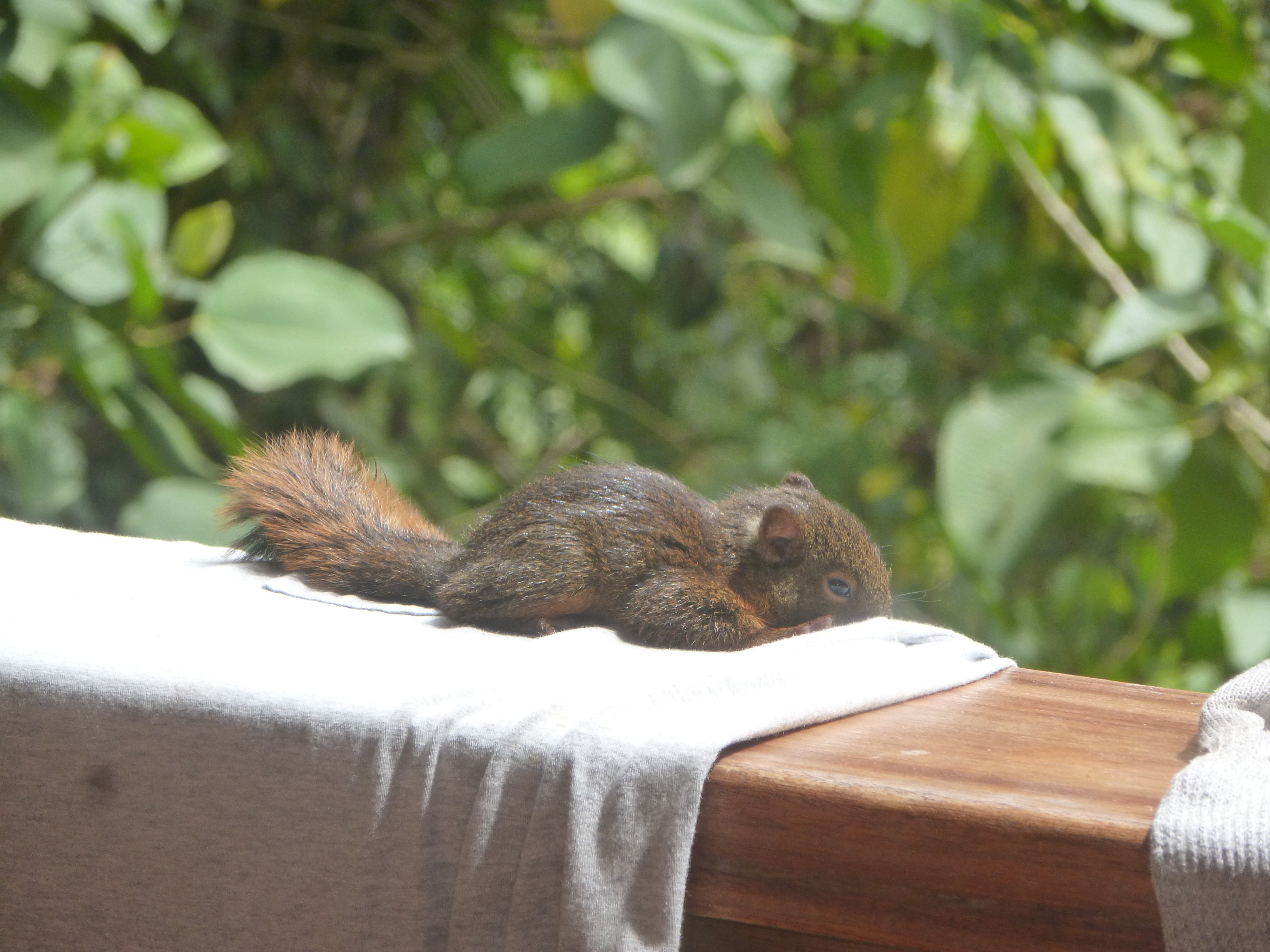
Squirrely sleeping on Shyama´s dirty work shirt
Two days passed with the squirrel sleeping on the porch, even though we´d stopped feeding it. We tried releasing it into the fruit grove where it was found, roughly 130 meters from the cabin. A day and a half later it was back on the front porch. This happened twice. Finally Shyama marched it much further away from the cabin, and in the opposite direction. We haven´t seen it since, but hope that it’s found its way and is enjoying its squirrel life in the forest.
One day, while weeding the garden and hacking away the encroaching jungle, we came across a Western Lowlands Rain Frog. It was hopping to escape in the thick bushes when Amanda snatched it up for closer inspection and a few pictures. It was a treat to see one up close, as we hear a chorus of frogs every evening at dusk.

Western lowlands rainfrog
This Marine Toad was actually spotted in Mindo, but was a neat find nonetheless. It also relieved itself twice on Amanda´s hand, which was pretty funny, and yet she persists in handling amphibians for identification.

Marine toad
We´ve also had the pleasure of observing a number of Torrent Ducks who have taken up residence on this stretch of the Nambillo River. Their unmistakable swimming expertise, from which they get their name, is impressive to witness firsthand. And apparently they are thriving in these waters, as we have spotted a mother and her ducklings on several occasions.

Mama Torrent duck and ducklings
It is also worth noting the abundance of bats that live with us in the forest. Every night we catch glimpses of them sipping from the hummingbird feeders, or catching insects above our mosquito net. Some had the misfortune of flying into mist nets during the bird surveys, while others were awoken from a pleasant day´s sleep when we cleaned the cabin´s rafters.

bat, unsure of the species, that Mauricio safely untangled from the mistnet
One of the most intriguing animal behaviors we´ve witnessed here is that of the Oilbird. They are typically nocturnal birds, and we feel privileged to have seen one in the daylight hours and to be able to add it to the Las Tangaras bird list. Oilbirds are known to roost in caves by day, and for their distinctive posture when perched on a branch. It was midday when we flushed this one off the Amor Trail, but luckily it only flew a few meters off the path. It landed on a branch and promptly positioned it´s head vertically down, with tail feathers pointing to the sky. It hung there motionless as we watched; only moving when the wind would stir the trees, whereupon it would sway like a leaf in the breeze. It´s ability to camouflage itself in the relatively open forest was uncanny. We admired this bird for some time before moving on, and we hope that it found its way home.

Oilbird hanging from branch (tail feathers up)

Oilbird hanging like a leaf
These animals are only a small sample of the abundant wildlife that exists here at Reserva Las Tangaras. We feel lucky to have witnessed these creatures in their natural habitat, and look forward to all that remains to be seen.

 Reserva Las Tangaras