The babies of August
August brought a very pleasant surprise to the Reserve, we found under the cabin a small nest of hummingbirds.
We were lucky to witness their development from small eggs until they left the nest, this happened in a period of five weeks.
We believe that the little ones were Green – Fronted Lancebill (Doryfera ludovicae),
What do you think?
Hello from Las Tangaras!!
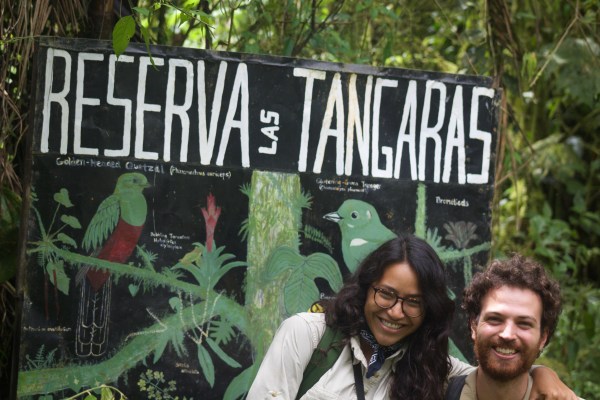
We are Pablo and Daniela, the new stewards of Reserva Las Tangaras.
We are from Ecuador, so sorry our english is not the best, but we try the best we can!
This month in Reserva Las Tangaras has been overwhelming because living in the Reserve has nothing to do with what one gets used to in the city, and that is the reason why we choose to do this work.
The most charming part of living in the Reserve is being part of the cloud forest and being able to live with countless birds and have the opportunity to observe beautiful mammals in your yard, and hundreds of insects with shapes and colors out of this world, that make you realize the forest is a magical place where life expresses itself in wonderful ways, and how powerful nature is.
There have also been challenges and to overcome them we had to strengthen our body and our mind, such as not having electricity or internet or having to walk an hour and a half to get your food, which makes you appreciate even more the simple things of life.
Here we leave some pictures of our “neighbors” and our new home.


Bird Banding & Farewells at Las Tangaras
For our last weeks at Reserva Las Tangaras, we were not just stewards, but also assistants on the Life Net Nature bird banding project. For many years now, Life Net Nature has organized groups of volunteers to conduct avian surveys through mist netting and bird banding at the Reserve. This data set is primarily used for long-term monitoring of avian species abundance and avian species communities within several different categories of habitat that the reserve provides to wildlife.


Working a bird banding project, you learn that there is a very specific and important protocol one must follow. You need to know which knots to tie to your net poles, how to string a net without getting it tangled, how to open the net each morning, how to start extracting a bird from the net, how to hold a bird safely, and what to look for when inspecting the bird. This kind of hands-on wildlife field research required a certain amount of hand-eye coordination and finesse that is different from a lot of other research we have done. You pick it up fast though, and on this project, we had the pleasure to work with a relatively small, but great team of banders who had a wide range of experiences from beginner to expert to everything in between. The work atmosphere was really conducive for learning, and both of us stewards took a lot away from this experience.

For us, handling the birds that we had been watching through our binoculars for so long, transformed the way we perceived these creatures. Rather than seeing them magnified through our scopes, we were able to hold them in our hands, and from there we were able to study them much more closely. It was an intimate experience, we were instructed on the proper bird handling technique, called the “bander’s grip”, and while turning these birds over in our hands, we measured things like wing feather length, tail feather length, culmen length, and tarsus length. We would also blow their feathers apart and do a full body inspection, looking closely at their cloaca, brood patch, furculum fat, and ectoparasite load (hoping all the while not to stimulate any projectile bird doppings). Through this project, we got glimpses into the lives of the birds of Las Tangaras, that were otherwise obscured and hidden from us by many layers of foliage and feathers.


One of the most stunning parts about this experience for us was that behind all those branches and leaves, and under all those layers of feathers, most of the birds in the forest are tiny little things. Pequeñitas! And for so many of these birds that call Las Tangaras home, while holding them, you are then able to see all the subtle details or dazzling patterns displayed on these small birds’ plumage. For us we realized that these small creatures are more beautiful than we ever could have understood from afar. We are so thankful that we had the opportunity work with these birds, to live in such a special place, and to share it with all of these extraordinary creatures. We will cherish these memories forever.
Gracias y Hasta Luego!
Dan y Bárbara
There are cats, and there are Cats
Imagine for a moment that you are camping under the stars (more realistically clouds) at the Las Tangaras Reserve in Mindo, Ecuador. You are at peace, bundled in your sleeping bag, and listening to nothing but the calls of frogs and insects. When suddenly you hear a different call. The call nobody wants to hear when they are about to fall into a deep sleep. The “Call of Nature”. Disgruntled, you extricate yourself from your sleeping bag, fumble for your headlamp, exit the tent, find your boots and make your way to the Las Tangaras outhouse. At last at the latrine and taking care of business, you reflect that this is not so bad. At least there’s toilet paper, and plus you have a great view of the forest, maybe you’ll see some neat animals. Then, you hear leaves rustling and twigs snapping. You sit up straighter, frozen, adrenaline pumping, “what is that?”. The sounds come closer and closer, it sounds close to the ground, and then at last a small shadow moves into view, and a white-eared opposum scurries past. Relieved, you relax back into your seat and carry on. Only to sit bolt upright as a much larger shadow falls across the entrance. A Puma (Puma concolor) stalks past, nose to the ground. It disappears around the corner in the same direction of the opossum. Well, this didn’t actually happen, but it may have happened if you decided to stay the night at Reserva Las Tangaras the night of the May 15, 2018! However, we’ll never know exactly what happened that night, all we do know is that the next morning there was a scattering of opossum tracks and one Puma footprint directly in front of the latrine.
The Reserve is very much a wilderness area, and we are constantly reminded of that fact. We have seen even more Puma tracks around the property as recently as June 15th, we have a photo from one of our camera traps of an Ocelot on May 23, and we have personally encountered an Oncilla as we were crossing the Río Nambillo very early in morning to catch the early bus to Quito. It’s one thing to know that these animals exist, we see their pictures, we read about them in our animal guides, but it is quite another thing to actually see them (or evidence of them) in the wild. We are very thankful, that we live in such a protected area. Not only does the Reserve, a 50 ha property, have a lot of primary cloud forest, but it is also borders the Mindo-Nambillo Bosque Protector, over 19, 000 ha of protected land that also encompasses many acres of primary cloud forest. Many of these rare and endangered animals like wild cats require large areas of intact forest to survive, and we are very thankful that this very special place can provide that for these spectacular creatures.
![0310:052318:55F:2569:CAMERA2 DB:2E[101:0415]G[032:0x001f]](https://reservalastangaras.com/wp-content/uploads/2018/06/ocelot.jpg?w=600)
Hogar Dulce Hogar
How do you define home? Some might say it is the place where you grew up, some might say it is the place where you have lived the longest, some might say it is where your family lives, some might say it is where you own a house, some might say all of the above and that they have many homes, and others might even say they have no home. Home seems to be a simple, but also very abstract concept that depending on the individual, can be defined in a multitude of different ways. For us, we are not Ecuadorian, we have not lived at Reserva Las Tangaras long, and our families live very far away. Yet, we feel at home here.
We came to Reserva Las Tangaras excited about the incredibly unique biodiversity in Ecuador and all of the new things we would learn about this Reserve and ourselves. And yes, since being here, we have definitely experienced that. We have seen new species of wildlife everywhere, we have heard bizarre animal calls throughout the Jungle, we have cooked with many different local foods, and we have met many amazing people both from Ecuador and abroad. We take great pleasure in, and cherish all of these new things we are experiencing, but there is something else about living here that we weren’t expecting to give us so much pleasure.

It’s also the same things that we have begun to notice everyday. There are small patterns you start to pick up on at Las Tangaras like the afternoon rains, seeing the same individual hummingbirds zoom around the house, walking alongside a column of army ants on the entrada trail to town, or hearing the Andean Cock-of-the-rock call as they descend down the mountain from their daily morning lek. As the Stewards of Las Tangaras, we take immense pleasure in not only the new things, but also these smaller things that have become routine. Maybe that’s another definition for home.


Although we don’t have very many human neighbors, we do have a Common pootoo that regularly roosts near the cabin, we have a Broad-billed motmot that often comes by to say hi when we are doing our hummingbird counts, and we have a pair of Orange-bellied euphonias that hop around the trees in our backyard picking berries as they go. Albeit only temporarily, this is our home now, and through recognizing the habits of some of the other creatures living here at Las Tangaras we feel like we’re slowly becoming part of the ecosystem here too.


We have found that we enjoy both the ordinary and the extraordinary, and we value each type of experience equally. This Reserve is a beautiful place that offers hiking trails, diverse avifauna, breathtaking views, swimming holes, you name it. There are plenty of opportunities for excitement here, but you can never know beforehand what those will be. For us, one of our greatest pleasures is watching the hummingbirds during a thunderstorm bathe themselves, and seeing them come to the feeders with crazy hair styles!


Reserva Las Tangaras is a little different from most other nature destinations, and if you approach your stay here with an open-mind you can find endless entertainment, enjoyment, and adventure.
Llegamos!
Hola a todos, we (Bárbara and Dan) are the new managers of Reserva Las Tangaras! We have been here only a short while, but it didn’t take long for us to figure out that we are living in a special place. Twice daily, there is an Andean cock-of-the-rock lek, hummingbirds swarm the lodge’s front porch all day long, and the forest is blanketed in misty white clouds. We still feel struck with the question “Are we really here right now?”. Much of the natural beauty on the reserve is owed in large part to its isolation from civilization. The reserve is pretty far off the beaten path, and to get there, one must hike 2km (45 mins) from the road along the Entrada Trail. It’s totally worth it though! The Entrada Trail is very different from the trails on the reserve, and it will lead you through several different habitat types and elevation zones. As you walk past the secondary forest and agricultural lands (don’t worry you’ll find that primary forest once on the reserve!), you have the chance to see how each of these different landscapes harbor different communities of organisms specialized for that habitat. Or alternatively, if you are new to Ecuador like us, everything will look new and different regardless of the habitat, but you don’t need to understand it to enjoy it!
Besides the mind-boggling diversity of flora and fauna at the Reserve, we have also been encountering and learning lots from our maintenance and upkeep of the reserve. For instance working on some minor suspension bridge improvements, cleaning our water tank system, and keeping food without a refrigerator have all proved to be challenging and educational, but in the end successful too! One of the most enjoyable upkeep tasks we have as reserve stewards is maintaining the trails. It is not only important for visiting guests, but also means that we are constantly encountering new wildlife, enjoying beautiful vistas, and learning the ecology of this beautiful mountainous region.


Finally, it’s hard to write about Las Tangaras without writing a little bit about the hummingbirds. Regardless of if we are beginning our day or ending it, we are never too tired to watch the hummingbirds zoom around. We have been consistently seeing about 12 species of hummingbirds a day at the reserve! And each day we notice new individuals or new behaviors that keep us on the edge of our seats.
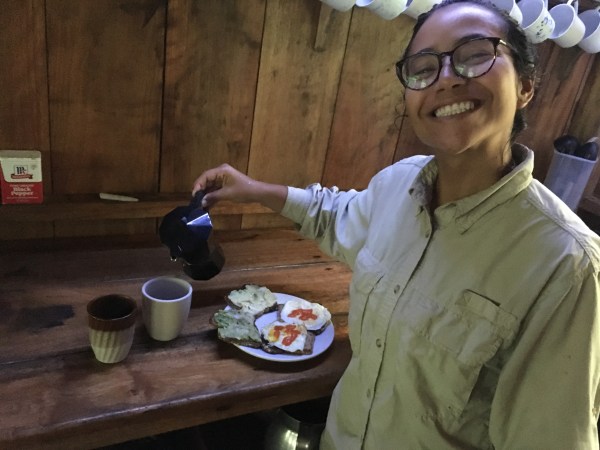
Getting ready for the hummingbirds with a coffee and snack!


Until next time!
Bárbara & Dan
Ranas y Orquideas y el Fin
Our final month is wrapping up here at Reserva las Tangaras (I’m not crying, you’re crying!) and as we look back on our time spent here, we realize all of the surprises that we encountered along the way. We both expected to see loads of birds while here at the reserve, and we certainly did! Every single day! But there were other organisms we encountered that we weren’t quite ready for, ones that completely held our attention for days on end.
For Juliana, the “surprise organisms” were orchids. Here she is, explaining her new-found orchid passion:
It all started when Jake suggested we visit a local Jardín de Orquídeas (Orchid Garden, pronounced “hard-een de orc-kitty-uhs”. Probably my new favorite Spanish word). I didn’t have much interest in this venture, imagining the typical white and purple orchids we find standing solitarily on side tables in the United States, but when you love a person, you support their interests. And so, we went.
Before I continue, I want you to take whatever notion you have, whatever image that comes to your mind when you absorb the word “orchid” and just FORGET IT. ERASE IT FROM YOUR MIND. Because it’s a STEREOTYPE.
Those flowers you can buy at Lowes back home? That’s simply the stuff of commercialism. Just like our fruits and veggies, we are all taught what a plant is supposed to look like and the industry does its darnedest to meet that taught expectation. But if we were to REALLY find, say..bananas in the wild, they wouldn’t look (and they don’t, trust me, there are pink bananas here) like the bananas you get at your local Costco, Harris Teeter or Piggly Wiggly (RIP). The same goes for orchids. To the Nth degree.
Our 30 minute tour through the Jardín de Orquídeas took us through 200 species (only about thirty of which were blossoming), a fraction of what exists here in Mindo and a wildly smaller fraction of what can be found in Ecuador. There are over 400 species in Mindo and 4000+ species in the country. I went from disinterested to rapt in 2 orchid species flat (roughly 3 minutes).
When we left the garden, my whole outlook was changed: more orquídeas please! We immediately begin to look for and find dozens of species of orchids on the reserve. And, as I do, I began to obsessively collect images for future identification.
Orchids are so interesting to me because: A) They are incredibly variable. They make up the second (might be first, no one can agree) largest family of flowering plants (10). As a result, you can’t just look at a flower and say “oh! that’s an orchid” because they rarely look similar (though most do have a tongue-like petal called a labellum) (11). You’ve got to feel up the plant and look for the tell-tale pseudobulbs located at the base of the stem to make a confident orchid identification (12). (BTW, these bulbs are the reason behind the name “orchid”. Click to read about the etymology if you like, but it’s not G rated…..)
B) Most, not all, are epiphytes, meaning here in the Cloud forest they’re found growing in mossy substrates on the trunks of trees. Once we started looking, I suddenly realized I’d been brushing elbows with orchids for weeks. Some are so resourceful, they can grow on rocks! All of the epiphytic species collect nutrients through root systems that cling onto their preferred substrate (ie tree, rock, whatever). These aerial roots are able to sap nutrients from organic detritus, animal poos (mmm!), mineral dust, and even humidity (with specialized roots called velamen) (12).
C) They all target specific pollinators and very few offer nectar rewards, hence their menagerie of arrangements and methods. Since most lack nectar, they must trick the pollinators into working for them fo free. This is typically done through attractive visual cues. And once the pollinator arrives, orchids get even pickier. Some orchids have such specific preferences, they’re structured to leave pollen on one small portion of the visiting pollinator to ensure that the pollinator can ONLY pollinate the same species and not cross pollinate (How many times can one say “pollinate” in a sentence?) (13). Others simply trap the pollinator within the flower and force it out an “exit route” that ensures pollination and prevents self-pollination. Some orchids even MIMIC lusty female insects so males will try to copulate with the flower and in the throes of love, pollinate instead of mate. (14)
Interestingly, in areas hard up for pollinators, orchids do without and self-pollinate. In public! *gasp!* (15) (16)
D) Orchids absolutely could not exist without fungus.
Wait? Do WHAT?
Orchids reproduce with seeds. No surprise there. They create bean-pod like structures that contain thousands of microscopic seeds (sometimes over a MILLION, to make sure that number is settling in, here it is written out in 1s and 0s: that’s 1,000,000,000!!!!!). These itty-bitty-babies eventually leave mama flower by hitching a ride on a gust of wind (“Spread your wings and take to the sky, my darlings” – Mama Clara Orchid). They’re super-d-duper light weight, so even in a heavy-aired cloud forest, they can float away from home base. Neat!
But being that light-weight and produced in the 100s of thousands has its costs: orchid seeds lack endosperms aka nutrients to survive off of in order to germinate and become new plants. So, they’re literally set up to fail. It’s about this time in the story we start frantically searching for a hero to save these babies from waste. Search no more, fungus is here! Each species of orchid has a tight relationship with a species of fungus. Orchid seeds MUST meet up with their fungus allies in order to grow beyond seeds because the fungus will provide the seed the nutrients it needs to develop. (17)
Needing to find the perfect type of fungus when you’re just an itty bitty seed with no sense of direction or map is pretty darn hard (heck, it’s pretty darn hard for full-grown adult humans to find their perfect types….). And so, many orchid seeds do go to waste and only a minute amount make it to adulthood. But those that happen upon the right fungus grow up to share their beautiful petals with any willing witness. As a result of this relationship, conservationists CANNOT protect wild orchids without protecting their habitats, because it’s within these habitats that the partner fungi live.
The more I learn about the connections between ecosystems & organisms, the more I realize fungus (and bacteria) is truly the wizard behind the curtain…there’s a lot of processes they are responsible for that we just never even think about — ahem, for example, beer.
Hold up…JZ’s got something to say: WHY WOULD FUNGUS AND PLANTS PARTNER UP?? Because they’ve coexisted for a long, long time! We are tinier than the tiniest orchid in the grand scheme of things…
Speaking of tiny orchids, here are some Platysteles species, which are smaller than a grain of rice. They’re really, really cute.


So, as you can see, I have become completely enchanted by orchids. And not ONE of the blooms I’ve encountered looks even remotely like the side-table standers from back home (If you’re tired of reading and just wanna see some dang orchids already, scroll down.)
And just as they are variable in appearance, they are variable in scent becuase they’re attracting those incredibly specific pollinators. Those orchids that employ scent to trick-and-not-treat use smells that range from citrusy to clean linen to valentine’s heart candies (I guess for attracting 1st graders?) to rotting cadavers to chocolate (for attracting Julianas) to bubblegum to sweet garbage to vanilla. Oh hey! Guess what! Vanilla is an ORCHID.
The most difficult thing about this new obsession is the level of effort it takes to determine an ID for each orchid. There are NO online resources (I tried googling “orchid species Ecuador” and now I can tell you all about the various orchid tours available in Ecuador!!) Fortunately, I’ve been able to rely on the Orchid Garden staff to help me make identifications at least to the genus levels. Pictured below are some orchids we haven’t yet identified…


And so, that’s the story all about how my birding addiction got waylaid by orchids at the Reserva las Tangaras !
For Jake, the surprise organisms was frogs. It’s not that he wasn’t already intensely interested in these creatures, it’s just that he learned and saw some surprising things about them:
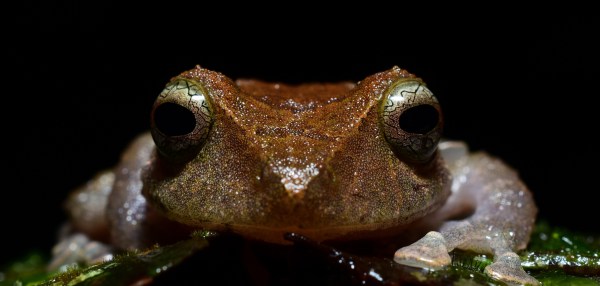
This past February the rainfall totaled at 591.20 mm, higher than the last three Februarys here at Las Tangaras. It is no surprise that this soaking creates an amphibian paradise. Mindo, and its plentiful rain seasons, harbor one of the most unique and biodiverse collection of frogs in the world. These frogs have taught me so much I did not know and captivated me throughout our stay. Here is one way analyze the anuran diversity in the Cloud Forests of Ecuador:
Wet conditions are often associated with amphibians because water is needed for reproduction. Most amphibians start their lives in the water and bear little (if any) resemblance to their adult form. They then undergo a drastic transformation¹, called metamorphosis, providing them with characteristics and tools to help them survive on land. From here on out, there is a varying amount of dependency each species has on water, but most are restricted to reproduction in an aquatic habitat². Many frogs exemplify this process by laying their eggs in the water, which then hatch into a strictly aquatic form. This form is commonly known as a tadpole— essentially a large round head with a tail used for aquatic propulsion. When they reach a certain point in their juvenile lives, they will begin to change. They begin to trade their tails for legs and hop into the frog form we are most familiar with.
There is a ton involved in this process and I am over simplifying and generalizing for brevity. But what is important to note is this is the primitive reproduction method for amphibians. It has existed in frogs for approximately 220 million years and is still the predominate form of reproduction today. Around 50% of all anurans (frogs) use this method of water eggs > tadpole > metamorphosis > terrestrial (or semi-terrestrial) adult³. Clearly this is a successful strategy and has some huge benefits. For one, problems of water loss during embryonic development are nonexistent because the eggs are laid in the water. Also, restricting juveniles and adults to their own individual environments prevents competition for food amongst the same species. Juveniles can eat for growth in the water, adults can eat to nourish reproduction on land, and neither has to do so at the expense of the other.
This development strategy is used by most of the frogs I work with in South Carolina and it is also the strategy used by several species here in the Cloud Forest of Ecuador:

Babbling Torenteer (Hyloscritus alytolylax)
The Babbling Torenteer (Hyloscritus alytolylax). A Hylid (treefrog) whose name indicates the rage of the waters it breeds near. This frog will mate near rivers or waterfalls and then lay eggs in the small pools that form on the edges of these water systems. The photo above pictures a metamorph— This froglet recently underwent metamorphosis, came on land, but still possesses some of its tail.
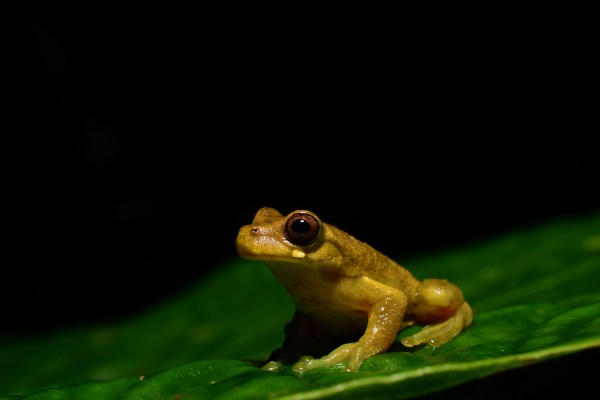
Executioner Clown Frog (Dendropsophus carnifex)
The Executioner Clown Frog (Dendropsophus carnifex)4 congregates in low lying areas and reproduces in the standing or slowly flowing water that collects from heavy rainfall. At Las Tangaras, these frogs are most commonly spotted at the start of the Motmot Trail. We frequently find them in a flattened area that serves as a water catchment from the hillsides surrounding it.
…
Though the above frogs are incredibly fascinating, I am certainly not constructing this article to discuss the common reproductive methods of amphibians. The other half of the world’s frog species are groups that are new to me. These include most of the frog species that surround us. They have a whole mess of tweaks they’ve added to this traditional reproductive strategy. All are designed to help them cope in unique environments.
These frogs lessen their need for a stable and consistent water source by laying their eggs on land. Amphibians, even terrestrial egg layers, lay eggs devout of a hard outer membrane and thus, are extremely vulnerable to water loss. Amniotes, such as birds and reptiles, lay eggs on land with a hard outer shell to prevent dehydration. Amphibians who laid their eggs in water had no need to expend the energy needed to create an impermeable membrane. So to lay eggs on land, amphibians needed to come up with a way to overcome this hurdle. They also needed to get the hatchling tadpoles back to the water. The cloud forests of Ecuador is certainly not a bad place to attempt this feat.
An analysis of many of the worlds frog species has shown terrestrial egg layers lay larger eggs. The larger surface to volume ratio helps decrease water loss5, Just like a larger body size helps decrease heat loss (as elephants can retain heat better than mice). Furthermore, most terrestrial eggs are packed closer together, further decreasing the area for water to dissipate. Seems simple, but it has come at a cost. Because of their larger size, more nutrients and energy has to be allocated for the development of these eggs. So the clutch size is often less and the average adult size of terrestrial egg-laying frogs is also smaller compared to aquatic egg-layers.

female Emerald Glassfrog (Centrolenella prosoblepon)
An example of one of the frogs who lays their eggs on land is the Emerald Glassfrog (Centrolenella prosoblepon). A very common frog found at Las Tangaras along the river embankments. Males will vocalize at night with the hopes of attracting a female. Following this attraction and the deeds that come with it, females will lay their eggs on vegetation just above the water edge. When the eggs hatch, out come the tadpoles who fall directly into the water to begin their stent in the Cloud Forests of Mindo.
Frog eggs are not only susceptible to dehydration, but also predation. The decreased clutch sizes of terrestrial eggs are especially vulnerable to predation because there are so few eggs to spare. In many species this has led to advanced forms of parental care. Keeping watch over your eggs helps prevent tampering or consumption. Many species of Glassfrogs will watch over their eggs. But in Mindo, it is the Darwin Wallace Poison-frog (Epipedobates darwinwallacei) that wins the best parent award. This frog and many other dendrobatids (Poison Frogs) will lay their eggs in a damp area on land. When the eggs hatch, the tadpoles will ride on their mother’s back until she can find a suitable water hole for them to reside in6.
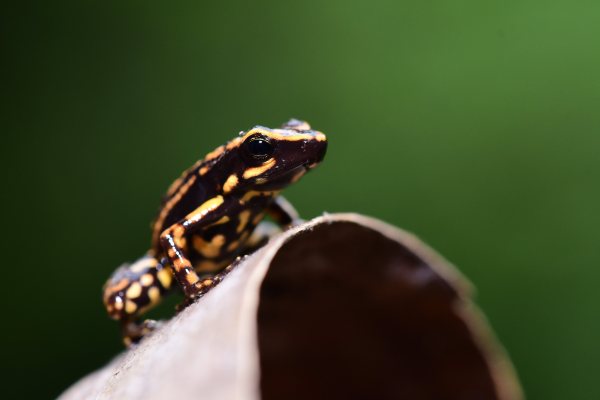
Darwin Wallace Poison-frog (Epipedobates darwinwallacei).
…
It is only natural for this metamorphic saga to continue with the largest family of frogs in Mindo: the Rainfrogs (Craugastoridae).
Carrying your offspring to the river can be a bit of a hassle. Especially so if you have already invested so much in laying big whopping eggs and also have to deal with the unpredictability of the environment around you. So, why depend on water at all? Do frogs have to go through a tadpole stage? Rainfrogs have shown that, no, frogs do not have to start out as tadpoles. Rainfrogs do not lay eggs in the water. In fact, many species never step foot in a body of water. Rainfrogs emerge from their terrestrial eggs as fully formed frogs, skipping the tadpole stage entirely. This is what we call direct development7.
In order to do this, Rainfrogs lay even larger eggs. Inside these eggs you will find a large yolk sac used to provide a surplus of nutrients facilitating the transition into the adult form. Looking closely at the embryos’ development, you will see these frogs begin growing legs very early. So they truly skip the tadpole stage and emerge as fully formed froglets. In embryonic development they do retain a tail, but this is speculated to aid in respiration8.
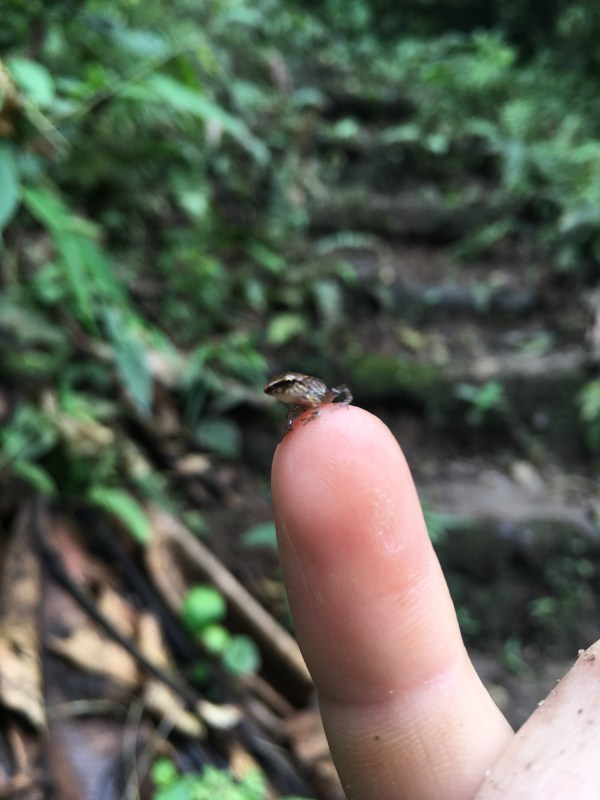 Upon hatching, the juveniles enter a terrestrial world. They enter the same world their adult conspecifics inhabit. Competing in the same environment for similar food items is definitely not beneficial for a species. However, many species seem to have found a work-around to ease this notion. Field notes of many herpetologist, and our own observations, indicate that younger and smaller members of the Pastures Rainfrog (Pristimantis achatinus) are most active during the daylight hours. On the other hand, the adults often restrict their activity to dawn, dusk, and night. The juvenile’s small size perhaps allows the frog to rapidly cool itself under leaf litter on hot Ecuadorian days. The larger adults do not have this privilege and thus are limited to foraging during the cooler night9.
The Andes Mountains are characterized by heavy and unpredictable rainfalls, fast moving water ways, and drastic elevation changes. Mudslides and directional changes in rivers are common occurrences, and there are often extended drought periods brought on by El Ninio. It is no wonder this group of frogs found more success abandoning the old ways of amphibians and releasing themselves from the restrictions of aquatic reproduction. In doing so, they have opened up a new door for Team Frogs—They now have the ability to populate previously un-amphibian populated habitats.
The genus Pristimantis— Which is the current genus given to Rainfrogs— is the most specious genus (aka most diverse) of terrestrial vertebrates on the planet. Spreading to new heights and new environments and rapidly evolving characteristics to be successful in these areas, has resulted in over 500 species of Rainfrog—Probably by the time you read this sentence the exact number will have changed. It is estimated that frog species are being found at a rate of 15 species per year10. The sheer diversity amongst the species is seemingly endless. To give you a taste, these are the few I have had the privilege of photographing in the parish of Mindo:
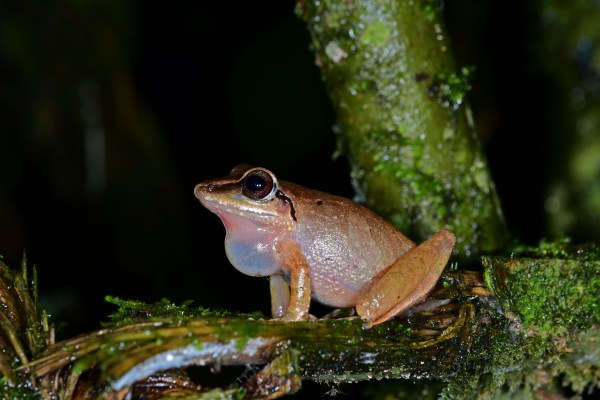
Pastures Rainfrog (Pristimantis acuritis)
Pastures Rainfrog (Pristimantis acuritis): This frog is perhaps the most common anuran found on the reserve. As its name suggests, it populates and dominates open habitats such as pastures. Their vocalizations often dominate the night sounds right outside Reserva las Tangaras lodge.
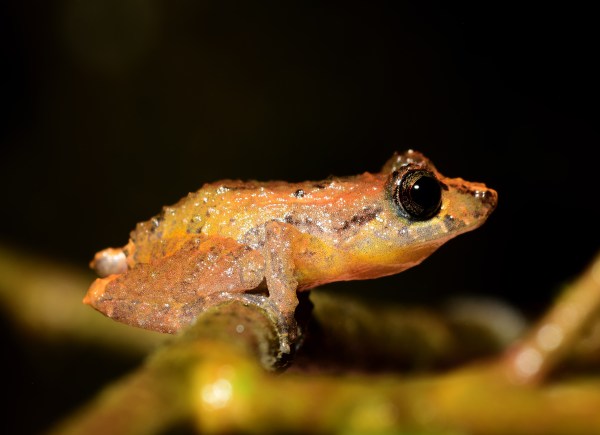
Yellow-groined Rainfrog (Pristimantis luteolateralis)
Yellow-groined Rainfrog (Pristimantis luteolateralis): Another common Rainfrog on the reserve seen most commonly on vegetation only a couple feet off the ground. It will hop from leaf to leaf looking for mouth sized insects to consume. The very similar Pristimantis walkeri looks identical to luteolateralis. However, walkeri occurs at elevations below 1240m, while luteolateralis occurs above.
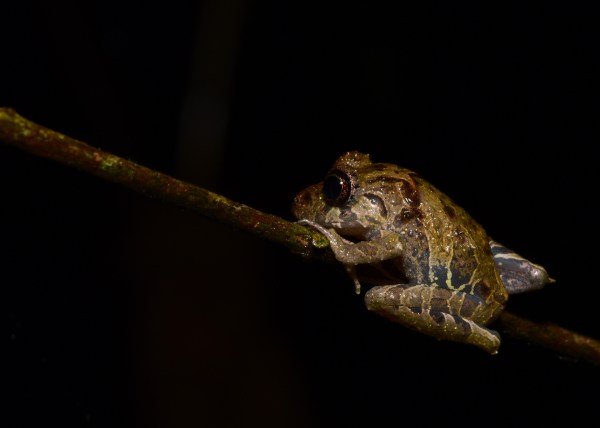
Pristimantis muricatus
Rio Faisanes Rainfrog (Pristimantis muricatus): A rare species endemic to the lower montane forests of Ecuador. We encountered this species on the Bosque Trail at Las Tangaras. This species, along with 16 other species of herps, are yet to be included in the field guide to the reptiles and amphibians of Mindo Ecuador due to their recent discoveries in the parish
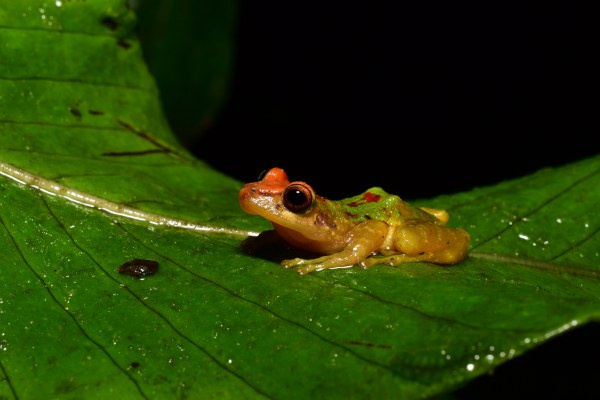
Lonely Rainfrog (Pristimantis eremites)
Lonely Rainfrog (Pristimantis eremites): This frog occurs at elevations of roughly 1700m – 2500m. The Bosque trail is the only place at Las Tangaras this frog could potentially be seen. However, to my knowledge it has not yet been sighted. However, a trip to Bellavista may prove successful. This photo was taken at the Bellavista lodge.

Fern-loving Rainfrog (Pristimantis pteridophilus)
Fern-loving Rainfrog (Pristimantis pteridophilus): “a nocturnal fern specialist” as described in the ‘Amphibians and Reptiles of Mindo’. Though the photo is not of this frog on a fern, these cryptic frogs have a preference for perching on ferns.
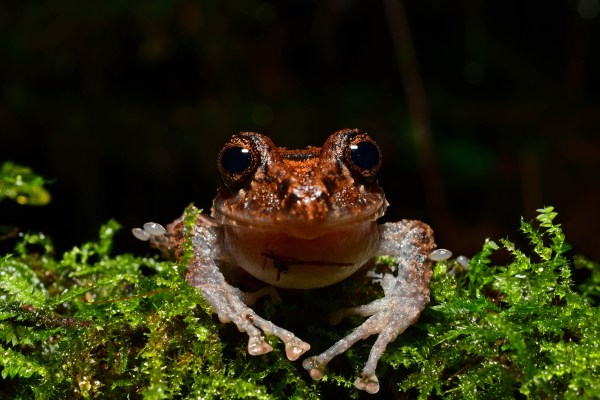
Spring Rainfrog (Pristimantis crenunguis)
Spring Rainfrog (Pristimantis crenunguis): The largest of all Mindoan Rainfrogs. Though it is an endangered species, the Spring Rainfrog is very common in the localized areas in which it occurs. To my knowledge this frog has not been seen a Las Tangaras, but is often sighted at our neighboring property. They have unforgettably unique vocalizations.
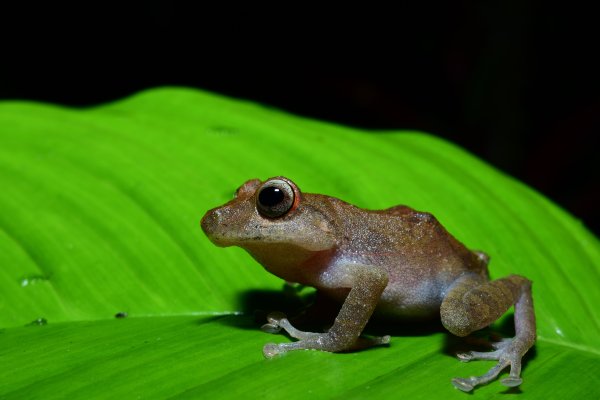
Watchful Rainfrog (Pristimantis nyctophylax)
Watchful Rainfrog (Pristimantis nyctophylax): An aptly named species seemingly for its big bulging eyes. These frogs are also commonly seen perched on low lying vegetation at night. This particular individual was rather fortuitous in our presence. Our head lamps attracted a good number of bugs and we witnessed this frog reach up and snag a large bug mid-flight. The hind toe pads kept this frog attached to the leaf.
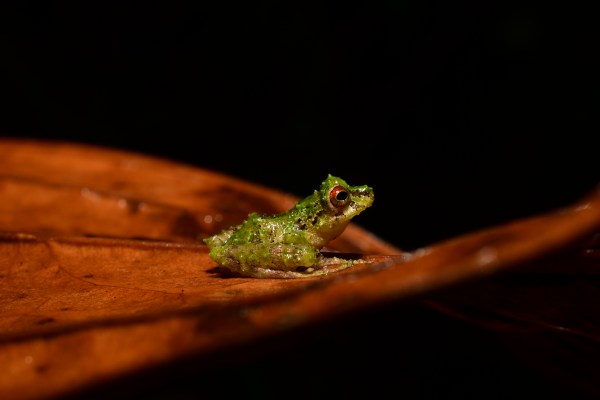
Blue-thighed Rainfrog (Pristimantis crucifer)
Blue-thighed Rainfrog (Pristimantis crucifer): Perhaps my most favorite. The piercing red eyes of this species are like nothing I have ever seen. These are secretive frogs, with no known vocalization. They inhabit the deep primary forests of the reserve, such as the Bosque Trail.
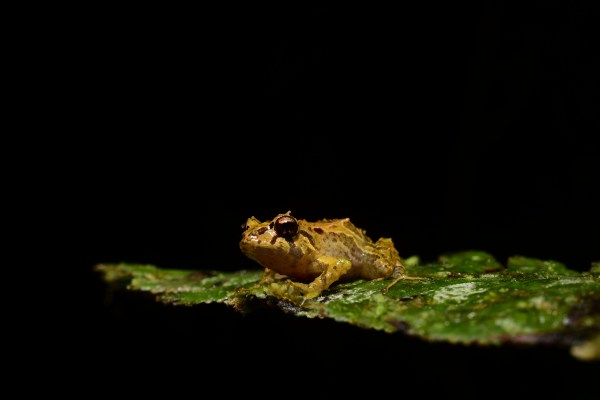
Mutable Rainfrog (Pristimantis mutabilis)
Mutable Rainfrog (Pristimantis mutabilis): This is a frog that has thrown everyone for a loop. This species was first collected in 2006. However it was challenging for herpetologists to determine whether it was a new species, or a morph of an existing species, for this frog has the ability to change its skin texture. The spiky looking structures (turbercles) covering the frog can vanish in a matter of minutes. So people would collect this frog in the field, and look at it in the lab and think they had accidentally collected a completely different frog. It was finally described as its own species in 2015 and is often referred to as the punk rock frog. Since its description, several other Rainfrogs have been found to have this ability
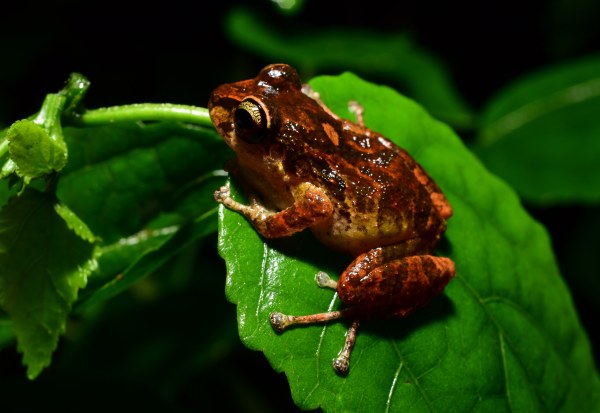
Mindo Rainfrog (Pristimantis mindo)
Mindo Rainfrog (Pristimantis mindo): A rather new species described in 2012. We hear this species calling frequently around Reserva Las Tangaras, but due to their highly arboreal and cryptic nature they are only seldomly seen. They were provided the species name ‘mindo’ after the anuran-diverse region they are endemic to.
…
So to conclude: frogs in the cloud forests of Ecuador are diverse! I have attempted to provide a framework as to why. Yet there certainly are many more reasons behind this diversity and it extends far beyond just amphibians. The birds are unlike anything I have encountered. The bugs are 10 times as plentiful and as colorful. The flowers.. well Juliana’s covered that. Mindo is an incredible place, and Juliana and I both have seen so much and learned far more than we could have expected.
And now, it’s time to move on for us. We will miss Reserva las Tangaras and all its inhabitants (especially the Hummingbirds) tremendously, but we are forever grateful for this experience and will never forget it for the rest of our days. Do yourselves a favor and come visit so yous can get a taste of what we’re raving about!
Ciao for now, Reserva las Tangaras!
Orchid Citations:
10. https://raincoastorchids.com/unique-orchid-species/
11.https://www.ctu.edu.vn/~dvxe/Hoa%20Lan/Doc%20on%20web/Orchid%20Anatomy.htm
12.http://staugorchidsociety.org/PDF/OrchidPlantPartandWhyTheyMatterbySueBottom.pdf
13.http://goorchids.northamericanorchidcenter.org/species/tipularia/discolor/
14. http://www.bbc.com/earth/story/20150202-three-ways-orchids-trick-insects
15. https://www.livescience.com/830-bizarre-sex-life-orchid.html
16. http://edis.ifas.ufl.edu/ep521
17. https://excelsior.asc.ohio-state.edu/~rothacker/Rothackers_orchid_pages/Fungi_and_orchids.html
Frog Citations:
- This transformation can be initiated by a number of factors. And as they get older, or as food in the environment decreases, or as predation increases, or for whatever reason (WILBUR COLLINS model, 1973)
- Some amphibians even return to the water for a third life stage such as Notophthalmus viridescens
- Gomez-Mestre et al.
- Yes that is the actual common name of this frog. The entomology of the species name ‘carnifex’ translates to hangman. This is in relation to herpetologist John Lynch, who collected many of the early specimens leading to the description of this species. I believe common name is in relation to this as well.
- Gomez-Mestre et al.
- darwinwallacei may carry their young to suitable water holes. However, if food is scarce the tadpoles will often consume each other. Best parent award, yes, but best sibling? I don’t think so.
- Though I have laid this post out in a seemingly flawless transitional sequence, it turns out direct development in frogs did not evolve from frogs more prone to laying their eggs on land and taking their tadpoles to the water. Rather, taxonomical research suggest this form of development evolved from the ‘traditional’ method of laying eggs in the water. Gomez-Mestre et al.
- https://www.sdbcore.org/object?ObjectID=316
- I speculate this work-around could only work in the tropics. The closer to the equator, the less fluctuation in photoperiods and temperatures. Animals outside of the tropics are required to cope with an array of weather conditions, thus restrictions would be tough to impose. Adults would feed during the winter days because they would match the summer nights, and vice versa for juveniles. Even though there is a clear divide between activity periods in adult and juvenile Rainfrogs, this is not collectively agreed upon. If there is food to be eaten and you can eat it, you do. That is life.
- S. BLAIR HEDGES et al. New World direct-developing frogs (Anura: Terrarana): Molecular phylogeny, classification, biogeog- raphy, and conservation
Walk on the Wildside
 If you’re not coming to Las Tangaras to see these guys (Andean Cocks-of-the-rock), you might be wondering what else the reserve has to offer. We’ll be the first to tell you, A LOT.
There’s birds, bugs, herps, orchids, bromeliads, ferns (tree ferns!), swimming holes, camping, colibres, mammiferos, fungi, and the list could endlessly go on if we don’t stop ourselves now.
You can enjoy ALL of the above listed things (and more) by taking a trip down one of Las Tangaras’ 10 hiking trails. Each trail is different in its own right, whether that be flora and fauna frequencies, elevation, difficulty, length, etc etc.
To give you a better understanding of the reserve and what wonders you can enjoy here, we’re gonna break down each trail for you and show ya some pictures, too!
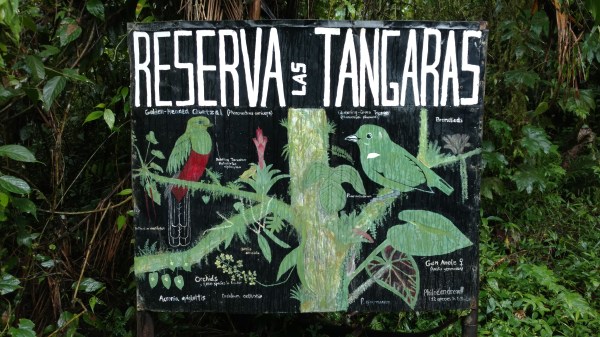
Entrada Trail (Entrance):
Travel Time 45 minutes
Distance 2.0 km
Elevation minimum 1340 m – maximum 1515 m
This trail is the FIRST impression someone gets of Las Tangaras, but it’s misleading. Your initial vista views are of cleared farmland, which isn’t Las Tangaras at ALL. Since our reserve is located on the far side of the Nambillo river, you’ve gotta trek through other properties to get there. The trail cuts through farms and a patch of cloud forest owned by another reserve. Its status as a share trail (meaning it’s used by the owners of the farms and their mules) means this trail gets the most traffic and as such, gets the most muddy (especially in the rainy season). It’s best to wear boots on this trail and if its your first time ‘mud skiing’, be sure to take it slow.
As you make your way to the reserve, don’t forget to look up! On a clear day, the views of the forested mountains are spectacular and you might even see toucans flying along the canopy. Make sure to scan for mudslide scars. Brown scars are fresh (mud), green are old (new plants).
About 30 minutes into your walk on the Entrada trail, you’ll begin to notice a roaring sound growing ever louder. This is the Nambillo river and it is your final obstacle to get to the reserve. Don’t worry, we’ve made it easy by building and maintaining a hanging bridge.
As soon as you start hearing the river, you’ll begin your descent through a Club-winged Manakin Lek, an onslaught of Darwin Wallace Poison Frogs, and Crested Guan resting trees. The rushing river ruido (noise) means you’re close to the lodge.
Of all the trails, we are most familiar with this, simply because it is our lifeline to all things modern. It’s muddy, it’s grassy, and pock marked by mule prints, but at its end, after you catch wind of the Nambillo river and cross it to the reserve, it becomes cloud forest lushary.
Los Patos (ducks), Los Colibres (hummingbirds), y Tres Tazas (three cups):
Total Travel Time 25 Minutes
Total Distance 0.60 km
Elevation minimum 1335 m – maximum 1370 m
These three short trails join up to make one long trail, but each has its own characteristics.
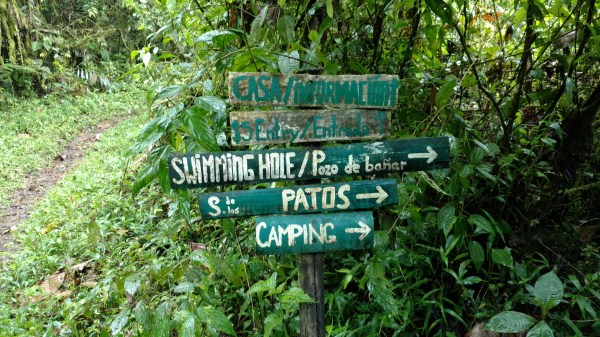
Los Patos: This is one of our easiest trails and we frequently suggest it to those looking for a quick jaunt through the reserve. It’s also one of our favorites to stroll after sunset as there’s plenty of Emerald Glass frogs to go around.
Los Patos is a low trail (by comparison), because it runs alongside the river. You are never out of range of its roaring and almost never out of sight of the river. It starts with a duck (pun not intended) under a fallen tree trunk covered in bromeliads, orchids, ferns, mosses, lichens, and bladderworts. Though they’re a pain to manage, fallen trees lend a sneak peak into the going ons of the canopy (orchid photos, mosses, etc).
At night, you can often hear Emerald Glassfrogs as they call to each other over the rush of the raging river. During the day, Darwin Wallace frogs are often heard and seen moving in and out of the leaf litter. There’s a camp site and a swimming hole (Playa de las Ranas aka Frog Beach). Depending on the river level, you can enjoy some great rock hunting at the beach, maybe see Basilisks basking and running on water, and find orchids in the trees along the trail.
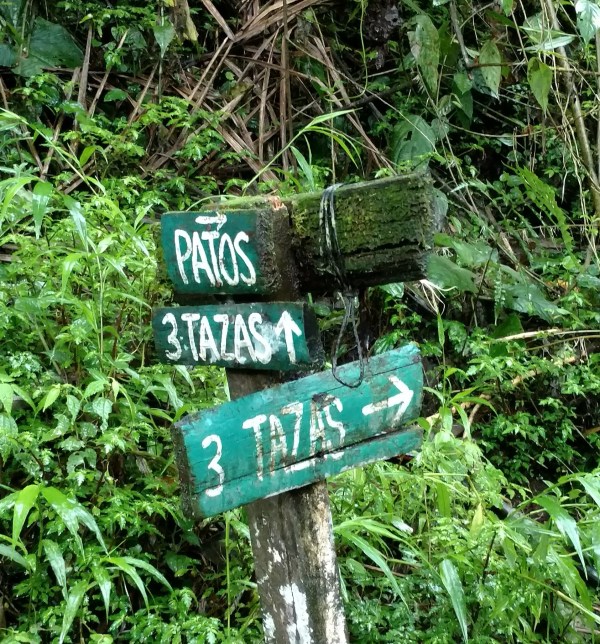
Tres Tazas: This trail is an offshoot from Los Patos. It dead ends at a stream that eventually meets the Nambillo River. At one point in time, it ended at a swimming hole, but the ever failing foliage has filled that area in. This trail doesn’t seem to be the most frequented, despite it’s proximity to one of our most often suggested trails, but it’s got a lot to offer. You must pass through one creek (now several creeks due to the amount of rain we’ve had…), duck under Angel Trumpet shrubs, watch out for Babbling torrenters, and look for hanging heliconia flowers.
As mentioned, a portion of the trail is in a shallow stream and much of it is muddy, so keep those rubber boots on while you search its subtle wonders.
Los Colibres: While the Los Patos and Tres Tazas trails are largely flat, the Colibres trail takes a sharp incline up to the elevation of the lodge, leading you away from the river. The staircase is beautiful and covered in the types of plants often found in hobbyists’ terrariums.
This trail is short and sweet, but it sheds a lot of light on the daily (nightly) going ons of the cloud forest. Animal tracks litter the trail. We’ve found evidence of Red-brocket Deer, Jaguarundi, Coatis, Agoutis, and white-faced possum on this trail. We think the animals like to use it to get to the river and given the amount of mud in the area, they usually leave a trail for us to follow.
Colibres ends at the lodge, bringing the LosPatos/TresTazas/Colibres loop to an end.
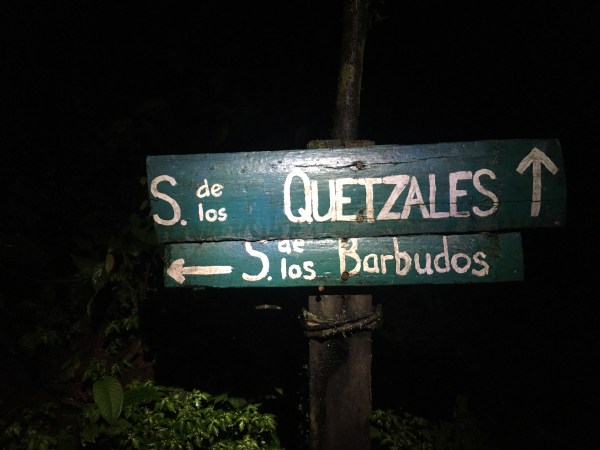
Quetzales Trail (Quetzals): Travel time 40 minutes
Total Distance 1 km
Elevation minimum 1330 m – maximum 1440 m
Quetzales trail is the “popular kid” of the reserve. It’s one of our most frequently suggested trails for tourists looking for a hike longer than 20 minutes.
Quetzales takes you up into the mountain and brings you back down again in a horseshoe. It features beautiful root staircases (courtesy of the trees), a variety of flora communities, canopy-level views (bird nerd alert!), several small streams you must cross (herp nerd alert!), and one small mudslide sight (Geo nerd alert!). It’s here, as you climb over the wide trunk to continue your hike, that you really begin to understand the ins and outs of the cloud forest.
The Quetzales represents both the light and dark side of the cloud forest. It’s the perfect trail for all hiking skill levels and takes up just the right amount of time to get you back to town again before nightfall.
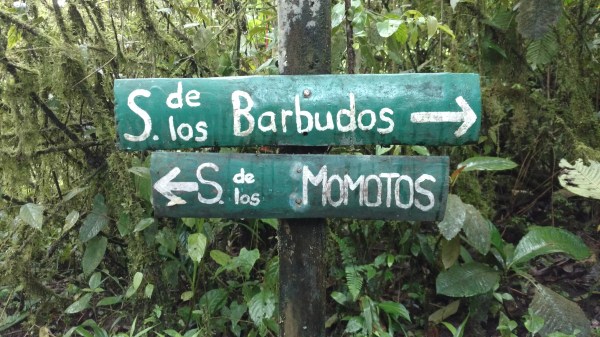
Barbudos Trail (Bearded): Total Travel Time 20 Minutes
Total Distance 0.4 km
Elevation minimum 1350 m – maximum 1470 m
Barbudos is a “stepping stone” trail. As in, you must use it to connect to other trails. It’s entirely up hill (one way, at least) and connects hikers to the Bosque and Tucanes trails.
Barbudos is incredibly different from any other trail on the reserve. It’s canopy-less and made of clay, which does make it a tad bit slippery, despite the amazing staircases built by previous managers. Given the lack of shade, there are gads of colonizing shrubs taking over the area and plenty of sun-loving organisms (i.e. bugs) to gaze at. (Seriously, though, if you haven’t taken the time to look at the bugs in the cloud forest, you are really missing out.)
Though it’s a lot of work in a short amount of time, the view from the top and halfway points of the Barbudos trail are simply lovely, even if the clouds are sitting low (typically happening). One can almost always appreciate the cloud forest for its cloud-covered mountains here and we’ve even been fortunate enough to see a rainbow. It’s also where the sun first hits the trees early in the morning, meaning lots of tanagers to look at (just as colorful as the bugs).
We don’t typically suggest this trail on its own, it’s a package deal. And if you’re going on an ACOR tour, you gotta put up with it, because it’s your ticket to the Bosque trail.

Bosque Trail (Forest): Travel Time 2 hour
Total Distance 1.4 km
Elevation minimum 1470 m – maximum 1800 m
The Bosque trail is like the kindly, wise old woman that lives a few doors down from you, but don’t you EVER cross her, because she can be a real tough lady.
The Bosque features lots of primary growth forest (you can find it on other trails, but this is the best place to experience it). It is laden with laenas, bromeliads, orchids, mosses, fungus, lichen, etc which, simply put, means it’s really stinking green, like a forest wonderland. It is always, ALWAYS wet because it is pretty much always in the clouds. The higher you climb, the more frequent the drops, even if it isn’t raining.
The Bosque dead ends at a clearing through which you *COULD* see a view of the surrounding mountains if it weren’t for the clouds. We’ve yet to enjoy that experience…
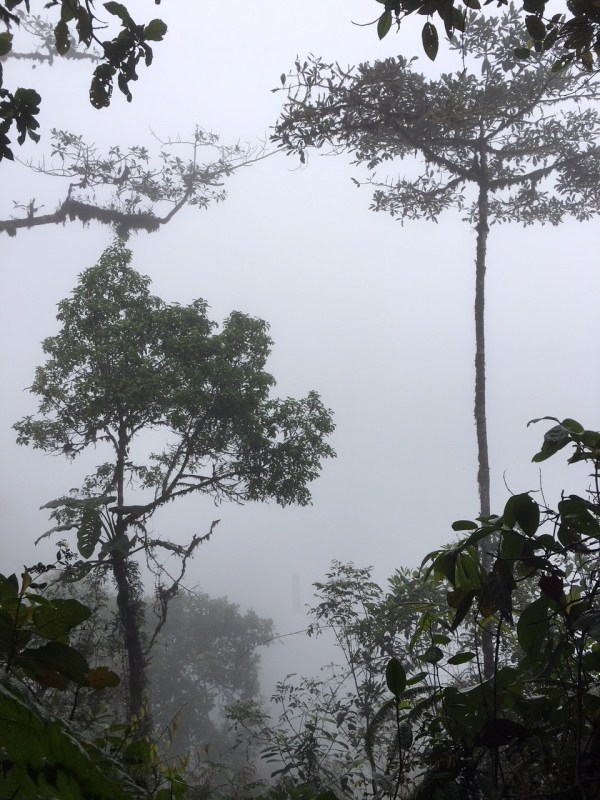
But, lower on the trail, we do sometimes get lucky enough to see the views. And if you’re willing, it’s a great place to enjoy the sunset on a clear evening.


The Bosque trail is best known for the ACOR lek (Andean Cock of the Rock mating site). The ACORs come to the same spot every day, twice a day, to get it on. The males form small groups and try to attract females by harshly crying, clumsily flying, and showing off their florescent red plumage.
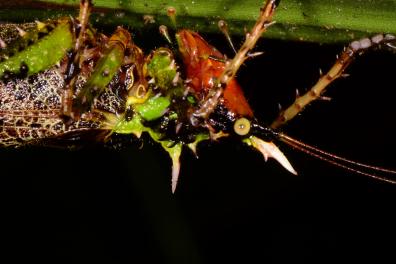
Spiny Devil Katydid discovered in the night on the Bosque trail
The trail is less well known for its nightlife, but equally as notable. This is where we frequently go when exploring the dark side of the reserve. Anything from delicate, beautiful orchids to tough, spiky katydids can be discovered here. It’s also where we’ve most frequently encountered lizards, rainfrogs, and mammals (including the jaguarundi and capuchin!).
If you decide to do this trail, be prepared to work hard in some areas, as it’s mostly up hill. It’s not easy, but it’s truly worth it. The Bosque is a beautiful slice of life in the cloud forest and a shining gem in the Las Tanagaras crown.
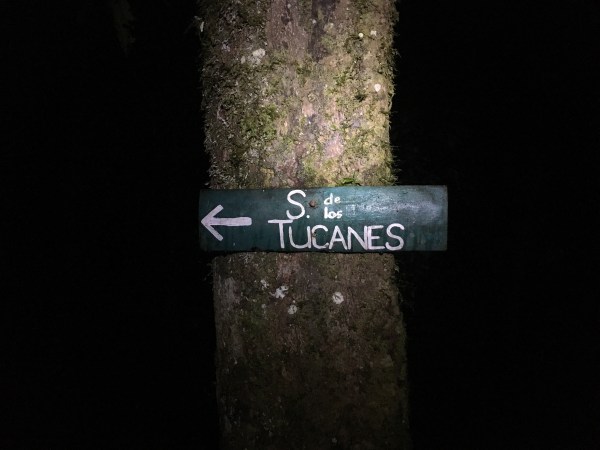
Tucanes Trail (Toucans): Travel Time, 20 minutes.
Total Distance 0.5 km
Elevation minimum 1425 m – maximum 1470 m
The Tucanes trail is a short trail that also leads you in a horseshoe, but takes you down and then up again (opposite of the Quetzales trail). It rests on the downward slope of the mountain that pushes towards the river which slices around the property. It’s lush, filled with low lying plants, and wet. Because of it’s proximity to both the river and a sunny, canopy-less spot on the reserve, you can almost always run into mixed flocks here. Tune in for bird chatter and have fun!
Cascades Trail (waterfalls): Travel Time 15 minutes
Total Distance .4 km
The Cascades trail is a brand new trail that hasn’t even made it on the maps yet. Granted, it’s still a work in progress, but the novel thing about the Cascades trail is that it ends at a waterfall. Definitely wear your boots, though, because where there’s a waterfall there’s water, and where there’s water, there’s mud.
Motmotos Trail (Motmots): Travel Time TBD
Total Distance TBD
Elevation minimum 1357 m – maximum 1455 m
This is probably our favorite trail and we can’t even share it with guests because it’s currently closed (should be opened again within two weeks tops, though!)
When we aren’t in town and aren’t at the lodge, we are most likely at the Motmotos trail working on our main project, a reroute. The motmotos has got problems, y’all, but we love it and it’s recovering.
Motmotos has got it all! Intrigue, daring, innovation, romance (maybe?)! It features the widest variety of micro-ecosystems of the cloud forest. Walking this trail takes you through recovering mudslide zone (no canopy), a fresh water wetland (in the rainy season), a small canyon (you could call it that), a reforestation zone, over a ridge and back down again, along the river (both above and next to), and through lush, green riverside forest. You can never get tired of the scenery on the Motmotos trail because it doesn’t stay the same for long.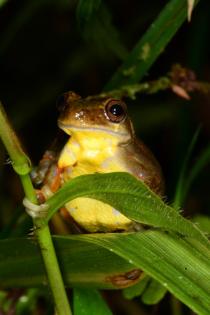
It also features views of the mountain tops looming overhead and not one, not two, but three swimming holes. One of which is the most divine place on this planet. Seriously. Stop whatever you are doing and do everything you can to get here and see it. When we first happened upon it, we were both awe-stricken. Our reroute, of course, does not prevent visitors from experiencing the joy of this secluded, waterfall swimming hole.
Since the Motmotos has a variety of transitions through ecosystems (which inevitably means altitudinal ups and downs), it’s one of our harder trails, ranking up there with the Bosque. But like the Bosque, it is so worth it.
The reason it is currently closed is because we are working on rerouting the trail around a mudslide that happened a little over a year ago. The slide completely wiped out a portion of the trail, but c’est la vie in the cloud forest.
We can’t wait for this trail to be finished because when it is, it will be our TOP recommendation to visitors as a must see area of the reserve.
So there you have it. There are our 10 babies we tediously look after. And even though you’re not supposed to have favorites..we do (can you tell?), so maybe you should just visit us and come to your own conclusions?
Rainy Seasoned

Hi! We’re Juliana and Jake, the first managers at Las Tangaras for the new year (2018). During our stay, we will regale y’all with tales from the trails on a regular basis. Here is the first installment:
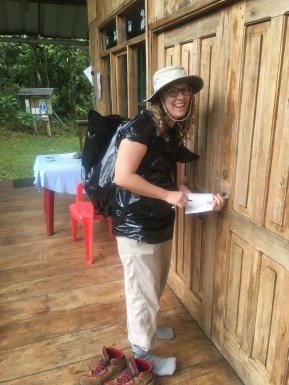
Before our baggage arrived, we used garbage bags. . .
“It’ll be the rainy season,” we were told when we applied for this job. “Prepare to be wet all the time. Bring lots of desiccant!” And we did. We prepared by packing rain jackets, pants, ponchos, desiccant tins, Epsom salts to make desiccant, and plenty of plastic bags to protect our things. However, due to a delay in receiving our luggage, we sometimes, very rarely, had to make due with more rudimentary measures during our first week here….
But, for the first several days of our stay, the Cloud Forest was anything BUT rainy. The sun was shining, the ground was dry and sandy, we were sweaty every where we went. Heck, we could get our laundry to dry in a day or less in the warm sunshine and soft breezes.
Four days into our stay, though, and things changed dramatically.
During our third night here, it poured harder than I’ve (Juliana) ever experienced and I lived through a reported 1000 year rain! Have you ever felt like the river in your front yard was rerouted during the night to flow directly over the roof of your room? I have. It was loud, it was hard to sleep through, and by god, I don’t think there were any individual “drops” in that downpour. I think it was one massive wash of water.
The next morning, we checked our rain gauge. It’d rained over an inch in the night and would continue to rain over an inch during the day.
We also checked the river. It was now raging.


And our bridge, it was still standing (or..hanging). And our trails, they were…well..needed some work. Trees and plants are constantly falling here, it’s the way of the wood.
So what is the Cloud Forest anyway? And why is it so wet?
The Cloud Forest is exactly as it sounds, mountainous forest that is constantly enshrouded in clouds. The trees here harbor many mosses, epiphytes, and lichens due to the constantly moist nature of the air. Even when it’s not raining, you will hear water drip-dropping all the live-long day in the Cloud Forest. This is because the trees and their communities of flora collect the moisture from the air and reroute them to the ground in what we like to call “dew form”. You’ll often see leaves turning over from the weight of the water they hold and bugs hiding beneath the leaves to stay dry. The Cloud Forest isn’t always rainy, though. This depends on the seasons, of which there are only two: wet and dry.
Wet season occurs during the summer here (jan – may). There aren’t four seasons like we have back home, because the sun is directly overhead here at the equator, so the amount of sun received is relatively constant throughout the year. So instead of spring, summer, fall, winter, you get wet and dry. It all has to do with the relationship between land and sea and the wind created by this relationship. During the summer, the land heats up faster than the ocean, which means the cool air over the ocean blows landward, hits the mountains here (Andes), and is forced up. Once up in the mountains, all of the moisture collected along the way rains back down in the Cloud Forest (or drips, or torrents, whichever). The rain is relatively predictable, happening in the afternoon between 1 to 3 and usually dwindling by nightfall, but not always as the last few nights have seen.
During the day rains, we used feel trapped inside or to our porch. We’ve since adapted and can be found out an about, like the animals, during the rain. The animals don’t seem to mind the rain. We’ve seen Guans hiding under the massive leaves of the “Poor Man’s Umbrella Tree”. And the hummingbirds continue to visit our feeders as madly as ever. The nights, though. That’s when the getting is good for fauna during the rainy season.
Recently, most of our explorations happen after sunset, when the forest comes alive with different sounds: amphibians and bugs for days (or..nights?), y’all. Here are some of the buddies we’ve encountered during our night walks.


We’ve also had the good fortune of having not one, but two locally renowned herpetologists walk with us and show us the ropes of herping in the Cloud Forest: Jaime (a contributor to the actual book on herps of Mindo) and Eric (basically our neighbor!). Here is a smattering of the organisms we found while romping around with them:


Some learnings on Cloud Forest Frogs:
The most abundant group of amphibians in Ecuador (and subsequently night time noise makers) are rainfrogs. Yep, they are actually called “rainfrogs”. We have the privilege of hearing hundreds of the Pastures and Yellow-groined Rainfrogs outside our house every night. As we move up into the cloud forest via one of our trails (aptly named the Bosque Trail), higher in elevation, we can run into the rarer Bashful Rainfrog, Blue-thighed Rainfrog, and the Mindo Rainfrog— a recently described species appropriately named after this biodiverse region.
Unlike most other families of frogs, rainfrogs undergo direct development—they skip the tadpole phase. This definitely makes sense in a mountainous cloud forest where standing, still water is hard to come by. There are other unique development behaviors, such as that of the Darwin-wallace poison frog. We caught a glimpse of this frog hiking one of the reserve trails (Tres Tazas) and can hear bunches of them on the walk in. The adult females of this poison frog carry the tadpoles on their moist back until and drop them into a small, slow moving stream. Food can be scarce in these moving bodies of water, so these tadpoles have been known to be cannibalistic.
However, there are certainly frogs here who do adhere to the teachings of the United-statesinized science textbooks. Frogs who lay eggs on vegetation (leaves) next to rivers. The adults say, “Peace, babies! I’m out of here.” When the eggs hatch, the tadpoles fall into the river and find their way to the very bottom where the water moves slower. The tadpoles sit and eat other larvae they can find and, well… you know the rest. One of these frogs is the Emerald Glassfrog, a must see for us while in Ecuador. Knowing we wanted more than anything to gently squish their little, see-through (glass), froggy bellies, our herpetologist friends were able to show us right where to find them: next to the river, the one that sometimes reroutes to flow right above our heads.
Bonus Photo of Jake and Jaime (the herp guide) making froggy photo magic with our first guests:
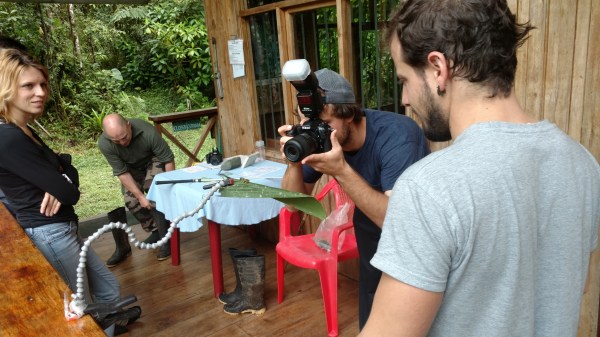
Taking photos of the Emerald Glassfrog. Jaime is in the gray shirt, Jake is taking photos.
Feliz 2018! Happy Birding at Las Tangaras
Thanks to 9 super-enthusiastic volunteers and our Ecuadorian staff we had a very successful avian monitoring project at Reserva las Tangaras in December. We recorded 173 bird species during our two-week expedition and netted 419 birds of 71 species. Volunteers also learned how to use Hall traps to net hummingbirds, make hummingbird bands, and band the little gems. We all participated in the Mindo Christmas Bird Count and racked up 104 species for the count.


December 2017 Life Net Nature Avian Monitoring Expedition: Team and Support Staff at Reserva Las Tangaras research lodge


