A Day at the Reserve
Three months have passed in what seems like the blink of an eye. We arrived at Reserva Las Tangaras in the middle of July, full of enthusiasm and expectation and still a little relieved to have made it here at all given the ongoing pandemic which, as I type, seems to have the whole of Europe gripped in a second wave of rising cases.
Here in Ecuador things seem to be getting better due I’m sure in no small part to the way the countries population have adhered to the government’s containment and prevention measures. Only now are we starting to see a few unmasked people walking the streets as the government updates it’s advice, but every business be it a shop, restaurant or bank still insist on masks being worn and hands being sanitised upon entry. Everybody is treated equally, and I think the population accept that measures such as these, coupled with social distancing and limits on the number of people gathering in one place have helped reduce the spread of infection.
As the Covid-19 situation improves here we are hopeful that international tourists will soon start to return to the area. Mindo is relatively isolated yet easily reached from the capital, Quito. The town and surrounding area has so much to offer the inquisitive traveller – it’s possible to ride a cable car to take in some of the amazing views, visit waterfalls and ride the river rapids in a rubber ring. Food and cultural experiences are plentiful and of course you can come and stay at the reserve or just visit for a day and let the peace and tranquillity of nature surround you.
Ideally placed on the edge of the Mindo-Nambillo protected forest, the 50 hectare reserve is perfect for visitors who want to get in to the heart of the Ecuadorian cloud forest and see some of the amazing fauna and flora that help make Ecuador one of the most biodiverse countries on the planet. More than 15 species of hummingbird are virtually guaranteed and in 13 short weeks our patience and I’m sure a small amount of luck has been rewarded with sightings of Puma, Capuchin Monkey, Coati, Agouti, Rainbow Forest Racer snakes, Andean Cock-of-the-Rock and too many other animals to list…

We’ve started to settle into a routine here and have a weekly schedule of work that sees us tackle jobs ranging from bridge repairs and trail clearing through to creating marketing material and hosting guests. There are tasks we like and there are tasks we like less but if we had to describe an ideal day this is what it would look like.
The day would start early, we set our alarm for 04:50 as this is the time you have to roll out of bed if you want a front row seat at the sunrise Andean Cock-of-the-Rock lek display. It’s a 20-minute hike uphill from the cabin to the lek site and but the headtorch illuminated walk is well worth it. There’s always the chance you’ll catch the eyeshine of a tree dwelling mammal like a kinkajou on the way up but even if you don’t, being on the ridge of the hill as the suns first rays emerge and bring the forests birdlife in to song is reward enough.
As the rising sun pushes back the nights darkness the stars of the show start to arrive. The calls begin off in the distance but before long you can make out the unmistakeable silhouettes of the Andean Cock-of-the-Rock males gathering on their favourite perches. Almost immediately the show begins as each male starts his display in order to catch the eye of any visiting female.
It’s quite a sight to behold, the lek can attract in excess of 12 birds and between the calling and the dancing you don’t know which direction to point the binoculars or camera. Often, I find myself taking a step back and just trying to take in the whole spectacle.
When a female arrives, things go up a gear, the noise amplifies and displays become more energetic. Having observed many of these morning spectacles there’s no mistaking the moment a female bird is on the scene, but she doesn’t usually take long to make her choice and as quickly as she arrived, she’s gone and the urgency amongst remaining males subsides.
In total the morning performance can last anywhere between 40 minutes and an hour and a half although the main group has usually dispersed by 07:00.
For me the drop in activity signals the time to return to the cabin. This time in the morning is often the best for bird watching and the 20-minute journey back down the hill can often take an hour or more as there are so many opportunities to observe birds feeding and going about their early morning routines. The forest feels alive with activity from floor to canopy.
Once back at the cabin a hearty breakfast is in order, an additional reward for the early start – on an ideal day it would consist of a stack of fluffy banana pancakes or a couple of slices of still warm French toast, drizzled with some local honey or served with a side of spiced apple compote – all washed down with a strong cup of café pasado.
With breakfast out of the way and a renewed spring in the step it’s time to set-out and collect the camera traps. Often placed in remote and quiet corners of the reserve the camera traps act as an ever vigilant pair of eyes, keeping track of any goings-on day and night. With the traps in hand is back to base to see what activity has been captured. It’s always an exciting moment, placing the SD card in the computer as hope is high for a fleeting glimpse of one of the reserves more elusive inhabitants. Maybe today is the day we finally get that shot of the Puma or the Jaguarundi but to be honest, we’re always happy with whatever turns up!
Now the real work starts and it’s out into the reserve proper with machete and saw in hand to do some trail maintenance. The forest is a dynamic place and without regular attention the trails would soon be reclaimed, and visitors would not find it so easy to explore. Heavy rains and high winds can easily bring down tree limbs already burdened with the weight of creeping vines or bromeliads. Even for a couple of active stewards like ourselves it’s not possible, or sensible to try and tackle more than one trail a day but a couple of hours of intense grooming with the machete works up a good sweat and is usually enough to get the job done.
By now it’s early afternoon and with so much already achieved and the sun high in the sky it’s time to down tools and head to the river for a revitalising dip in the crisp and clear waters of the Nambillo.

At the reserve we’re lucky enough to have a couple of safe swimming holes that have been created in back eddies of the swift flowing water and a few moments spent washing away the mornings hard work are enough to remind you that lunch is long overdue.
You might think that the reserves’ isolated location and lack of fridge would restrict the menu but it’s quite the opposite. It’s been said that limited options encourage creativity and we have certainly found this to be true. Our repertoire of dishes has increased, and we are using ingredients that we might have previously ignored, especially dried beans and pulses and fruits and vegetables that you would not find on the shelves of a UK supermarket.
After a good lunch it’s time to turn our attention to data collection. We make a daily survey of the hummingbirds that visit the cabins’ 3 feeders and note down information the number of species we observe, the number of individual birds and their gender split. This is always a special moment in the day as it’s a period of intense bird activity and it’s possible to watch up to 23 species flit form feeder to feeder jostling for their position on one of the plastic flowers. Their reward is a sip of diluted sugar mix which we make for them daily.
Once the survey is complete the days work is done. Now it’s time to relax with a good book selected from the cabins’ small library and read through to the light fails. Days are regular here, close to the equator. The sun rises at 06:00 and sets at 18:00, give or take 10 minutes and the darkness creeps back as quickly as it was chased away by the sun in the morning.
The LED lights come on and we turn our attention to dinner. This is as exciting an event as lunch and after 3-months we still approach the cooker with a sense of enthusiasm.
The perfect day is topped-off with a well earned glass of homemade ginger beer and a game of cards (which I always win) and it’s not long before bed is calling and thoughts start to drift to what exciting adventures tomorrow will bring…
It’s what you don’t see…
The title is a bit misleading as you can actually see a lot of what you don’t see if you’re looking (and listening) carefully…
I’m new to the jungle, not just in terms of this trip but in terms of life experience. I’ve done a ‘Jungle trek’ once from Rio de Janeiro which consisted of a 2 hour jeep ride in to what appeared to be a large expanse of jungle behind the vast city of Rio and then what a brisk hike to a very picturesque waterfall for a bit of splashing around followed by a brisk hike back to the jeep. There was not a lot of time to dwell on the surrounding fauna and flora, but as a group we were lucky enough to come across a large wasp stinging a tarantula to death in order to lay it’s eggs (so we were told by the guide). Other than this brief experience and the vast array of documentaries I’ve watched on TV over the years I built myself a preconceived idea of what jungle life was going to be like!!
How wrong I was. First of all, I’m not living in just any jungle, I’m living in tropical montane cloud forest and secondly, the jungle fauna is not just hanging around waiting to be seen but if you use your eyes and ears, you’re patient and you’re careful where you put your feet, the jungle inhabitants will reveal themselves to you.
Let’s take mud, not a thing one gets terribly excited about, but in a tropical montane cloud forest (in July and August) there’s plenty of it around as rain is common. It didn’t take long to start noticing that amongst my own muddy footprints there were signs of what had passed before me.
It must already be clear that I’m not a biologist, so you’ll understand that coming across sets of muddy animal prints didn’t immediately trigger a process of animal track recognition from a university course that I didn’t do. However, I am a mobile phone user and through the power of technology I managed to take pictures that I hoped would help identify my unseen jungle companions when I got back to the lodge. Even with its small library of reference books, identifying animals from their tracks is not as easy as it sounds but the images I took were enough to narrow the owner down to family and in some cases individual species. What was especially useful was having the camera traps set to confirm that we weren’t seeing Paca, Red Brocket Deer and Agouti.
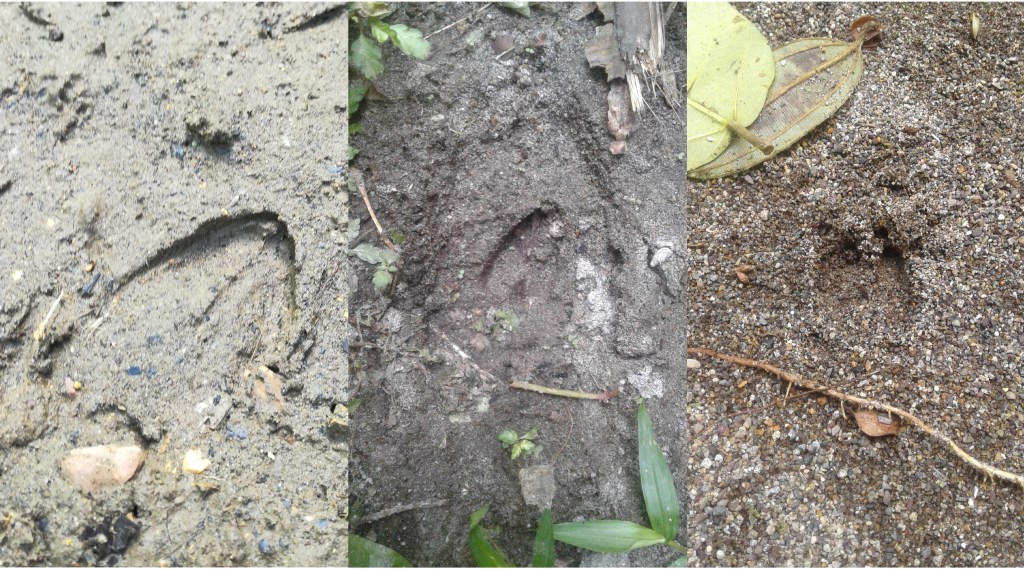
The next clue to the existence of animals we weren’t seeing was also a visual one, they leave behind droppings. What is consumed at one end is in part excreted at the other…
Although we’re not seeing a lot of animal faeces, what we are seeing points to the existence of small carnivores. In the two samples I’ve managed to picture, both have been relatively compact and there is clear evidence of fur.
Not long after arriving at the reserve we were lucky enough to see the rear end of a puma disappearing into the jungle but just the size of this cat rules it out as the owner of the droppings. We have also captured both Tayra and Jaguarundi on our camera traps so either of these could be the owners but there are also reports of Ocelot and Margay on and around the reserve so it’s a possibility either of these cats could be responsible.
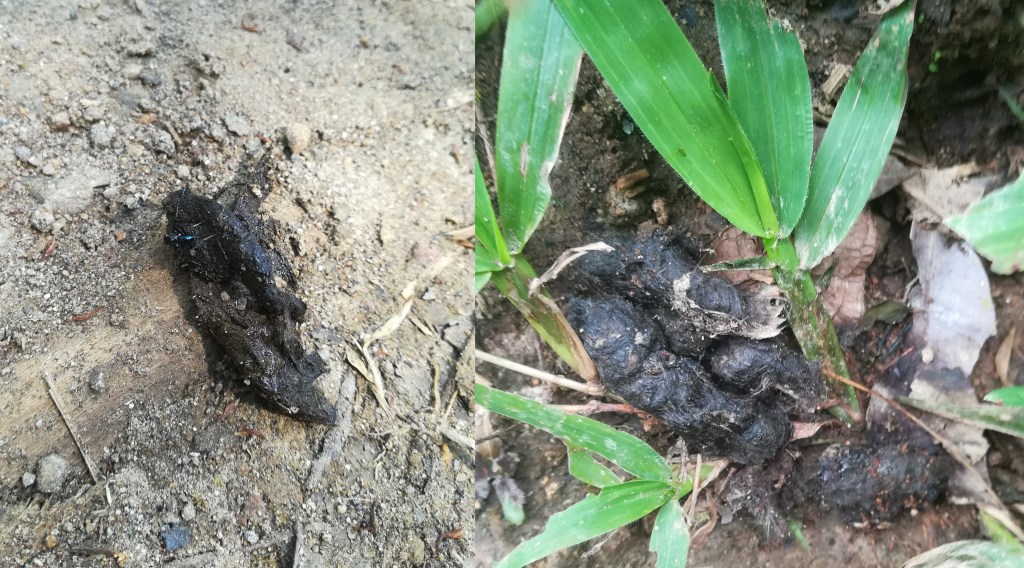
The last piece of evidence for the existence of unseen jungle companions is sound.
On more than one occasion, and once night has fallen, we have heard strange sounds coming from around the lodge. A torch lit inspection has failed to yield any results, but the loud snuffling suggests a foraging armadillo.
In the early morning, just after sunrise and towards dusk, the air is often filled with the sound of bird song. Spotting birds is easy in the jungle, they’re all around but if you only use your eyes for identification then you’re just scraping the surface of what’s out there. There are some obvious calls, like the Andean-cock-of-the-rock and the Choco toucan but if you listen carefully you might pick out the staccato pipping of an ornate flycatcher or the mocking chuckle of a well-hidden quetzal. There are some really good mobile apps to help with the identification of birds by their call and although in the 8 weeks we’ve been here we’ve spotted over 70 different species we know that we’ve got a long way to go to hear, and hopefully see more of the 300+ species we know inhabit the reserve.
The onset of another tropical shower or the arrival of dusk signals the jungles many species of frog to begin their ritual calling. Pastures rainfrogs, emerald glassfrogs and yellow-groined rainfrogs can be seen and heard easily enough but a keen and experienced eye is needed to spot many of the other species that are hidden in the leaf litter or up in the trees.
At night rarer species like the Mindo rainfrog can be heard calling from up in the trees and on our Tres Tazas trail we have been teased by the sound of the Darwin Wallace poison-frog but have yet to find our first specimen.
The failing light of dusk also gives confidence to the millions of insects that inhabit the jungle. From roots to treetops the sound begins to build as individuals call-out to attract a mate. Crickets and katydids do battle for who can shout the loudest and although you can’t always see them you know you’re not alone…
Reserva Las Tangaras is a home to hundreds of different species of birds, mammals, reptiles, amphibians, bugs and fish. It would be impossible to see them all, or even get close to it even with an extended stay but it’s reassuring to know that there are clues left all over the reserve to help you see what you don’t see!
Jungle Nights
I woke up during the night a couple of weeks ago to find that a cloud had settled on the lodge. Living in the montane cloud forest, we regularly find ourselves above clouds or even in them depending on the weather conditions. That night, the conditions must have been exactly right to have the cloud at precisely the level of the lodge. The close-to-full moon was lighting up the cloud making it glow and give the lodge an ethereal quality. As if to complete the eerie and magical scene, fireflies flashing red and green were hovering lazily above the mist.
It reminded me how special the jungle is at night. It’s something many people don’t choose to experience or even actively avoid. I imagined the first time I entered the forest at night, that it would be a stressful experience of wandering through creepy, quiet darkness with the vague feeling that you are being watched by something that you cannot see. I was wrong for the most part. First of all, the rainforest at night is LOUD. The chorus of birds heard throughout the day is replaced by an equally enthusiastic chorus of insects and frogs. While indeed the remote forest is dark, the darkness can have its benefits. Since the Las Tangaras reserve is far away from the artificial lights of inhabited areas, there is no light pollution to mask the starlight. If you are walking in Las Tangaras on a clear night, it is well worth turning off your head torch and looking up to see a sky full of more stars than you are likely to have ever seen. As for the feeling of being watched…well you probably are, but this is true in the daytime too and the vast majority of creatures in the forest would much rather slip quietly away from you than risk any confrontation.
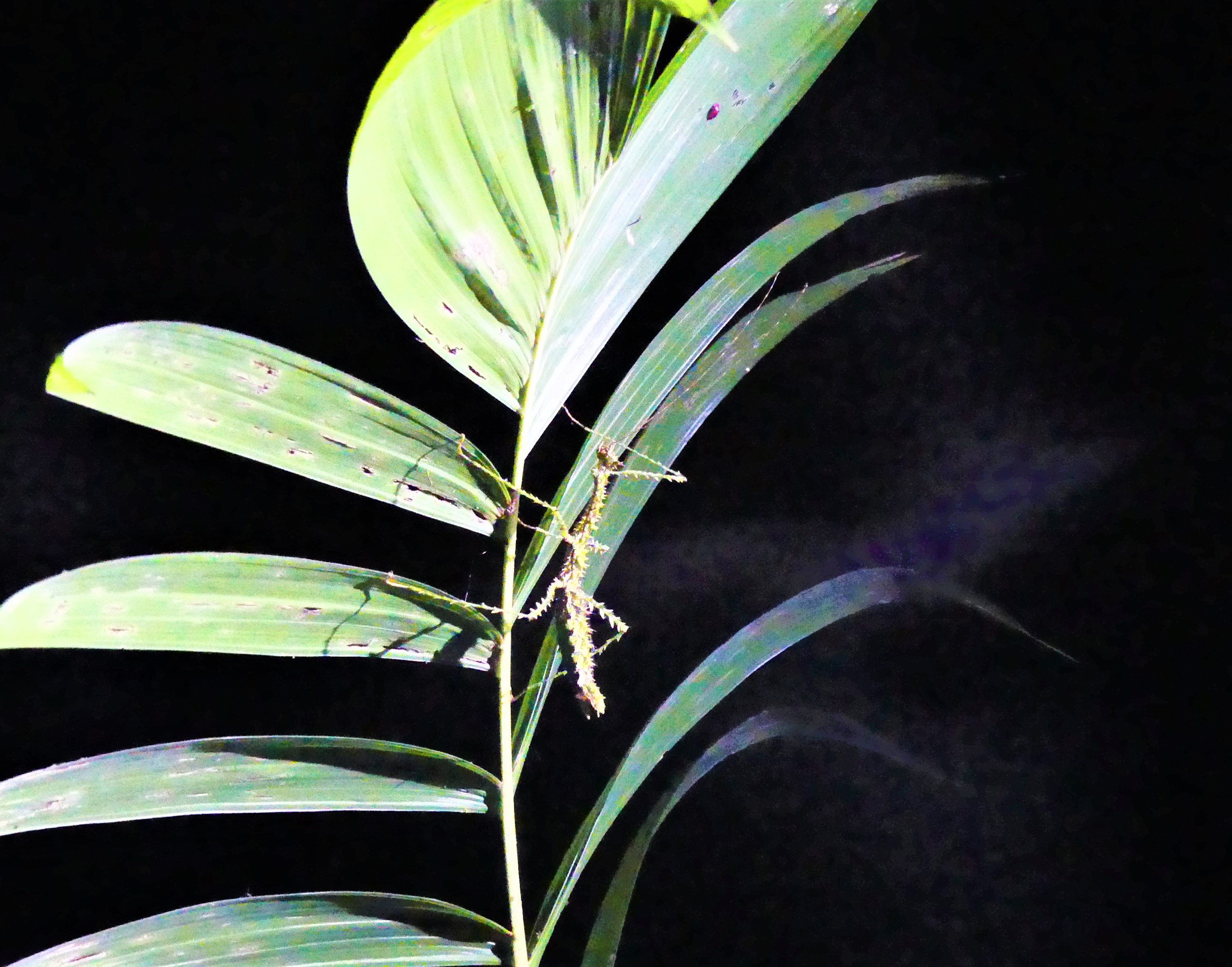
Spiny Stick Insect
Also, rather than stressful I find walking in the forest at night quite relaxing. The air is pleasantly cool and you keep your walking speed extra slow. This is for two reasons. Firstly because walking fast in the jungle at night is a recipe for tripping over a root and falling flat on your face. And the second (and more exciting) reason is that you aren’t going to see anything interesting if you are speeding through the forest not paying attention to your surroundings. My advice is to relax and not rush when walking at night. Use your torch to search for the eyeshine of animals like kinkajou and opossum that may be watching quietly from the trees. Listen carefully for frog calls and then try to locate the caller. The air and plants around you are full of interesting insects from the smallest iridescent beetle to sizeable and amazingly shaped stick insects. The riverside trails at Las Tangaras are home to plenty of emerald glass frogs that sit on the leaves surrounding the paths and a common potoo has taken a liking to a tree near the cabin.
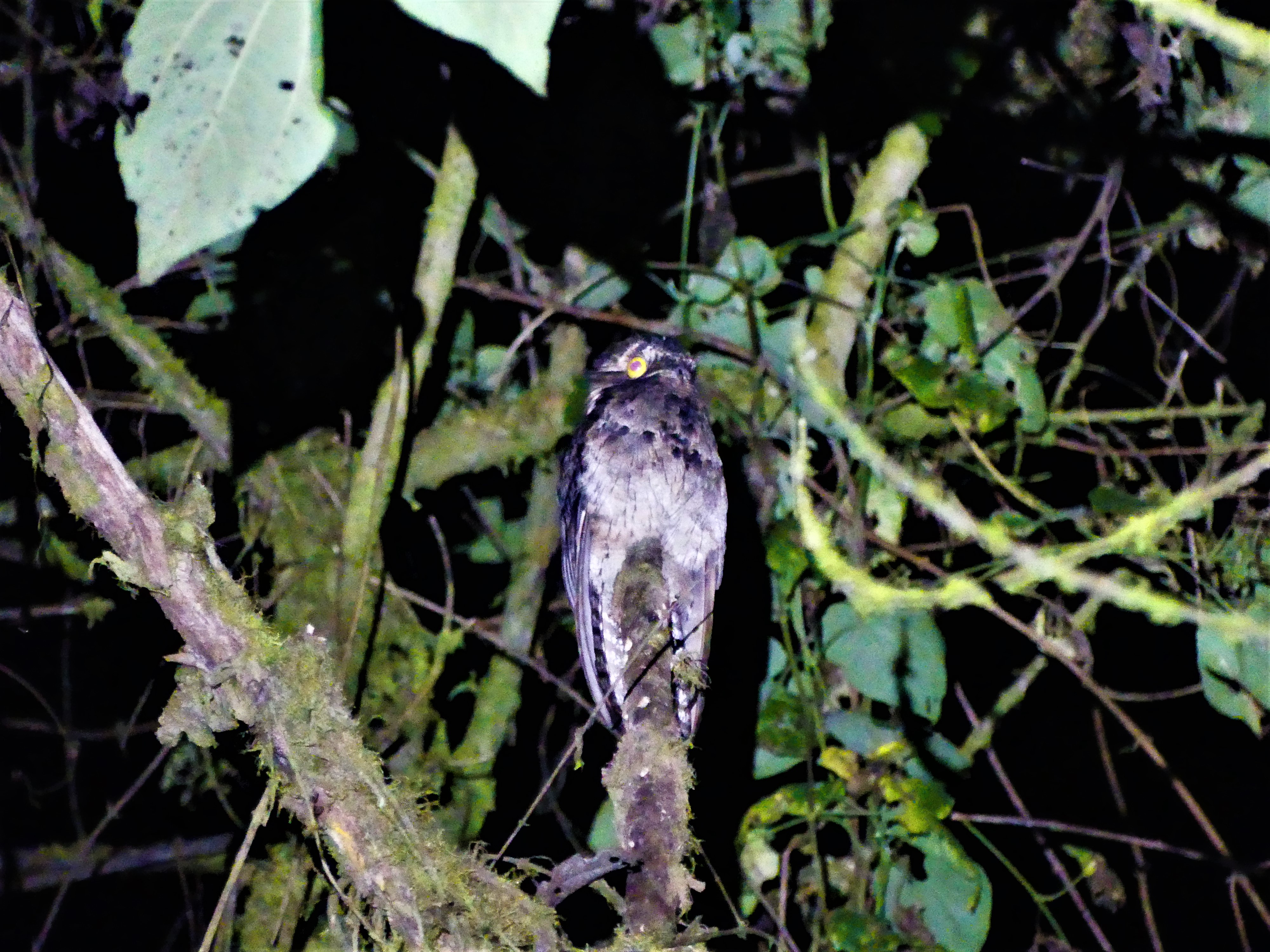
Our resident potoo.
I hope I’ve made a good case for the night time rainforest being a magical and fascinating place to be! If you happen to be in the area of Mindo I hope you stop by (by night or by day) and enjoy the forest with us.
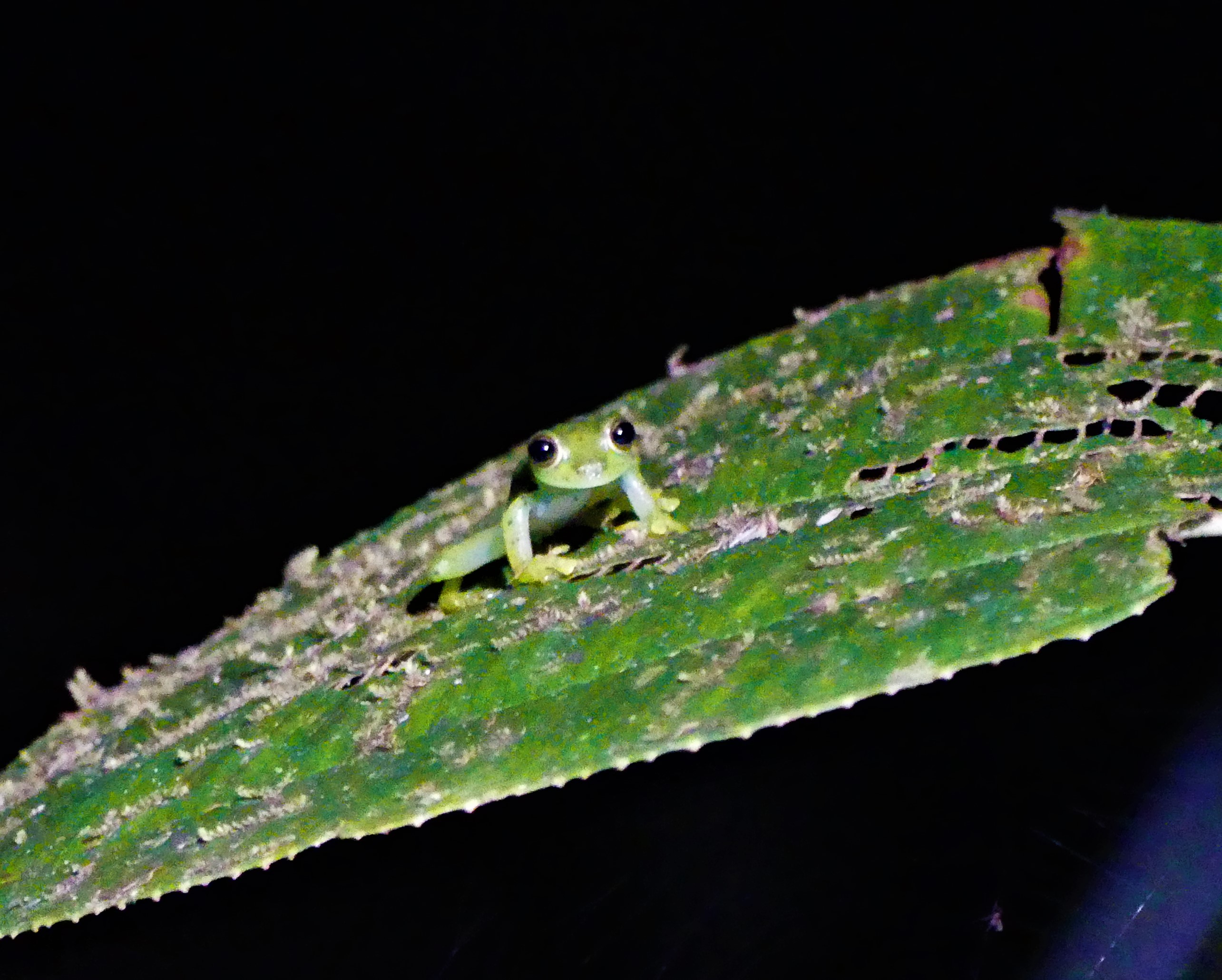
Emerald Glass Frog.
We are here and ready for visitors!
We are finally here at Las Tangaras! We applied for the position of reserve stewards almost a year ago and getting here to start work has been no easy task. Understandably Ecuador is enforcing strict security measures to control the spread of covid-19. For us this meant arriving into Quito from the UK with negative corona tests, carrying all the paperwork to prove we would be working at Las Tangaras and an address in Quito where we would quarantine.
We spent our quarantine at a guesthouse in Quito called Casa Bellavista. Despite not being able to venture outside we were made to feel very comfortable and welcome. The guesthouse kindly organised food for us and put so much effort into every meal. As a result, we are desperate to try cooking some Ecuadorian dishes ourselves and they will go on the guest menu at Las Tangaras once we are happy with them.
Once our quarantine was completed, we set off for Mindo. The two hour drive is stunning and offers beautiful views of the dry forests of Quito which then give way to cloud forest of Mindo as the altitude decreases. The winding roads of the journey are enough to make even the most hardened traveller feel a bit queasy. As I demonstrated. Twice. Giving me another reason to be thrilled to arrive in Mindo.
Mindo is a pretty tourist town full of small hostels and restaurants with almost every wall covered by murals of the local bird life. There is a huge variety of fruits and vegetables in the towns shops, including fruits we’d never heard of like naranjilla and tree tomato. The famous bird life also starts appearing in the town. Black vultures circle the roads, parrots fly in flocks overhead and hummingbirds feed from flowerpots. Getting to Las Tangaras from Mindo was a short taxi ride and then a hike with our backpacks down the valley to the reserve cabin. We were welcomed to the reserve by our first toucan sighting and quickly spotted one of the famous Andean cock-of-the-rock’s just outside the cabin.
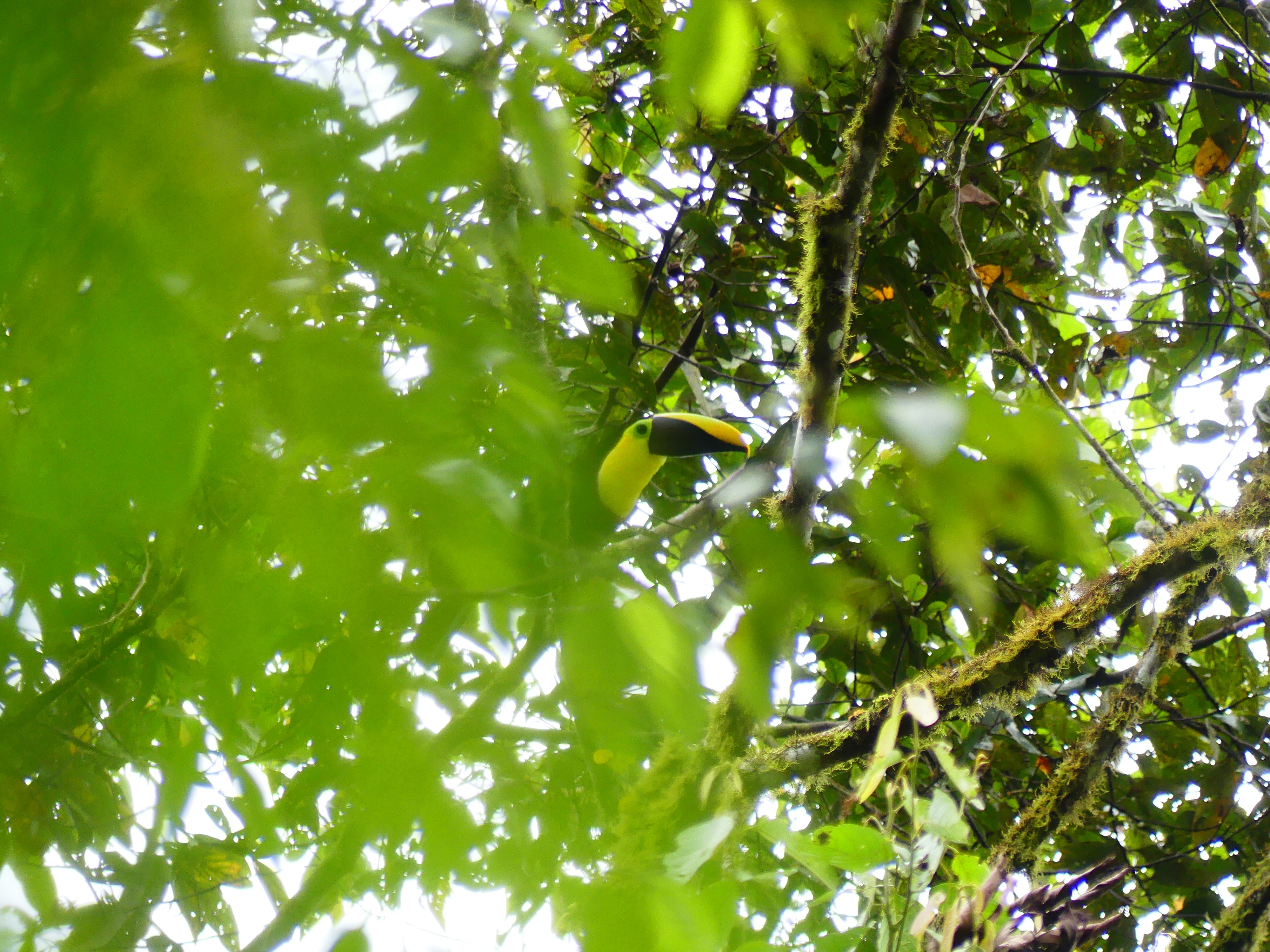
Our first glimpse of a toucan.
If you love nature, Las Tangaras is the place to be. Just sitting on the veranda, you can watch hummingbirds feeding, hear the Nambillo river rushing past and watch the clouds roll down the valley. Still, we have work to do. Since the reserve hasn’t been manned for a few months all the trails are overgrown and there are kilometres of it to clear. Usually a machete each is enough to allow us to clear the majority of growth but large trees have fallen since the trails were last cleared so we bring a saw and an axe along as well. It’s physically demanding work but we are getting there. On the plus side the fresh air, fresh food and intense daily exercise is toning us up. In other words, we look gorgeous. Actually I look gorgeous. The mosquitos here apparently love Phil so he’s got a more “handsome but possibly contagious” aesthetic.
Other than maintenance and clearing trails, our days are spent focusing on the birdlife. We survey the hummingbirds each day and are getting to grips with recognising individuals in the nearby Andean cock-of-the-rock lek. It is amazing to have a whole nature reserve to ourselves for a while and we are looking forward to welcoming visitors so they can enjoy the sights and sounds of the forest. The trails are now up to scratch so come and visit us!
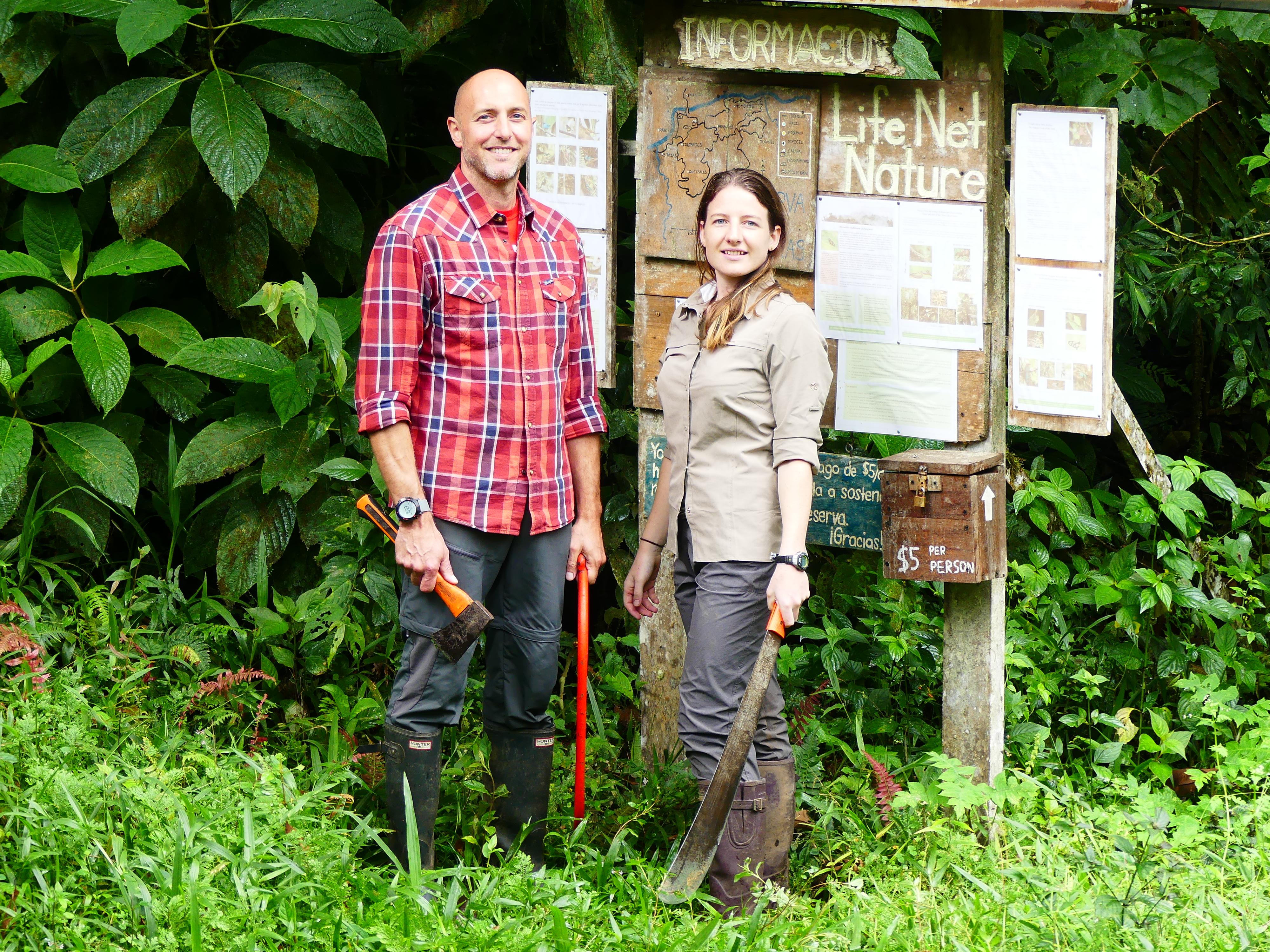
Phil and Sophie (us!)
Headline: More covid… sorry
Each month that passes, I hope that the next will be covid-free and we can return to discussing the beauty of Ecuador like we used to. But, Ecuador continues to suffer from the silencing grip of this global pandemic. And, although things are finally calming down in Guayaquil (the epicenter of the virus in Ecuador), more and more cases are appearing in the Pichincha province — where Mindo and Las Tangaras are located.
Luckily, Mindo has done an excellent job of remaining isolated from the chaos. With the exception of one food truck per week, no one is allowed to enter the town, and only a select few are allowed to leave if they’ve acquired a “salvoconducto” from the chief of police. Will restrictions lighten up or get worse? Who knows… Certainly not Ecuador’s politicians. Luckily for the entire country, many citizens (especially in Mindo) have taken curfew extremely seriously. So seriously, in fact, that we couldn’t even buy more propane for the cabin. Yikes… Interesting to compare that to the hundreds of Americans that splashed around in the Ozarks and contracted the virus. Is it bad that I kinda hoped they would get it? I sure do wish I was literally any other nationality…
Switching gears to a lighter subject, we have exciting news: the manuscript Bridget described in her last blog post on the avian species composition of Las Tangaras has finally been accepted and will be published in Cotinga, a peer-reviewed journal that focuses on tropical ornithology, at a later date. We are ecstatic that years of data collected by Las Tangaras staff and volunteers will finally enter the public sphere. It’s about time!
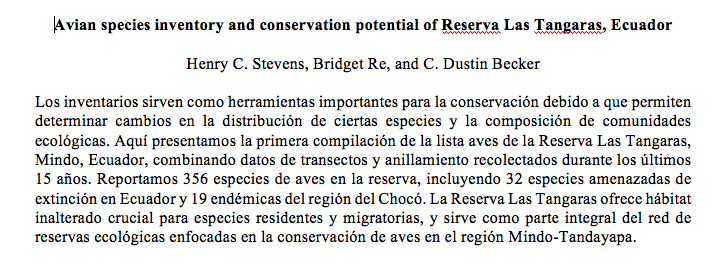
Now, let’s both be real here — you probably aren’t going to read the article when it’s published. I get it, you’re busy. So allow me to summarize some of our most exciting results with you here! I’ll start with the numbers. After removing dubious records, we finalized the official Las Tangaras list at a mouth-dropping 356 bird species. In other words, that’s more than 3% of the total bird species in the entire WORLD (I know Bridget used this fact in her last blog post but I’m reusing it because how incredible is that??) in an area of just 100 hectares. Amazing. Of those 356, 19 are endemic to the Chocó biogeographic region, a megadiverse ecosystem that ranges from Colombia down to southern Ecuador.
High numbers of species are exciting and everything, but for ornithologists, quality is more than important than quantity. In other words, does Tangaras support species of conservation concern? That’s an excellent question, Henry, and the answer is a resounding yes. In fact, 32 species of conservation concern in Ecuador use Tangaras for breeding, foraging, overwintering and/or dispersal. Such species include the charismatic Long-wattled Umbrellabird, the adorable Cloud-forest Pygmy-Owl, the chunky Dark-backed Wood-Quail, and the elusive Slaty Becard.
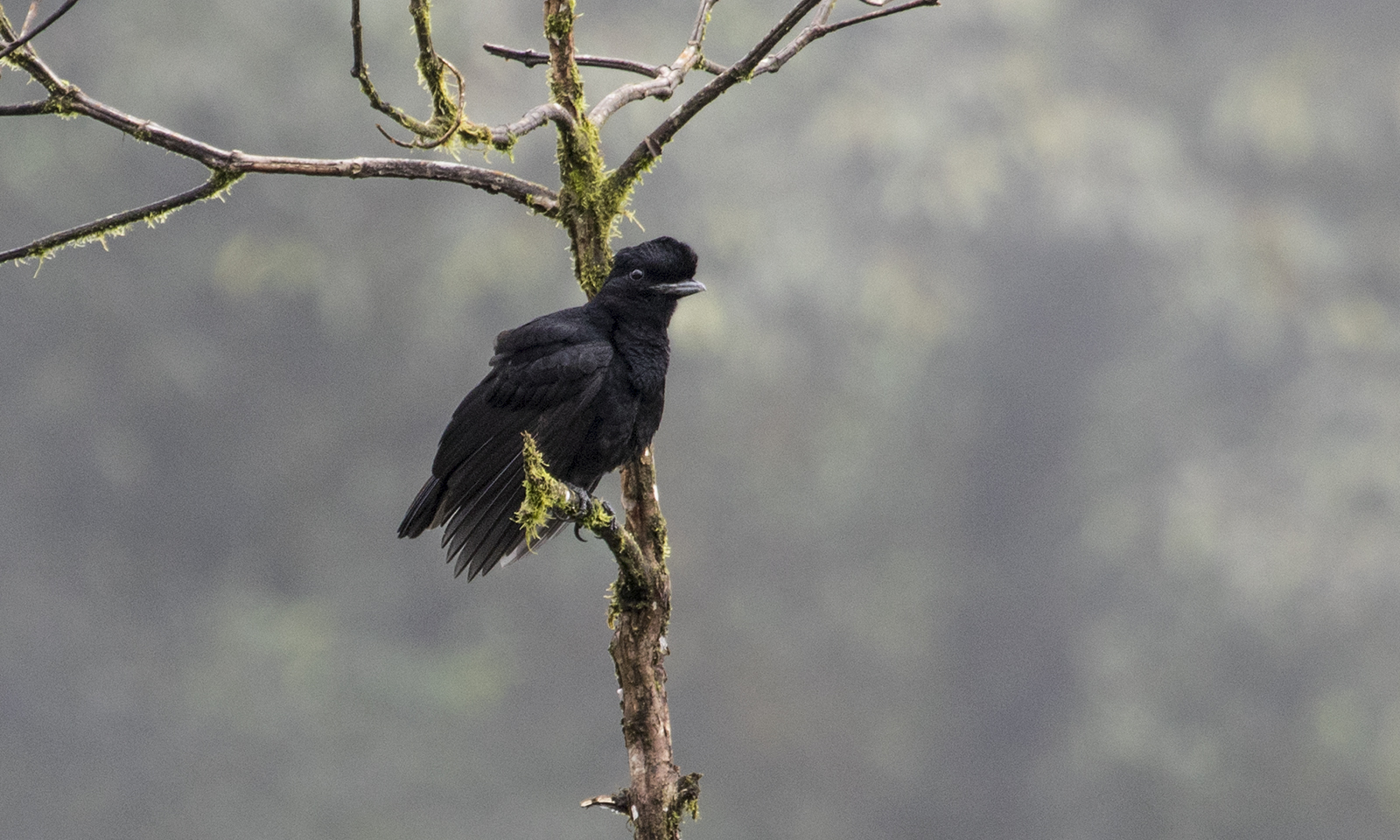
A Long-wattled Umbrellabird visiting Las Tangaras. Found and photographed by Zak Pohlen.
As it turns out, Tangaras even supports species unrepresented in the local Mindo area, and often contributes unique species to the annual Christmas Bird Count (fun fact: the Mindo Christmas Bird Count usually records more species than any other count in the entire world!). Such species include the Lanceolated Monklet and White-throated Hawk, and, if you’re lucky, maybe you’ll be looking at the right place at the right time and see one of these gems next time you’re visiting the reserve!
Unfortunately, not all our results are uplifting. Our long-term dataset allowed us to determine which species have undergone local declines over time, and unfortunately, this seems to be the case for species such as the Russet-backed Oropendola, Crested Quetzal, Powerful Woodpecker, and Toucan Barbet, among others. While these species are still detected sporadically on the reserve, their total abundances have dropped noticeably since the founding of the reserve just after the turn of the century. Figuring out the drivers for their declines is a crucial, yet extremely difficult, task for future research, especially given the list of potential culprits. Is climate change gradually shifting their ranges upwards in elevation? Has local habitat destruction forced them to seek larger patches of undisturbed habitat than Tangaras? Is fruit availability controlling their movements? Who knows, besides that it’s time for some serious science to happen in Latin America.
Bridget and I have been lucky and privileged to pursue our dreams in science. We were lucky to have families that supported us emotionally and financially in our decision-making, and for the opportunity to attend and focus on school throughout our lives. Unfortunately, not every aspiring young scientists shares our luck and privilege. There are students in Latin America and around the world who want to contribute to the growing field of ecology but simply lack the means to do so. In the midst of such dark times, we loved following #BlackBirdersWeek and the Binoculars for Black Birders event and hope similar initiatives can support Latin American scientists in the future. A pair of free binoculars can change someone’s life forever (it certainly did for me), but there are so many other ways we can encourage science in Latin America, like hiring locals for research projects and promoting community-based conservation schemes. Hopefully, in a post-covid world, Tangaras will be a place where Ecuadorian students learn to identify and band birds — and prepare them to combat the 6th extinction.
Sorry, didn’t mean to end on such a dark note. Here’s a picture of us and some pretty flowers:
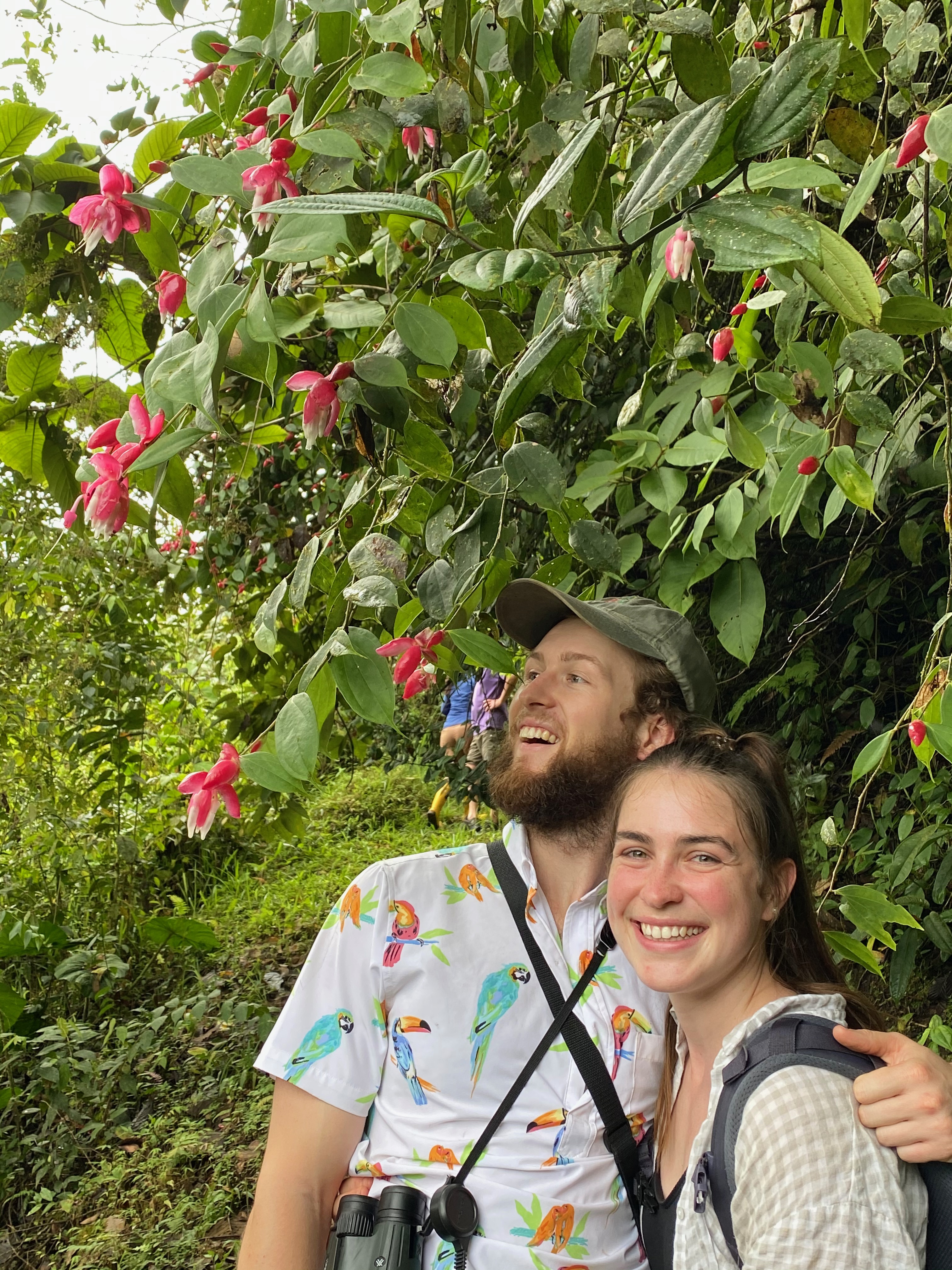
Remember to keep quarantining until health officials give us the green light!
A Scientific Tidbit
Amidst the global pandemic, the Ecuadorian government has required all nonessential businesses to close causing Life Net Nature to shut down Reserva Las Tangaras to the public.
However, at the heart of Las Tangaras is scientific research. So, while the hospitality services we typically provide are suspended for the time being, we are still hard at work collecting data. As Henry mentioned in the last blog post, we’ve been writing up manuscripts using the large database and information that has been collected since RLT’s beginnings. Henry and I are eager to share our research with everyone and thought informative distractions would be well received.
While RLT is mostly known for having the largest Andean Cock-of-the-rock lek in Mindo, it is also home to a wide variety of species from common Beryl-spangled Tanagers and Ornate Flycatchers to rarer Purple-throated Woodstars and Rose-faced Parrots (pictured in order below).
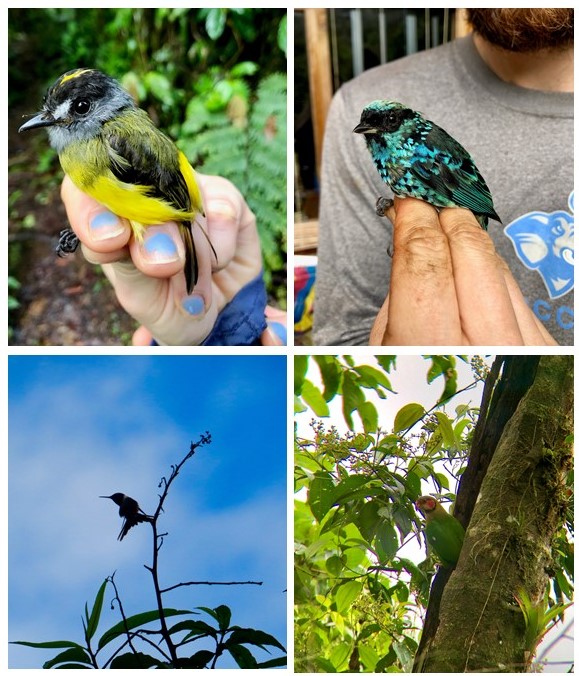
Since 2005, dedicated banding expeditions have occurred at RLT resulting in a HUGE data set—as in 7,613 birds have been banded thanks to the efforts of Life Net Nature staff and volunteers. For two budding scientists, this made our hearts go pitter-patter knowing we had such a large comprehensive data set. The first manuscript we wrote was an avian inventory list detailing all of the species detected within RLT.
Begin sidebar I: such information can be used as important tools to monitor species range shifts which is particularly important for areas like the cloud forest that are susceptible to rapid ecological modifications due to climate change. Furthermore, the information collected while banding (i.e. body measurements, age, sex, parasite loads) can be used to glean knowledge about population demographics. It’s super important to gather this information to monitor species of conservation concern, but also just in general!
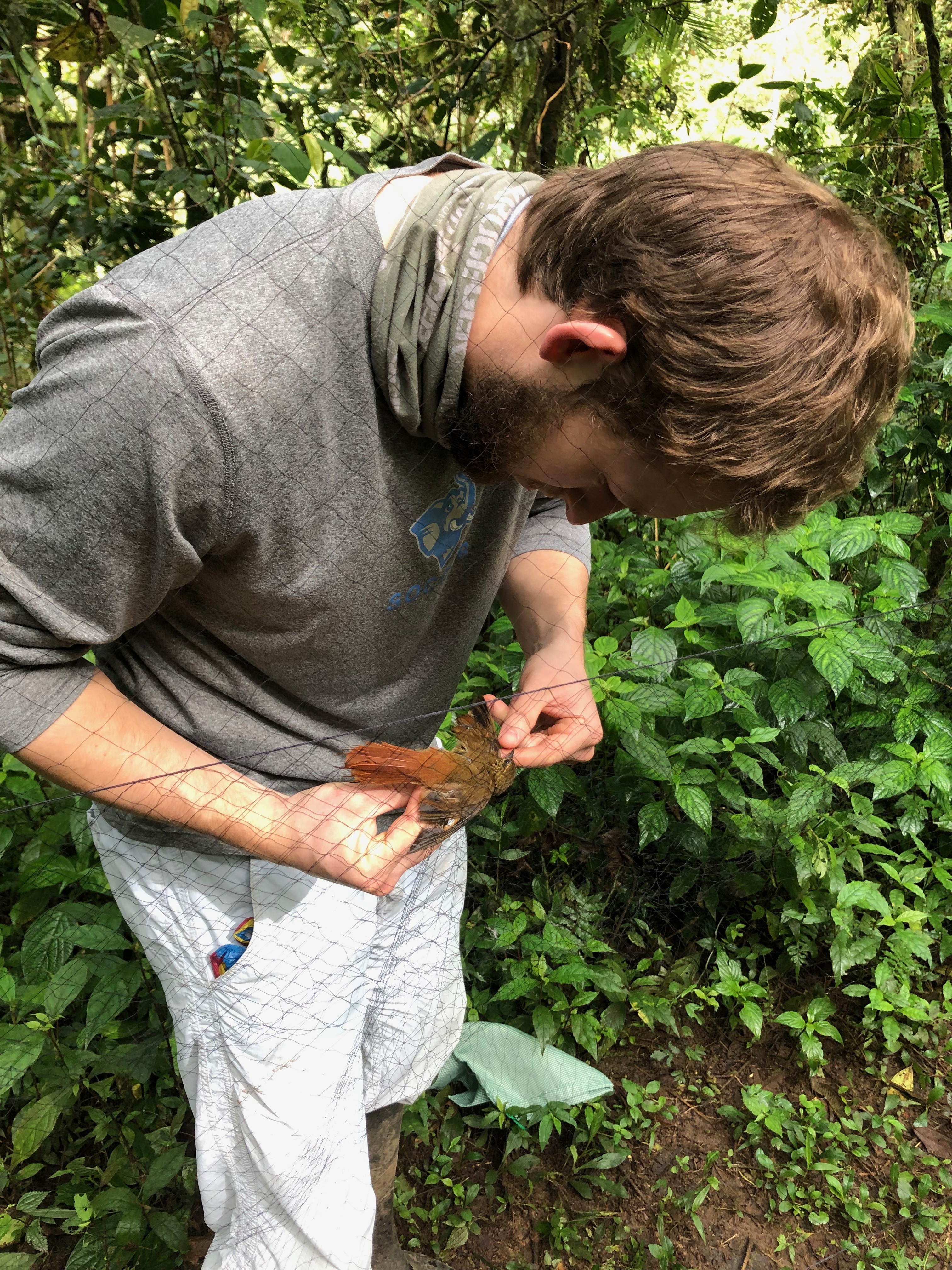
Henry carefully extracting a Scaly-throated Woodcreeper.
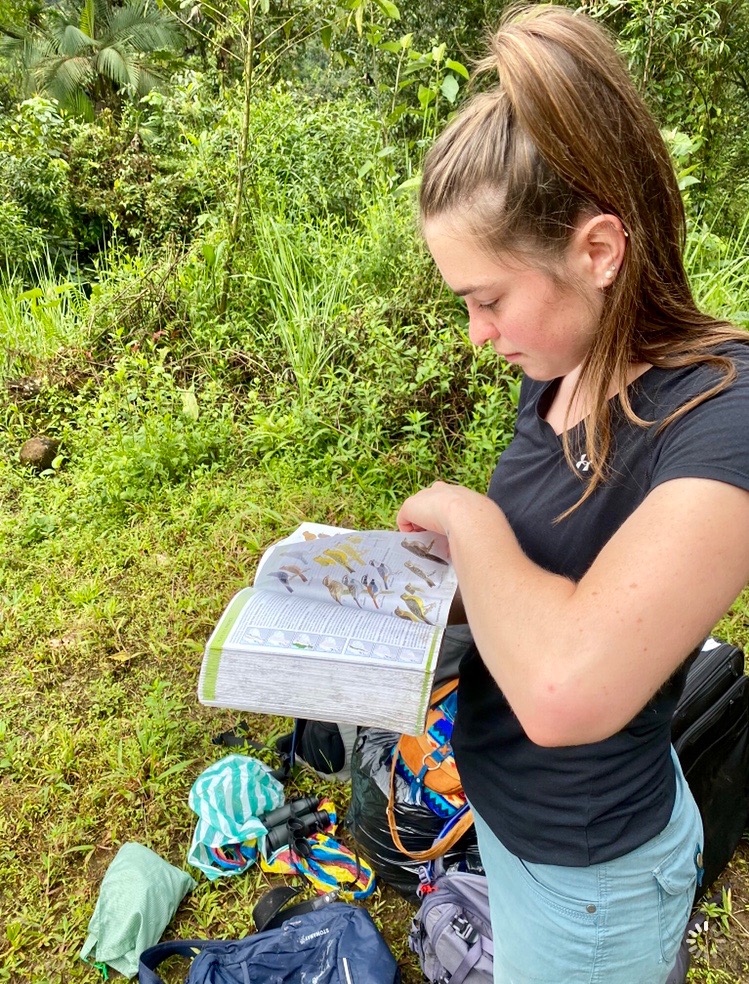
After extraction, we use the Birds of Ecuador guide to properly ID all individuals before banding.
End sidebar I.
Combining banding information with monthly bird counts, we were able to establish an abundance ranking for each species. What this means is that we were able to determine how often a given species was seen, heard, or banded on the reserve and whether it was common, fairly common, uncommon, or rare. Through fifteen years of data collection, 363 species of birds have been recorded on RLT property, 21 of which are of immediate conservation concern. For context, there are 1,640 species currently known to occur in mainland Ecuador (excluding species from the Galápagos) meaning 22% of species in Ecuador (and 3.6% of species in the world) occur in our backyard! Incredible!
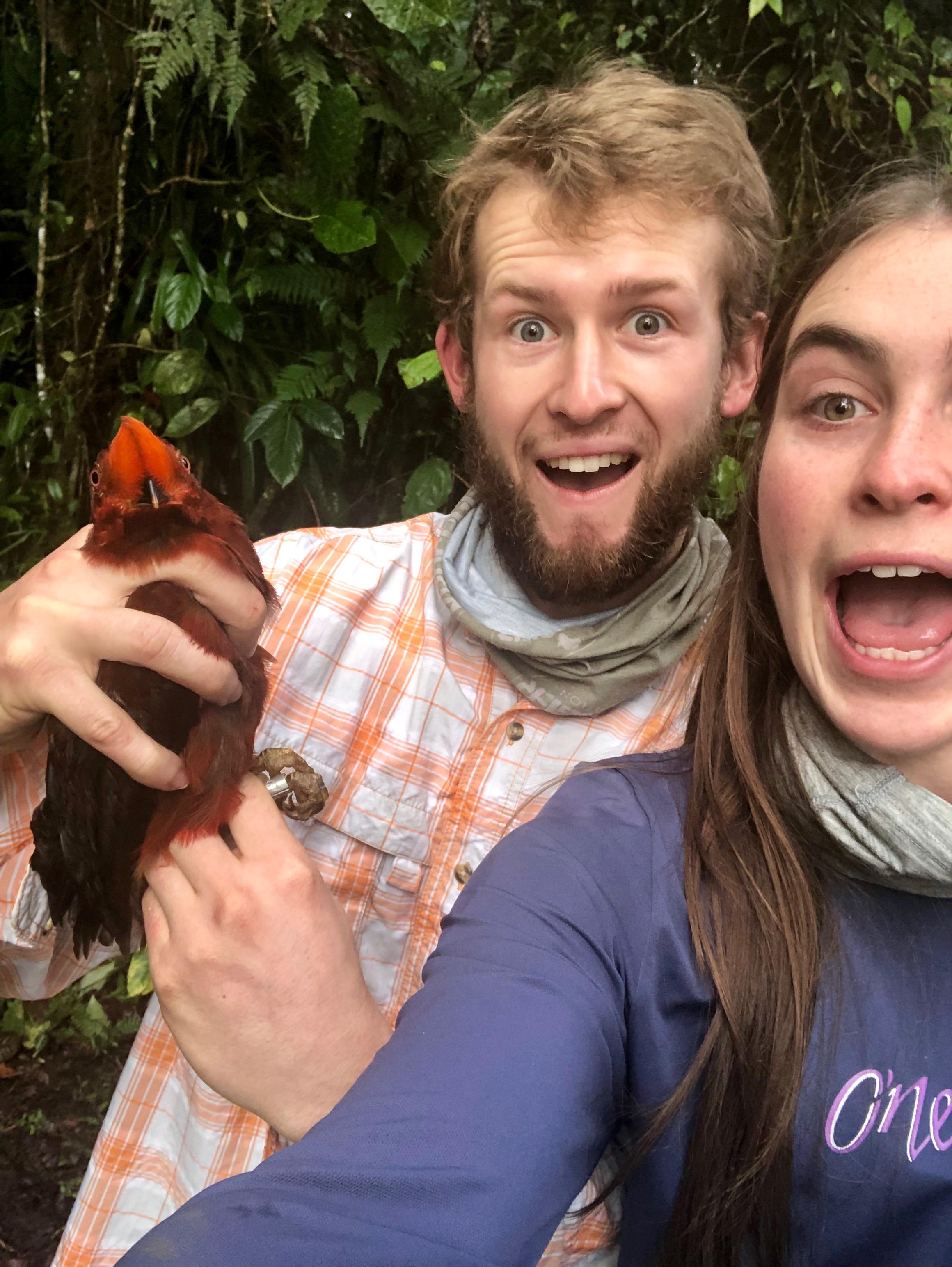
We hope this avian inventory list can provided another example of how small, privately owned reserves can be of great conservation help when managed to protect and promote wildlife.
Begin sidebar II: ever wonder what the result of accidentally purchasing $5 of apples looks like? Enjoy this picture of Henry with our surprise bounty.
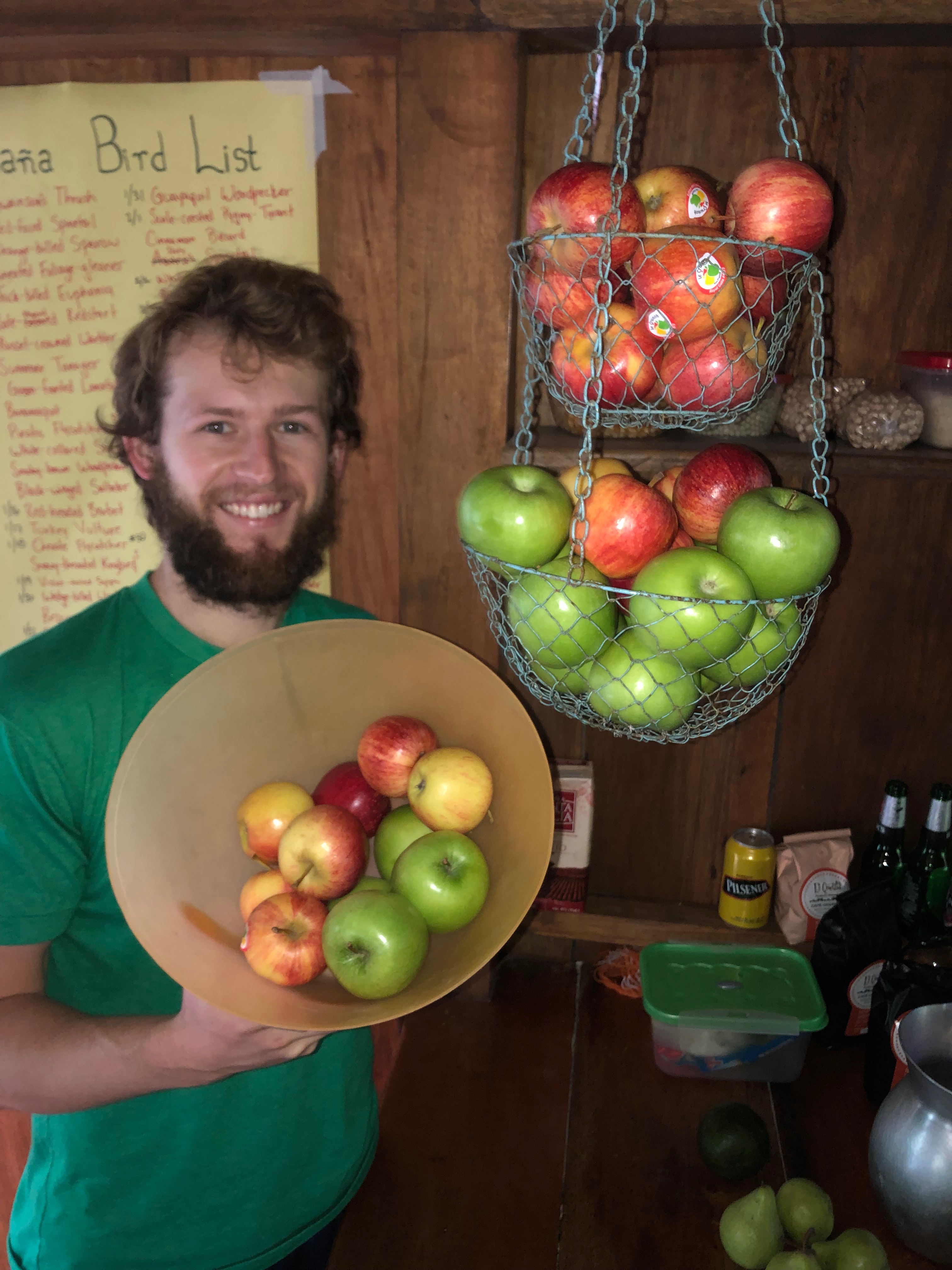
End sidebar II.
One of the 21 species of conservation concern on RLT is the Cloud-forest Pygmy-Owl (CFPO). As Henry previously mentioned, I have been writing about their natural history. Little is known about these owls given their secretive nature and geographic limitation. To put it into perspective, over the fifteen years of banding RLT has netted and banded three individuals… so a tricky study species at best. Luckily, one of those individuals was recaptured allowing us to infer that CFPOs can live up to five years of age. Additionally, this individual had a lizard in its mouth the two times it was captured.
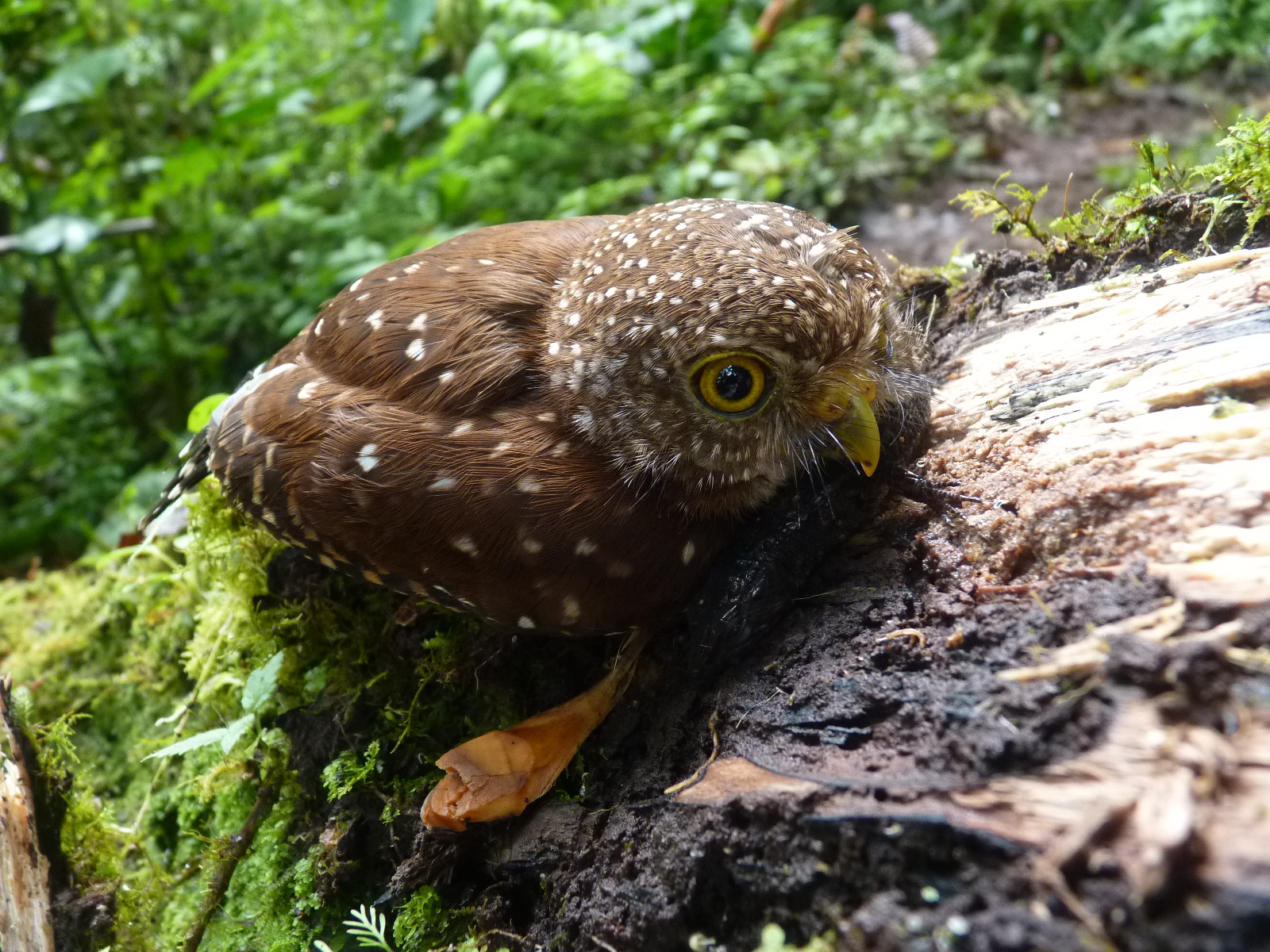
The fierce little CFPO determined to keep its lizard; photo courtesy of Dr. L. Vereen.
Given that other species of Pygmy-Owls (Glaucidium) are generalist feeders, we presume that reptiles make up a portion of the CFPO’s diet along with other prey items (i.e. small birds and mammals). It is important to note that these observations were made during the dry season. Therefore, it is feasible that they are a result of the seasonal activity of prey, and that CFPO alternate their primary prey based on what’s available (hence the generalist diet spiel). We cannot say for sure, but encourage further in depth studies to assess what makes up the diet of these cuties.
Speaking of further in-depth studies, we have been conducting targeted mist netting of CFPO to try and gather more information about their natural history and morphological traits. Unfortunately, we have been unsuccessful in capturing them, but have consistently heard a response to the callbacks–along with being screamed at twice by a Kinkajou for playing said callbacks.
While we continue our efforts to understand the natural world around us, we sincerely hope everyone remains safe and healthy during this time!
March Madness
Hey folks, Henry here. Everyone in Mindo is deep in a self-quarantine period. The president of Ecuador basically shut down the country on 3/17, and I think everyone is supposed to avoid leaving their homes unless it’s an absolute necessity (food, medical emergency). Apparently, these restrictions will only last until April 6th, but given the situation keeps getting worse I’d imagine the restrictions will just become stricter starting on April 7th. I never thought things would get serious here like back in the States, but I suppose it’s a good measure to take against this stupid virus.
I had the title of this post, “March Madness,” figured out long ago because of all the guests we were supposed to have this month — 21 total, leaving the cabin booked for all but six days in March. Even though that changed (no guests since Bridget’s family left on the 13th), I feel like the title is still appropriate. We have limited knowledge about what’s going on in the US and other affected countries, but it sounds like absolute madness. Everything cancelling, schools going virtual, grocery stores being entirely depleted?? I’m picturing pre-apocalyptic scenes of vacated cities and ghost towns. Guess we chose a good time to live in Ecuador for 6 months, eh?
Even though the rest of the world is in utter pandemonium, absolutely nothing feels different on the reserve. That is, besides the complete disappearance of all day and overnight guests, but we don’t really mind having our slice of paradise to ourselves. The weather has been really weird in March. For the first half of the month, it rained incessantly all day and all night — one day we got a total of 90mm, insane! We literally did not see the sun for 7 days straight, I kid you not. But the second half, so far anyway, has felt totally tropical and awesome. Sunshine all day, and barely any rain in the evening or during the night. Absolutely bizarre. We haven’t said this out loud in fear of jinxing our luck, but *maybe* the rainy season began and ended on the early side this year? Damn, I bet I just jinxed it by writing it out. Oh well, too late. We’ll see what happens I guess.
We had some awesome guests in the first chunk of the month. First off were a Canadian couple, Elaine and Steve, visiting Ecuador again after having volunteered in a remote Amazonian village last year. It was amazing to hear their stories, and it sure did take some pressure off us knowing that they had slept in a shack in the rainforest. Those types of experiences really make our cabin look like a boujie luxury resort! Then we got to meet Tom, one of the previous Tangaras managers from 2015, and his two friends from London, Simon and David, who all stayed for one night and were excellent company. It’s cool how many people of different nationalities we’ve been able to meet, beyond Ecuadorians and Americans: Canada, England, France, Spain, Italy, Switzerland, Belgium, Czech Republic, Netherlands, Hong Kong, and we recently met an Australian couple in a cafe frantically trying to readjust their travel plans after the Ecuadorian president announced he was shutting down the Quito airport.
Our star guests were Bridget’s family — Mark, Nora, Pete, Neil, and Susan — who arrived on the 9th and stayed with us until the 13th. We had such a total blast. From hiking up to the cock-of-the-rock lek at the crack of dawn to our salsa dance party, every minute they were here was golden and unforgettable. I honestly don’t think the reserve has ever experienced the level of fun that permeated the air during that week. They also helped us with our reserve chores (don’t worry Dusti, we got stuff done), including but not limited to bathroom and cabin cleaning, clearing the Quetzales trail, and building the new exterior bamboo shower. Our work-hard play-hard efficiency was simply off the charts. Here are some of the highlights:
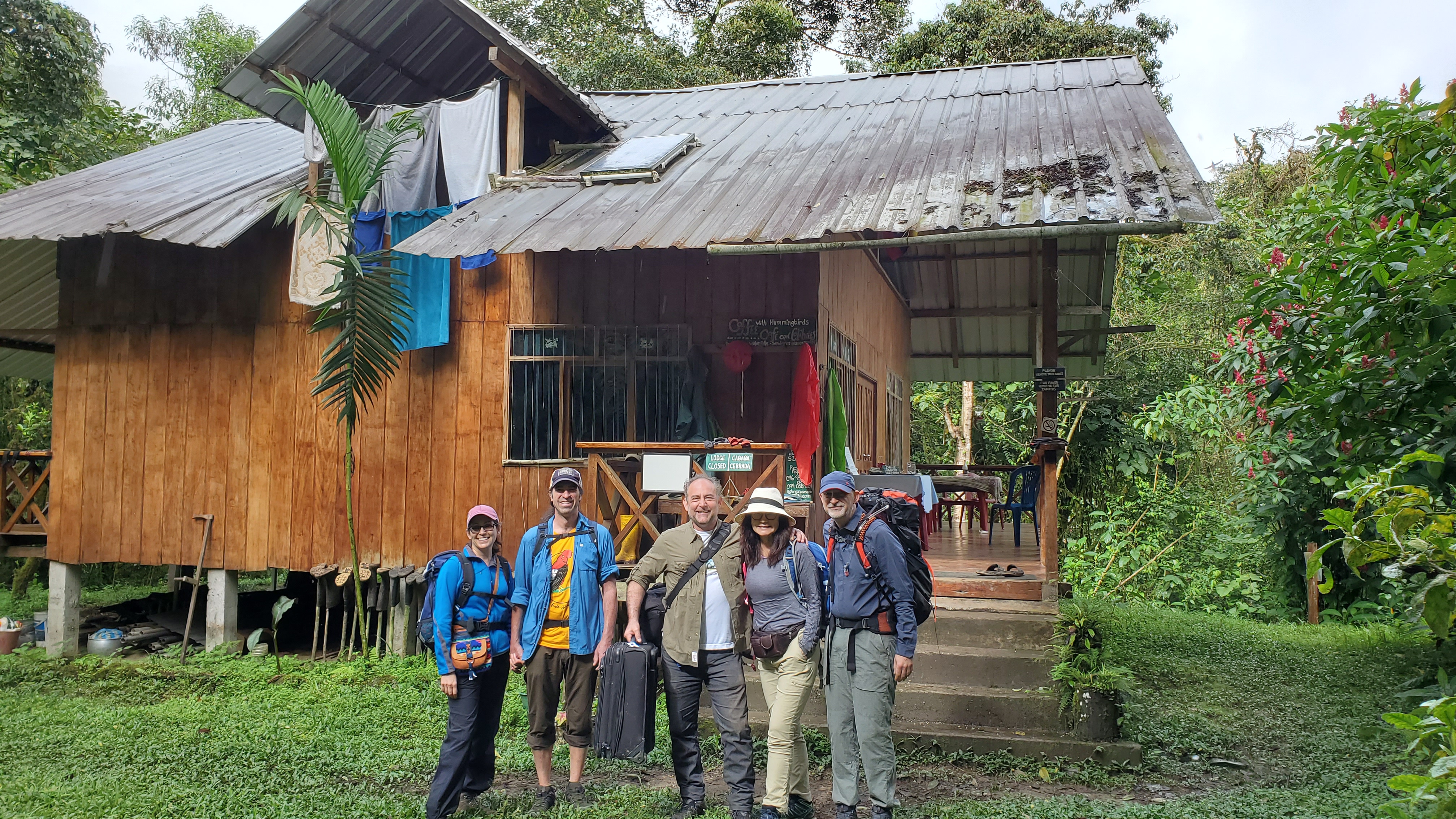
Everyone arrives! Check out Neil’s roller suitcase full of goodies for us 😀
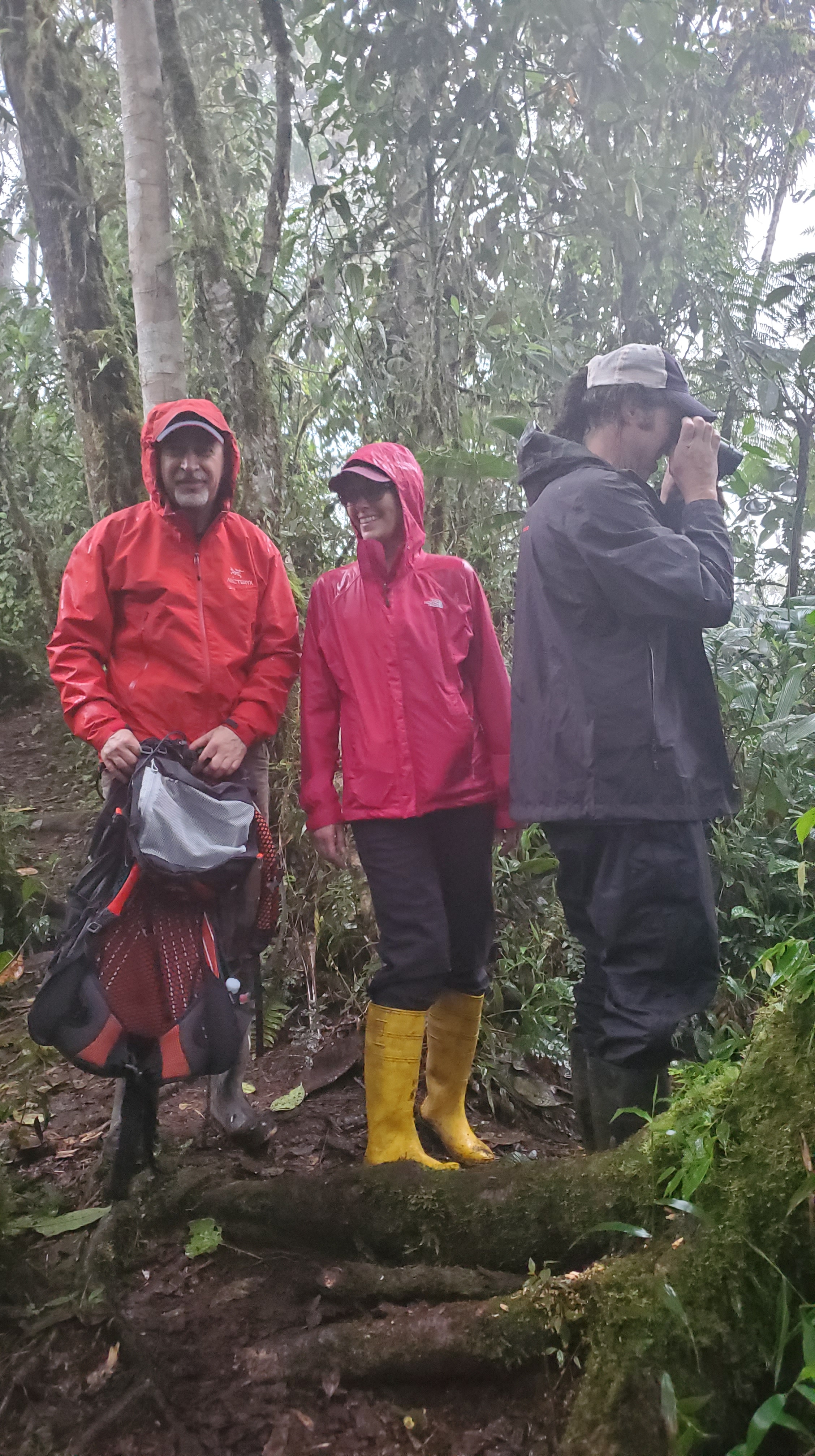
Here, we see two strategies for finding cock-of-the-rocks: blend in and search, or wear red and wait for them to come to you.
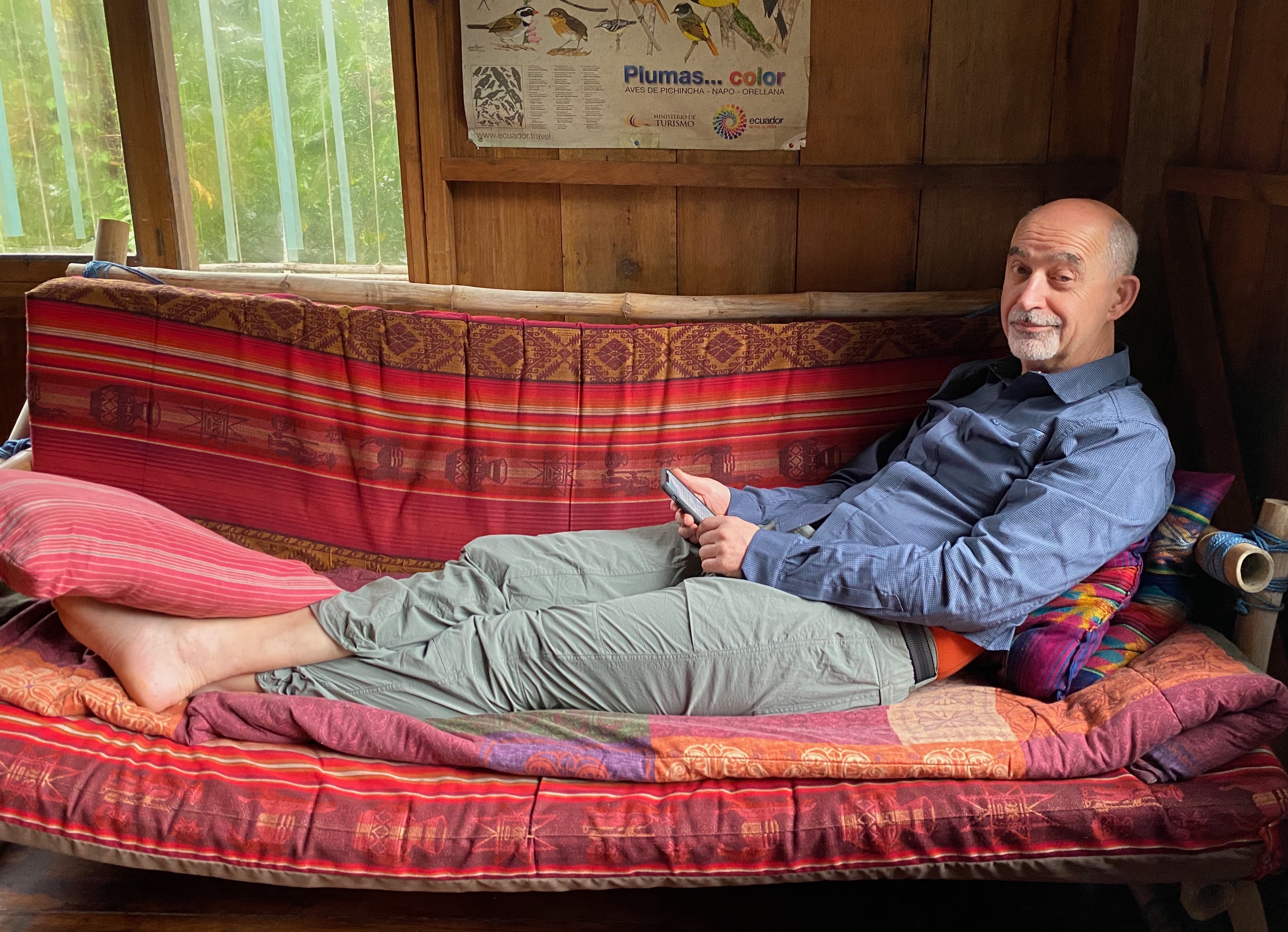
Pete’s favorite spot in the reserve (can’t blame him).
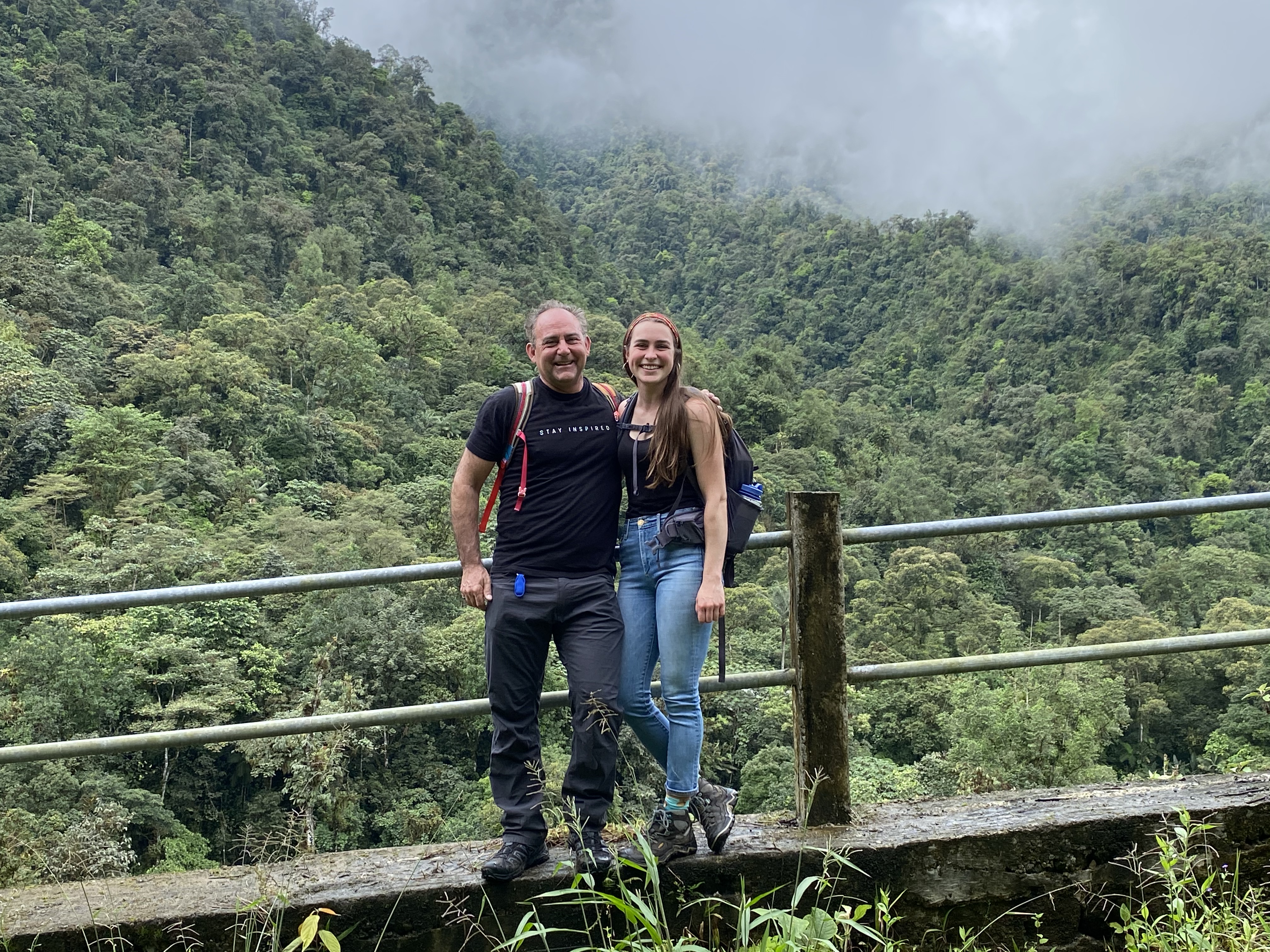
Cute!!!
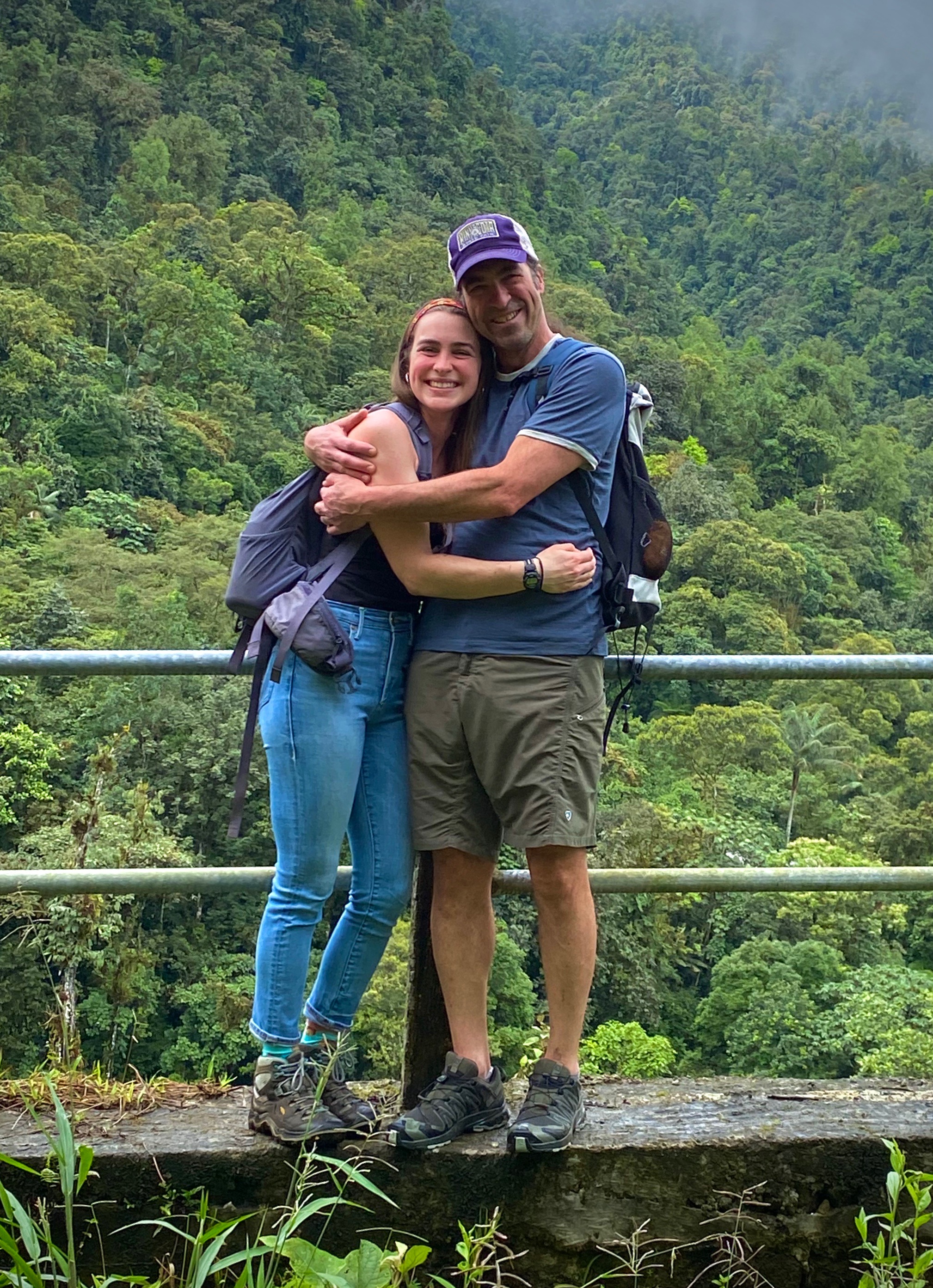
Cute again!!!
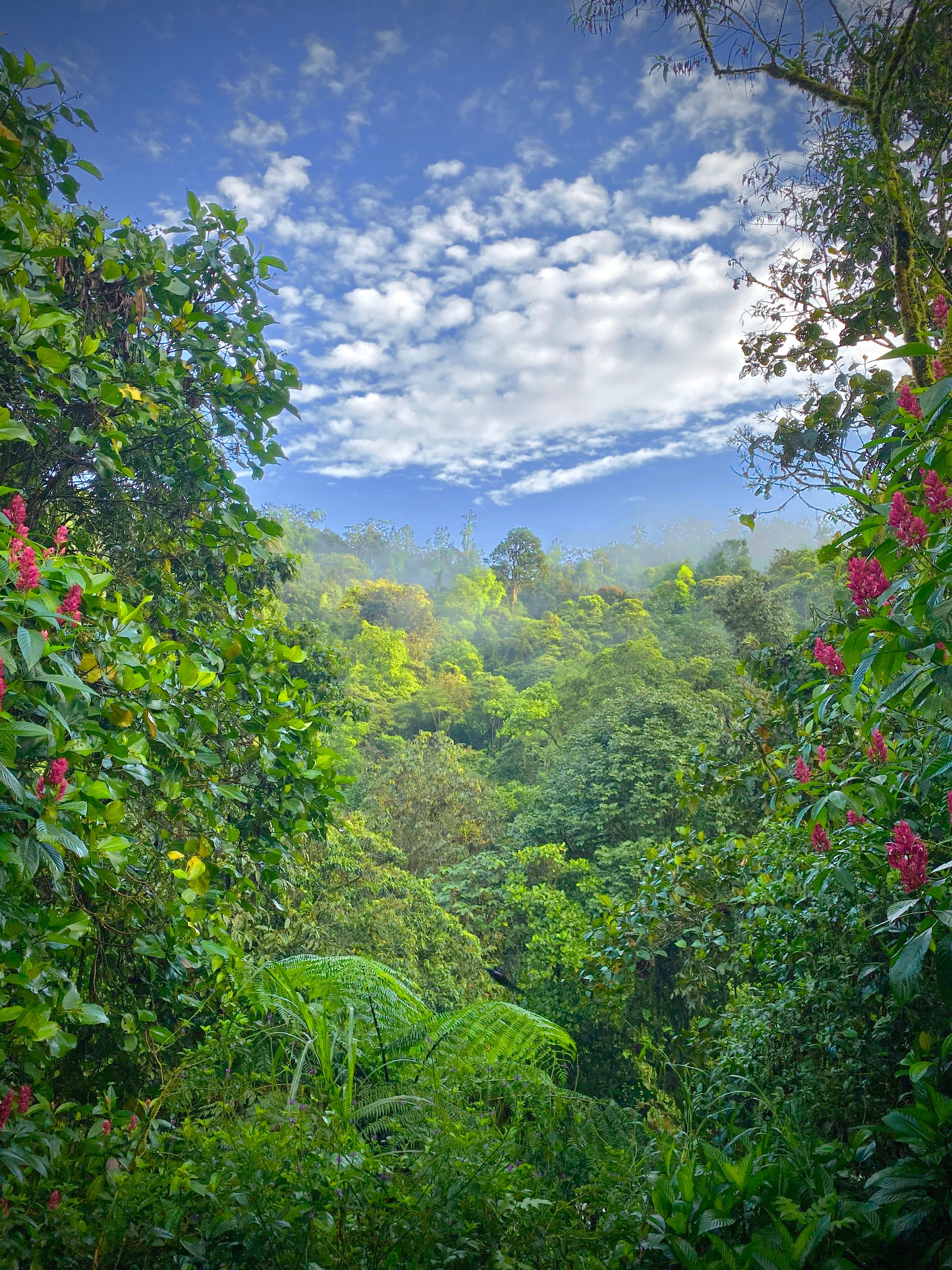
Sun finally came out after a week of clouds. How pretty is this??
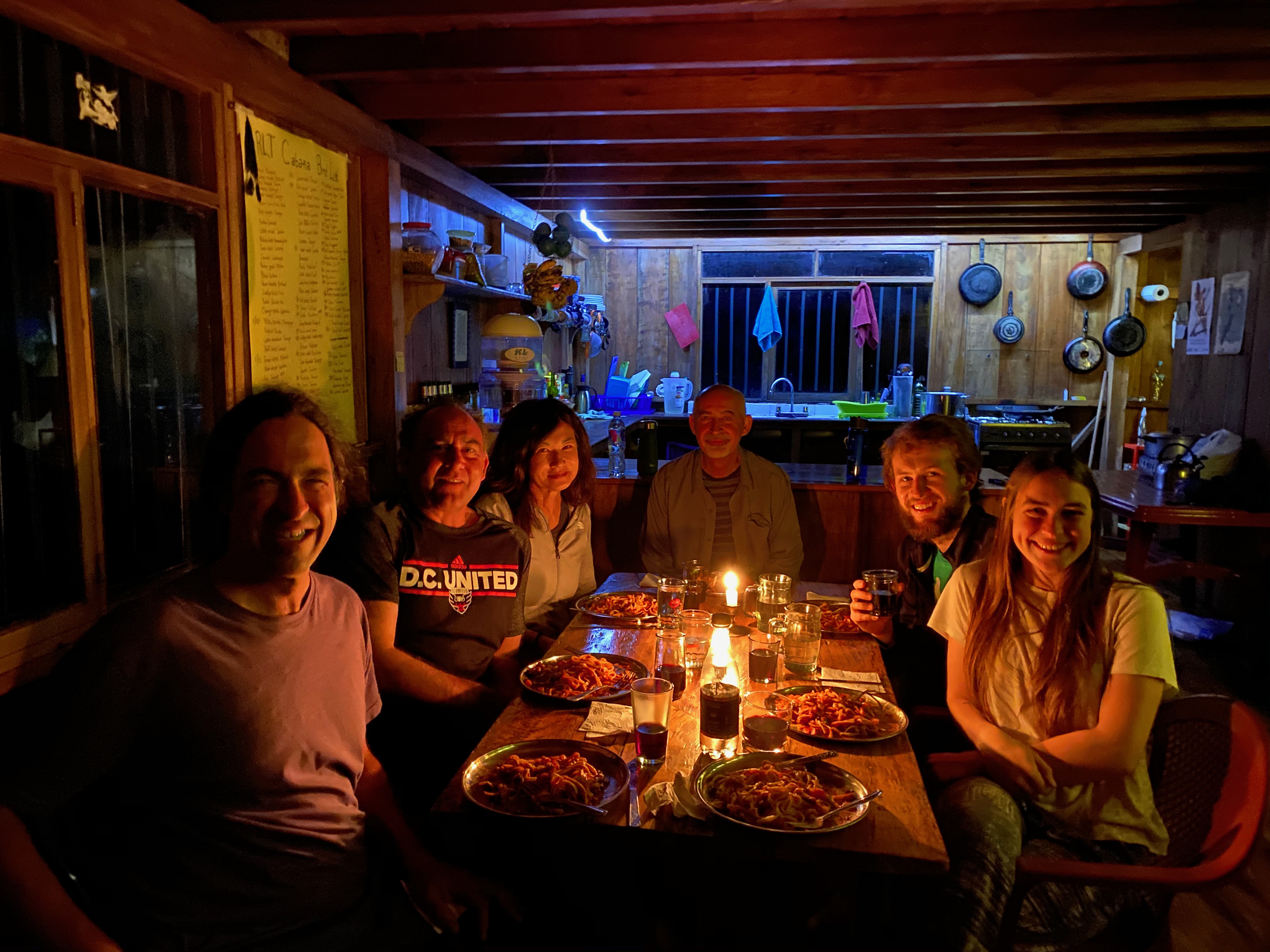
Yummy family dinner!
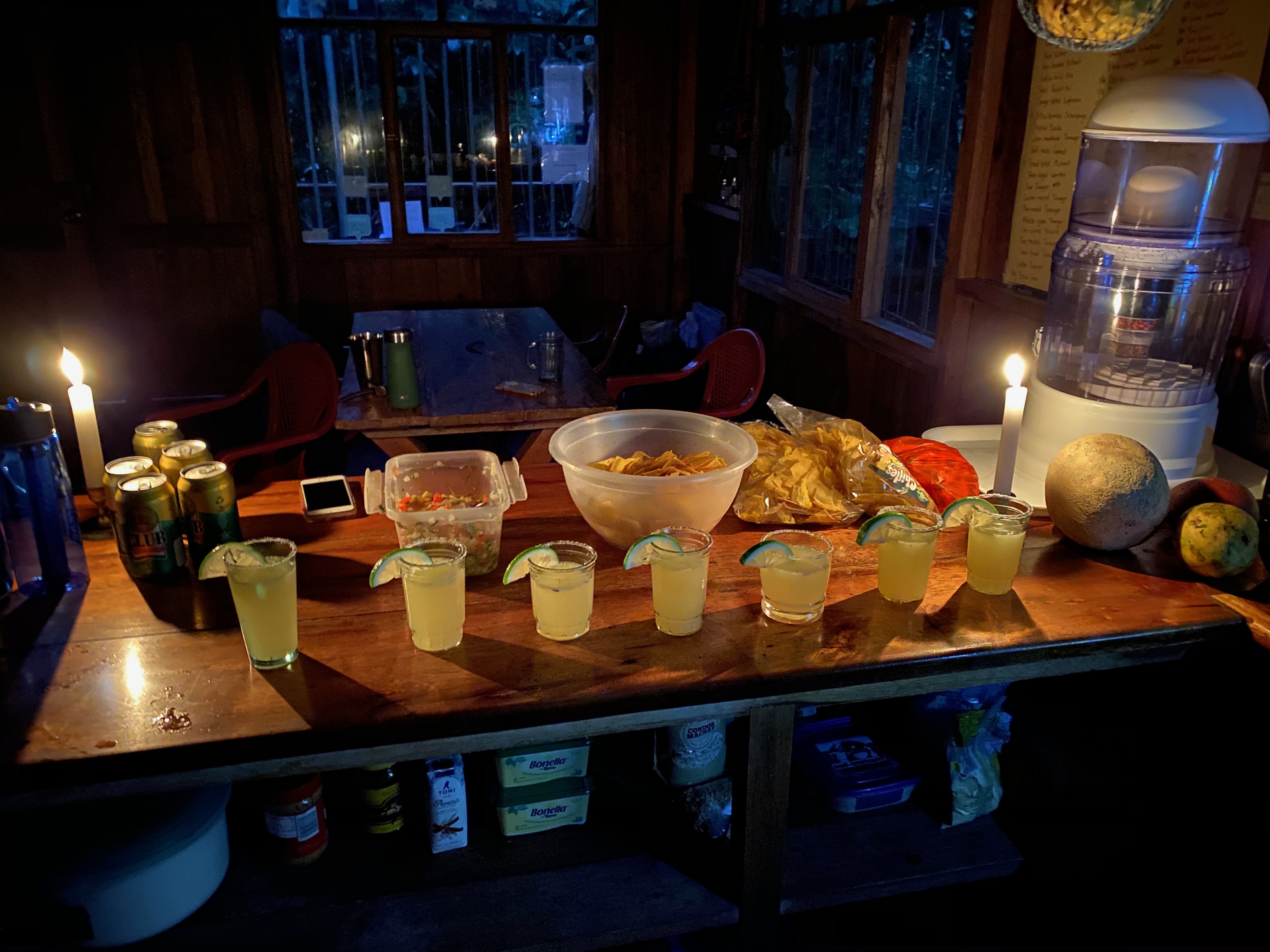
Marg + chifles & guac + salsa music = one hell of a night.
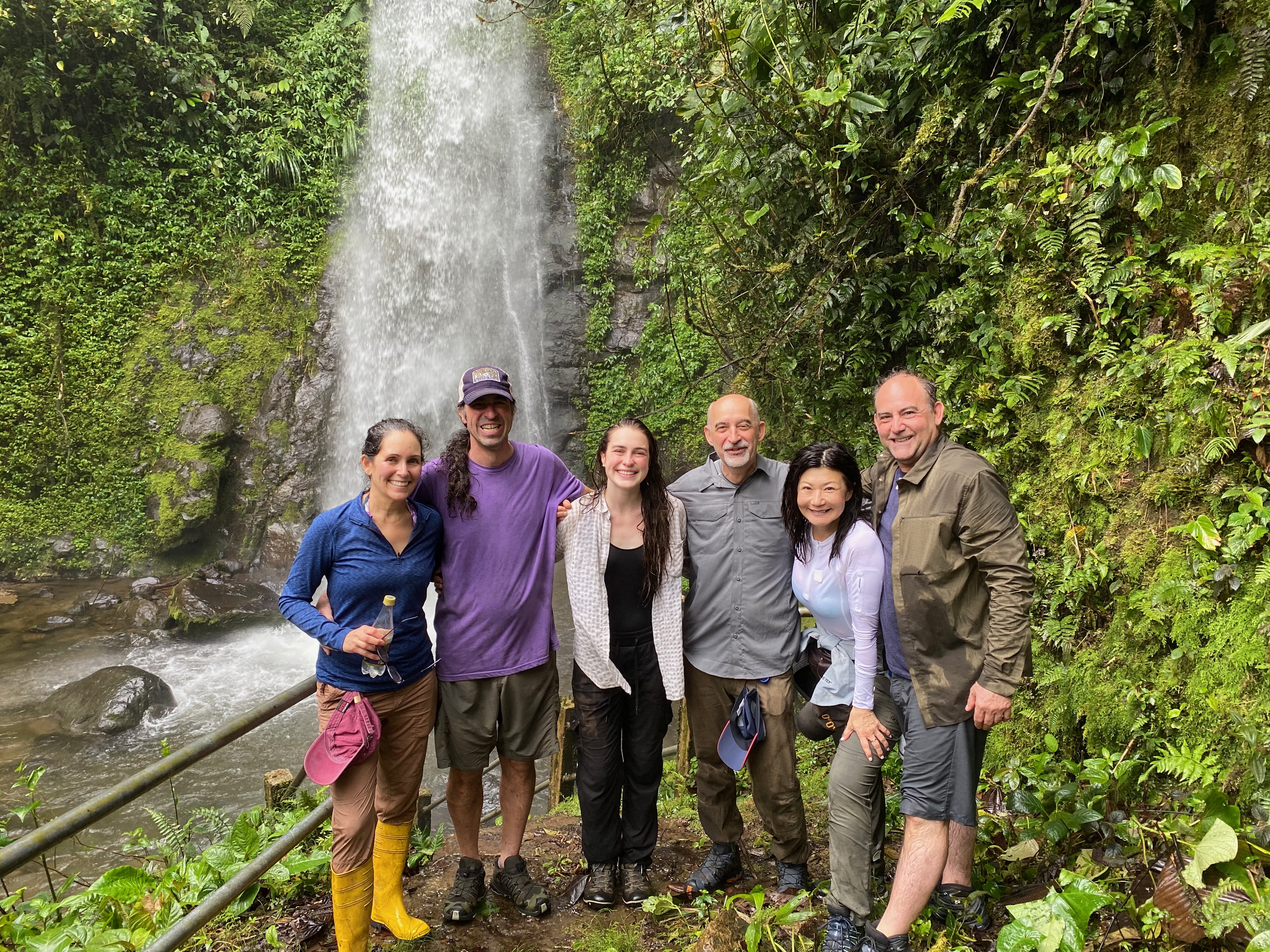
Waterfall hike! Bridget, Susan, and Neil all braved the cold swim.
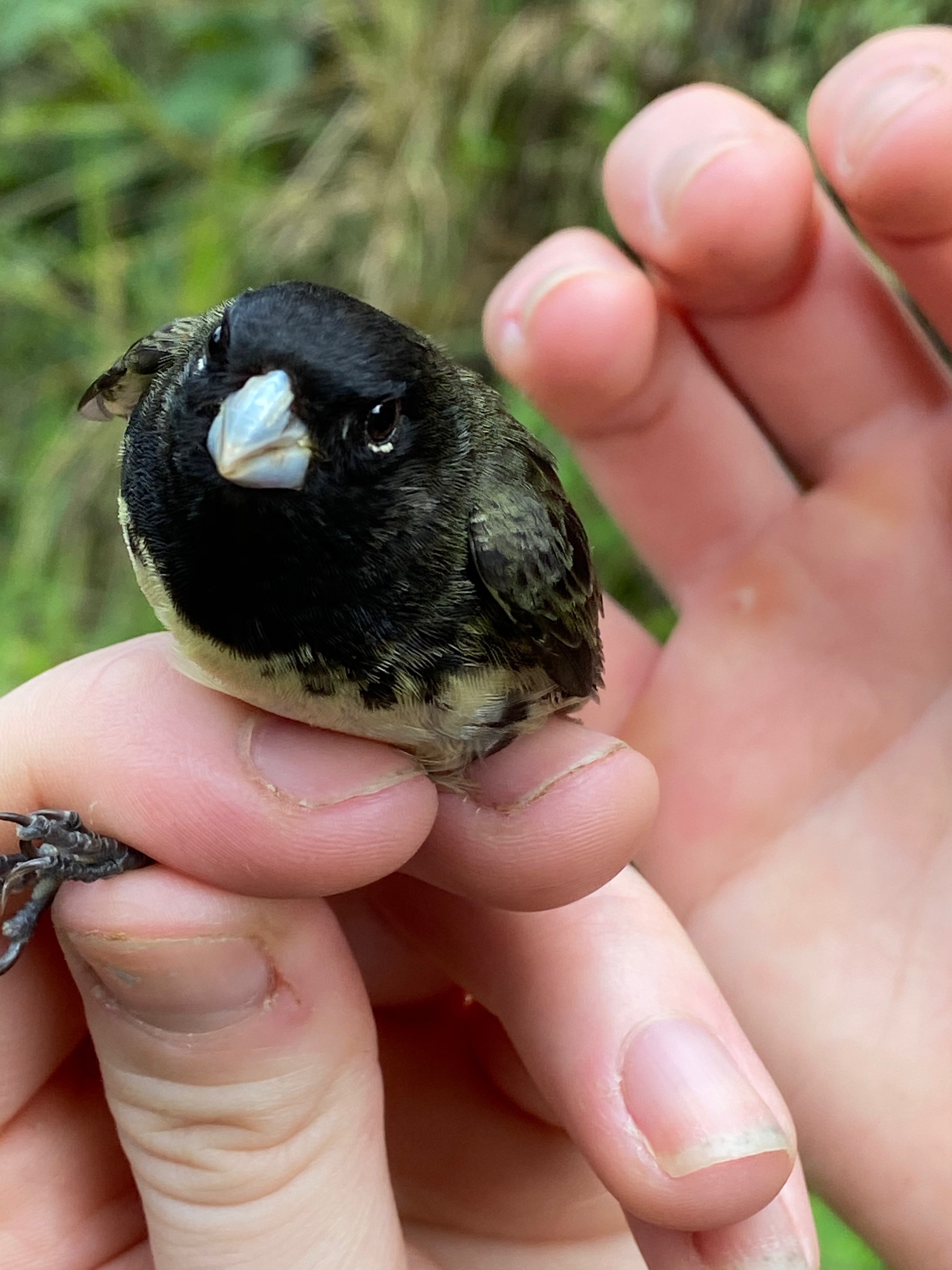
Banding demonstration for Bridget’s family with this Yellow-bellied Seedeater!
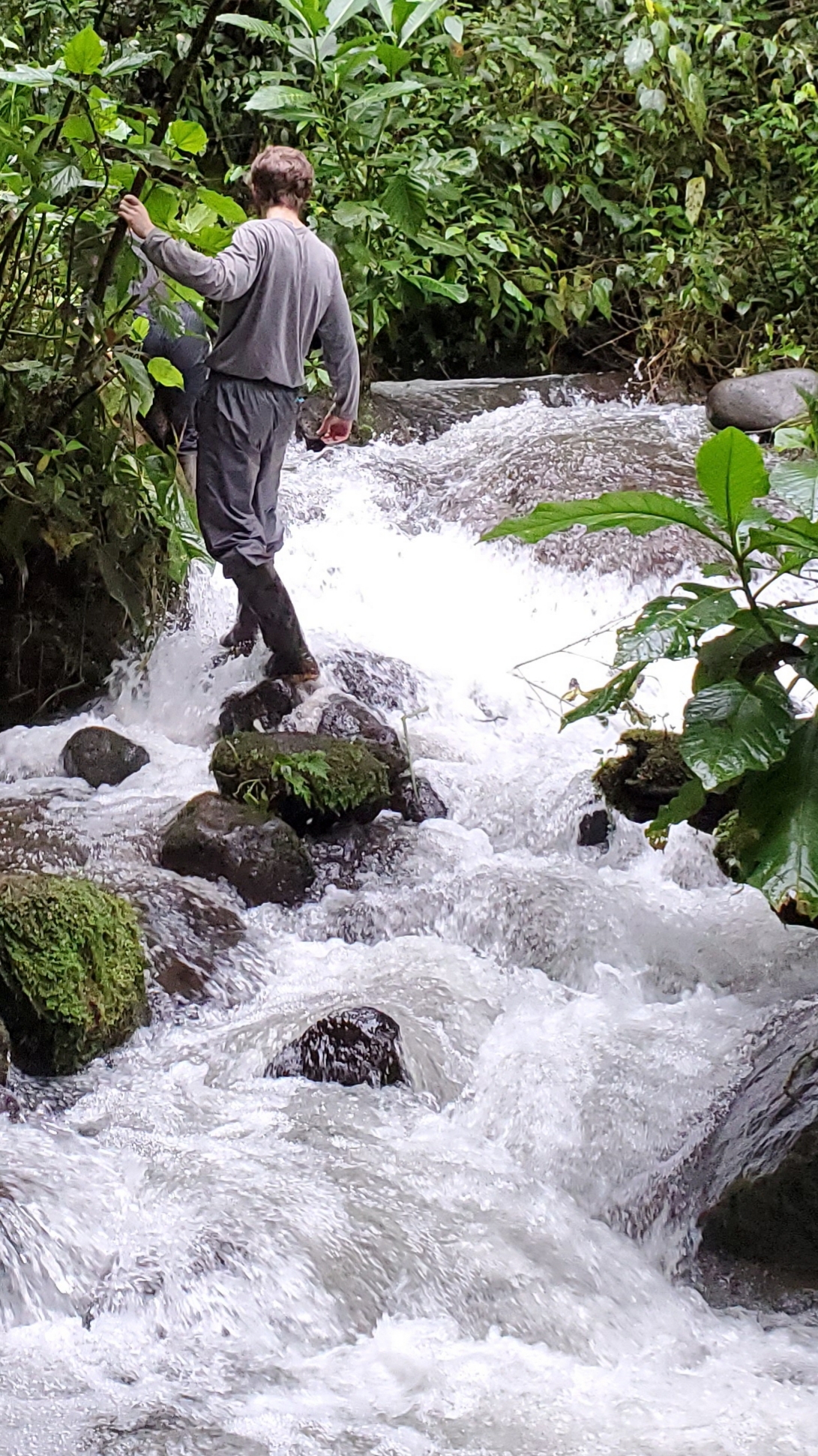
The water system broke half way through their stay, so Bridget and I exposed Mark and Neil to the wonders of the water trail. Turns out a giant tree had fallen across the manguera and snapped a valve clean off. That’ll do it…
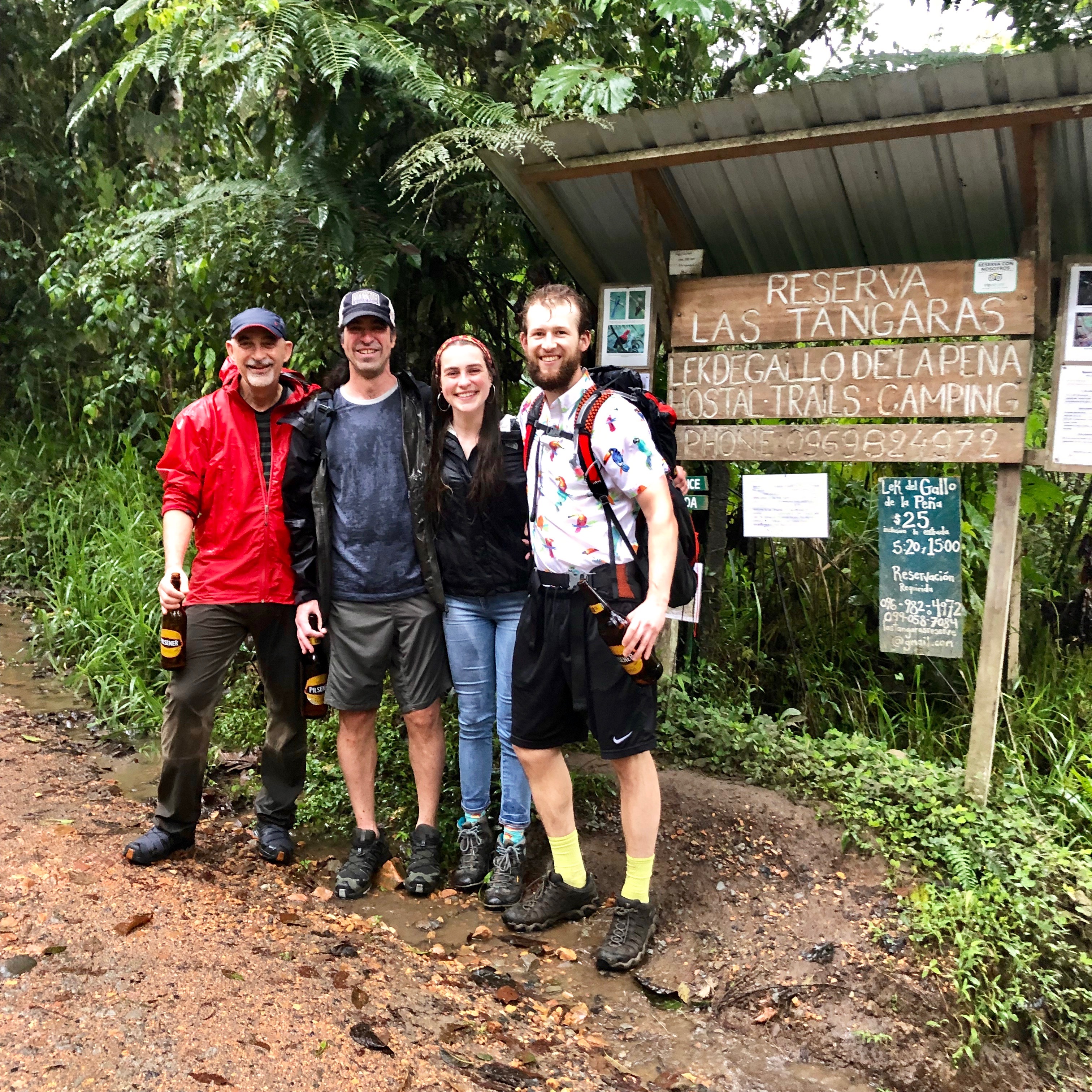
Road beers make the 5-km hike back to the reserve in the rain MUCH easier.
It was really special for both of us that Bridget’s family were able to make the trip out, especially considering all the problems brewing in the States in response to coronavirus. It was actually the first time I got to meet several of them which was awesome, and Bridget absolutely loved seeing them all again and catching up. We were totally psyched to show them around our new backyard, and it seemed like they enjoyed it too! Guys, if you’re reading this, thanks a million!
Speaking of our backyard, let me now segway to the second half of the month which has been characterized by solitude (the good kind) and nature (do I sound like Thoreau yet?). I know you all are really here to hear about the latest bird gossip on the reserve, so I won’t waste any more time. We completed a 4-day venture to capture Cloud-forest Pygmy-Owls for a scientific paper that Bridget is spearheading. Unfortunately, we did not catch any (awww), but every morning there was at least one owl calling right above the mist nets (yay!). Cloud-forest Pygmy-Owls have an extremely limited range on the western slope of the Andes in Ecuador and the southern bit of Colombia, which makes them an inherently threatened species without even considering the additional negative impact of human deforestation and climate change. As a result, the Cloud-forest Pygmy-Owl is currently listed as Vulnerable, making any research on them valuable contributions to their conservation — cue Bridget et al.
Our cabin bird list (started by Guillermo and Alya, you can only add birds to the list that you saw, no heard-onlys, from the cabin) now stands at 104 species with recent additions of Tawny-bellied Hermit and Purple-crowned Fairy. The hummingbirds have been delightfully plentiful recently, both in abundance and species in richness. Beyond the normal suspects, we’ve been receiving frequent visits from a Purple-crowned Fairy, a pair of Purple-throated Woodstars, a female Booted Racket-tail, a Buff-tailed Coronet, and even a Bananaquit!
Bridget and I have spent most of our free afternoons writing up scientific manuscripts with the years of bird data that has been collected from the reserve. Writing these papers is really a win-win for all parties involved, because the data gets published, Bridget and I get writing experience and publications, and the birds eventually benefit from environmental policy and management plans based off of the published journal articles. We’ve really enjoyed the process overall, even if there are some tedious data management and editing tasks. I’ve been mainly focusing on two papers about Andean Cock-of-the-rocks, and Bridget is working on papers about cloud-forest hummingbird survival and Cloud-forest Pygmy-Owl natural history. We also submitted abstracts about our research to the North American Ornithological Conference, held in Puerto Rico this year, so hopefully we are accepted (but I have a hunch that the conference is going to be cancelled due to coronavirus…).
It’s totally weird seeing Mindo quiet like this with no tourists, street vendors or music. But at the same time, nobody seems that preoccupied with the situation — not with getting sick, anyway. People seemed more concerned about the lack of tourism that normally drives the Mindo economy. When you prevent tourists from coming to a town that survives on tourism, people start getting worried. Hopefully this all blows over soon, for their sake, and for everyone else around the world who has been left jobless.
Who knows what things will be like moving forward. But I guess life stays interesting because you never know what’s going to happen next, right? I’m sorry, I recognize that was a cheesy bit of philosophy. Isolation in the forest does things to you.
See you in April!
Henry
Slipping and sliding through February
Well despite it being a leap year, another month has flown by! By now we’ve been able to explore the entire reserve and have a good knowledge about the trails. I think we’d both agree that the trail we frequent the most is the Fuente de Agua trail. While it may sound like a lovely, tranquil trail running along the river, let me assure you it is quite the opposite. The Fuente de Agua trail, or the water system trail, is our slippery and very muddy trail leading to the intake source for our water supply. I should add that getting to the intake source requires us to walk up stream in the river, using rope to swing across or climb up the bank in some sections (don’t worry parents this is why we use the buddy system).
Now if it’s such a bad trail, why are we on it all the time you may ask. Well this month the water system has broken a record seven times in three weeks. The first time it took us an exhausting six hours going back and forth along the trail trying to troubleshoot the problem. We located a gaping hole in the manguera (the black rubber piping that carries the water to the house) and fixed it to the best of our ability. However, two days later we realized that our best just wasn’t good enough and had to fix it a total of two more times–each time learning from our mistake and making the section stronger–throughout the week. The main problem now seems to be air bubbles getting trapped in the manguera which happens during heavy rains, and seeing that we are in the rainy season, there’s not much we can do about that besides monitoring it. While it’s very demoralizing to turn on the faucet and see the slow trickle of water turn to nothing, the silver lining is that we’re now great plumbers who stay in good shape hiking back and forth and back and forth and back and forth…
Apart from the water problems, we have been very lucky this month with our guests. We’ve had people visit from Belgium, Hong Kong, Canada, etc. all of whom are very friendly and eager to talk to us about what their time in Ecuador has been like. We’ve even had some familiar faces this month, including Henry’s grandma who braved crossing the bridge to bring us our own supply of TWO jars of yummy peanut butter (thanks Edie!) and the previous incredible managers Alya and Guillermo.
Each visit gave us a much needed boost of happiness! Additionally, we’ve had an awesome volunteer with us for the majority of the month. Laura’s been super helpful staying on top of trail maintenance while we go off to battle the water system, and provides us with words of encouragement and yummy zucchini bread to lift our spirits. We’re very sad to send her off to Quito today.
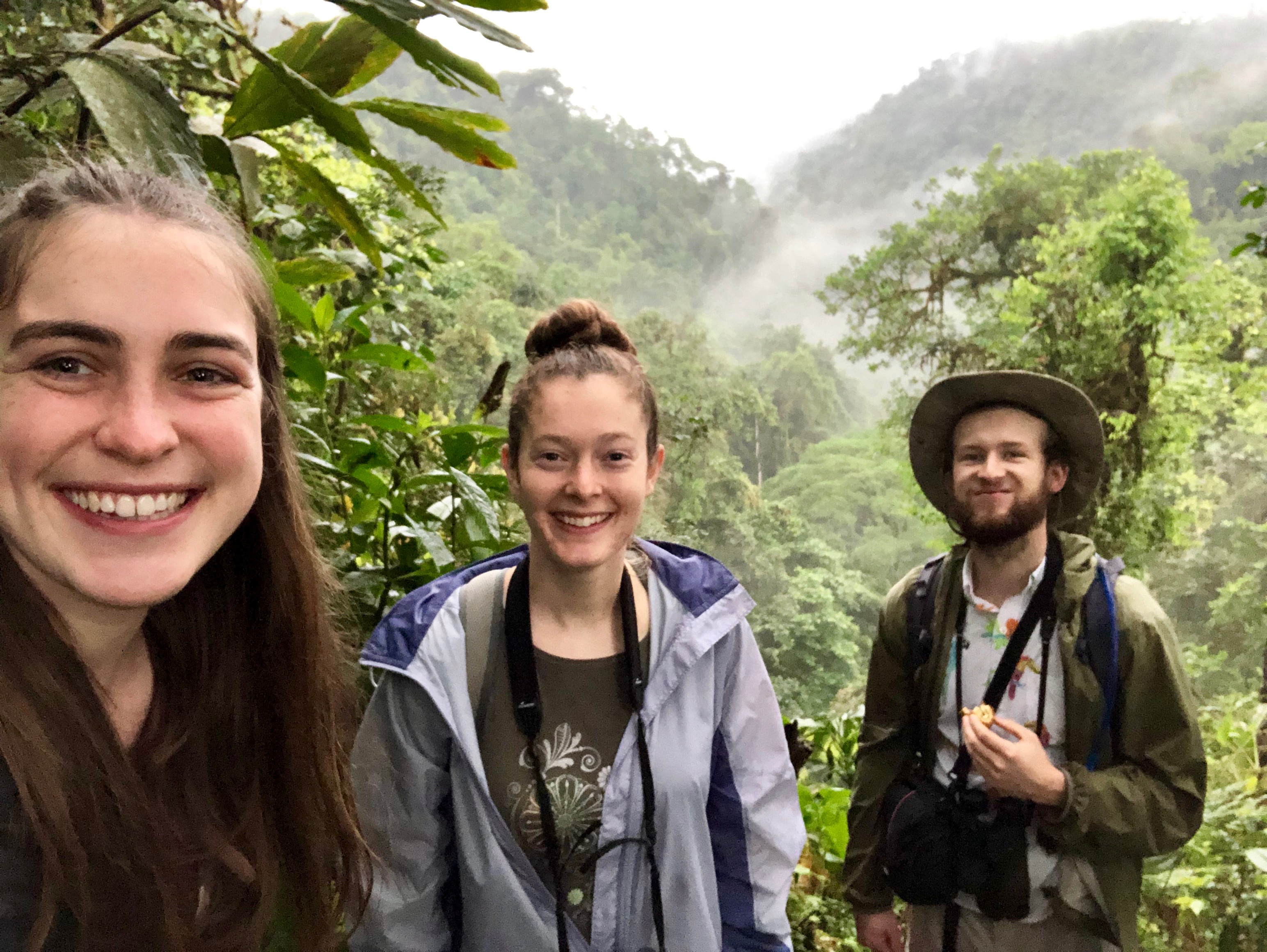
(Left to right: Bridget, Laura, and Henry ft. his favourite breakfast bun)
We’ve also been very lucky in the bird world from seeing to banding new species. We saw a Mottled Owl from the cabin (which was calling at 3 am and yes, Henry made me get out of bed to help spotlight it), we banded a pair of Beryl-spangled Tanagers which are nesting 3 meters away from the cabin, and Henry saw a Cerulean Warbler (which is apparently rare and exciting).
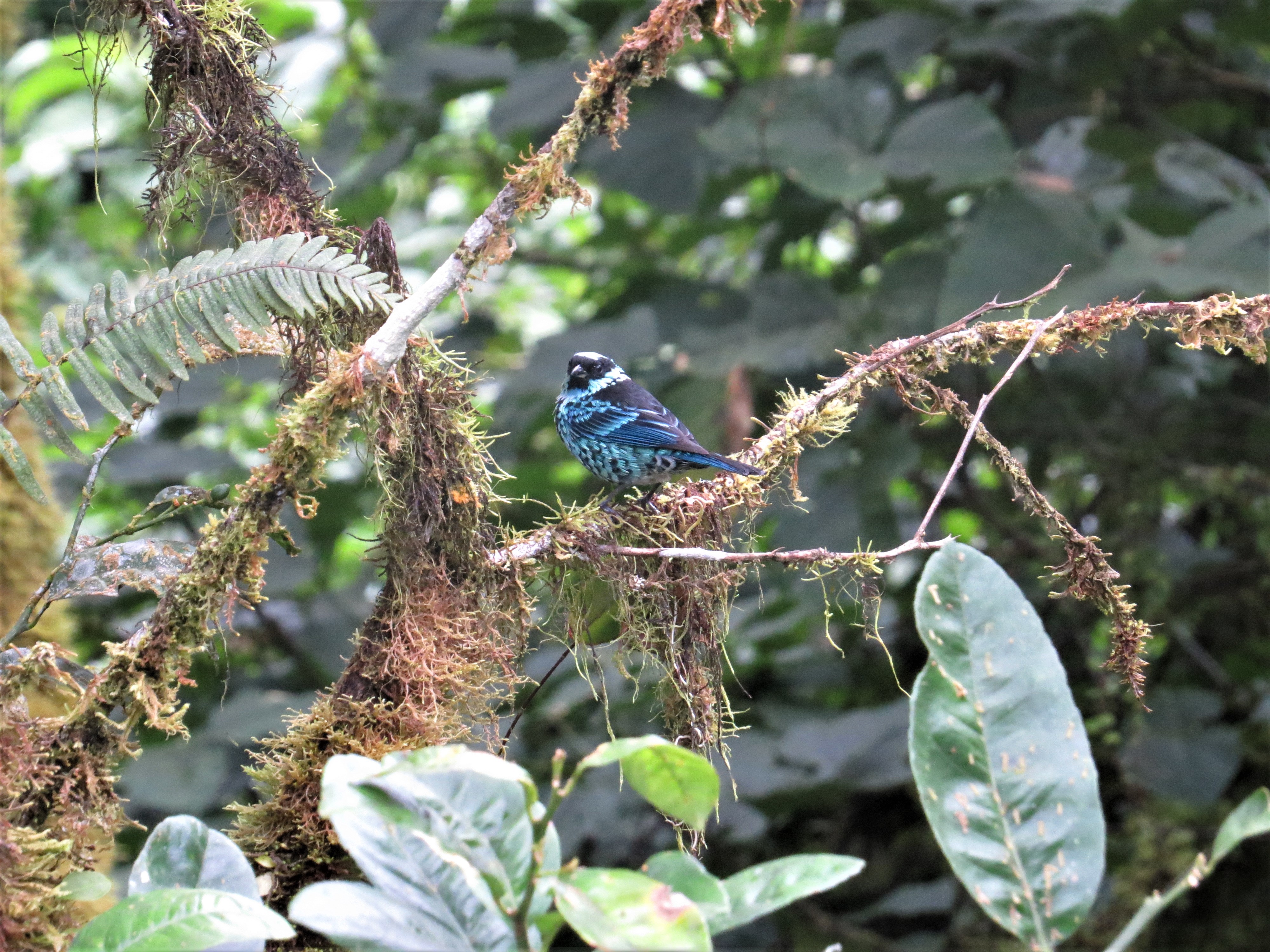
(One of the Beryl-spangled Tanagers parents outside the cabin)
But nothing has been able to outshine my personal favourite: a tiny Purple-throated Woodstar that has been coming around to our hummingbird feeders. If you don’t know what it looks like I’ll wait while you go ahead and Google it… adorable right?! And it’s not just its size that makes it so stinking cute, it’s the way it behaves around the feeders too. While the other hummers divebomb each other and flit aggressively around the feeders, the Purple-throated Woodstar floats in, bobbing up and down while wagging its tail–making it impossible not to smile. I thought it must be singing a little diddy in its head while flying, to which Guillermo laughed and told me it was a good thing we were going into town soon.
Another exciting development are the three Gray-breasted Wood-Wren nests that Henry discovered! We’ve been documenting the chicks growth by weighing them and keeping track of their development i.e. when their gape formed, when their eyes opened, when their feathers developed (NOTE: Henry has extensive experience handling baby birds–we would not be attempting this otherwise!). I’ve found it really cool seeing the weird alien babies turn into something that resembles a bird. We’re hoping to publish our findings once they’ve fledged and provide useful information about Wood-Wren breeding biology. Also, I found a Rose-faced Parrot on one walk into town and Henry saw that its mate was inspecting a snag as a nest site! We were both super excited since it is a very elusive species and information about them is greatly needed. We jumped on the opportunity to learn more and set up a camera trap the next day.
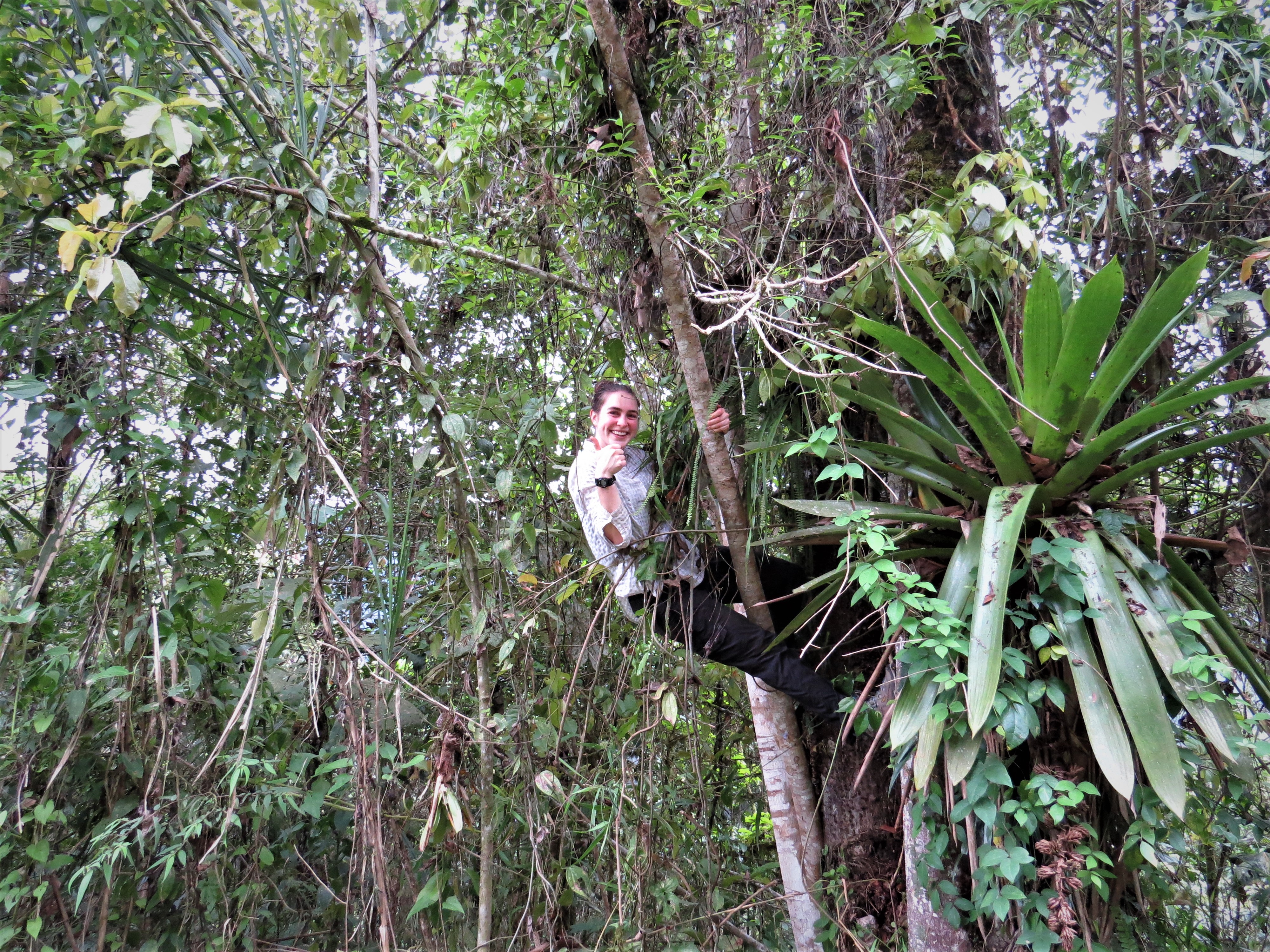
(Alright, Henry did give me a small boost up there!)
It’s a good thing I climbed lots of tall trees as a kid. Neither of us have spotted them since, so we aren’t optimistic that they are nesting there, but we’re keeping our fingers crossed!
On that same day into town, a super friendly taxi driver, Giovanny, offered to take us the rest of the way into town. We learned that he’s had just about every job possible, but his dream is to work in transport. He loves being a taxi driver and has become a good friend of ours–he even invited Henry to play soccer on the weekend with his friends. Another person we’ve befriended in town is a chef named Fernando who owns a fantastic vegetarian/vegan restaurant. Being vegetarians at the reserve due to our lack of refrigeration, we’ve both found that if we eat meat or fish in town upsets our stomachs. So we’ve been avoiding it while not sacrificing any of the taste or flavour. After all, it’s impossible to miss the taste of meat while eating a delicious authentic Argentinian empanada made with fresh dough. Fernando happily offered to bring us things from town if we ever need them since his family drives up the road every Sunday. We haven’t asked him for anything yet, but we talked to him about bringing us propane tanks which brings me to another peculiar story. While Henry and I are both strong, the idea of carrying a propane tank across the bridge is something we’d like to avoid. So in order to get more propane, we call a man known at the reserve as Simon the Mule Guy. Appropriately named, Simon brings a mule from town who crosses the river, picks up our empty tanks and walks back to the entrance to meet a taxi driver we previously called to bring two full tanks from town, exchanges the tanks, and then walks back across the river to the reserve. Quite a trek, but so is the way of life on the reserve!
Well that sums up the peaks and valleys of this month. We’re eager for March to come since both of our families will be visiting and we can’t wait to show them around the reserve and Mindo. Until then we’ll be blissfully enjoying the two consecutive days we’ve had of working water–must be a Carnival miracle!
The Integration Period
Hello from the cloud forest!
Bridget and I (Henry) are about to begin week 4 of managing the reserve — woah! We got here on January 8th (my birthday yay!), and haven’t been alone until now. We were lucky enough to overlap with Dusti, the owner of the reserve, for a few days, and with the previous managers, Ayla and Guillermo, for 5 awesome days before taking on all responsibility. On the 12th, we welcomed our first volunteer, Jory, who was with us up until the 26th. So, here we are now with a moment to breath and have the reserve all to ourselves. Let’s catch you up on the highlights of the last 3 weeks!
First and foremost, I’ll give some background on who we are. Interestingly, Bridget and I were both born in California, but didn’t meet until the very beginning of 2018 in Peru for a semester abroad with the School for Field Studies. We both recently graduated from undergrad; Bridget from the University of Maine in Orono with a degree in Wildlife Biology and myself from Tufts University with a dual degree in Biology and Environmental Science. Bridget spent most of her life growing up in Pittsburgh, PA, and I grew up in Exeter, NH. We are both wildlife ecologists, and were primarily drawn to Reserva Las Tangaras by the sheer potential of research that could (and should) be done. That, and we have some time to kill before starting grad school in the fall. Bridget’s research interests focus on conservation biology and species interactions within an ecosystem (e.g., how coffee agriculture affects pollinator communities, or how birds adapt to parasites), whereas I focus entirely on conservation ornithology with a tropical emphasis. Our past field jobs and internships (some together and some not) took us to New Mexico, New Hampshire, Cape Cod, Mt. Pocono, Costa Rica, and Belize. Ecuador will likely be the most challenging and rewarding of them all!
Travelling from Boston (we were in New Hampshire before coming here) to Quito was surprisingly straightforward — except for the fact that I found a bat in my hiking shoe when we were waiting to check our bags, and freaked out about rabies for a while after that even though I’m pretty sure I didn’t get bit. But the actual travelling was really quite easy. Actually, Copa Airlines almost didn’t let us check in because our return flight was more than 90 days after our arrival flight, and the tourist visa only lasts 90 days. Me trying to explain to them that getting the extended visa was really quite straightforward once we were in Ecuador didn’t help, so we just booked an earlier flight home and then cancelled it once we arrived (PSA for anyone else planning an extended visit to Ecuador: apparently you can get your extended visa in Connecticut before leaving).
Taking the bus from Quito to Mindo only costs $3.10 per person despite being a trip of 2 hours! I forgot how much I love prices in Latin America. We arrived in Mindo and walked around for about an hour before meeting up with Guillermo, Ayla and Dusti at a boujee (well, boujee for Mindo) place called El Quetzal, where we learned about “el almuerzo” — if you go into practically any restaurant in Mindo, you can ask for “el almuerzo,” which isn’t advertised on any menu but is often the cheapest lunch item available. We got “el almuerzo” at El Quetzal, which consisted of a big soup and a main plate of trout, rice, beans, and veggies, plus juice, all for $5.
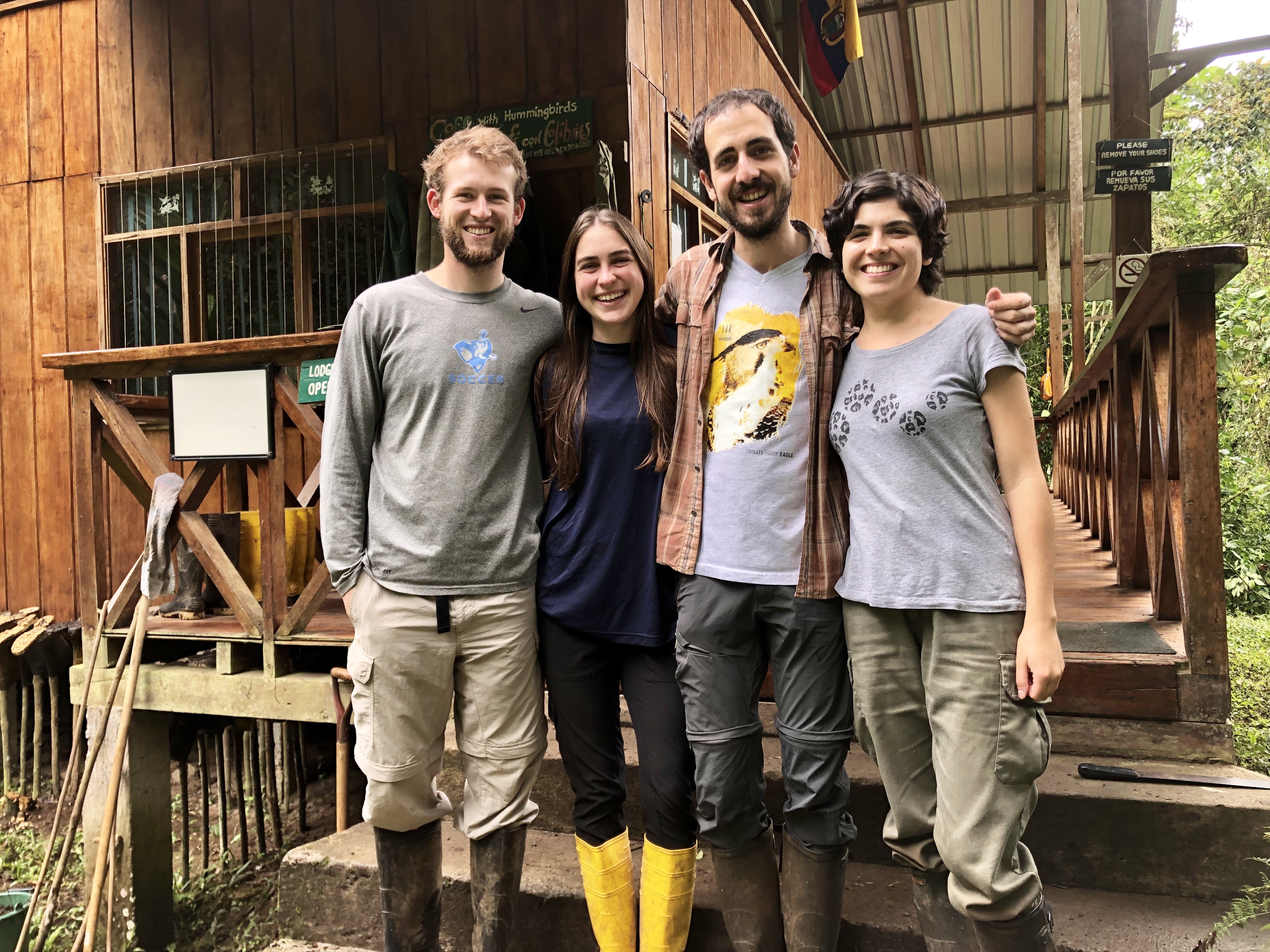
(L to R: Henry, Bridget, Guillermo, Ayla)
After lunch, Guillermo and Ayla showed us around town and pointed out every shop we’d most likely have to visit during our stay here. There are 3 main “grocery stores,” which are the size of a gas station minimart but somehow contain an amazing variety of food, and each of the owners seem to be easily offended if they know you’ve been shopping at another store. If you don’t visit them once a week, they start questioning and guilt-tripping you: “Didn’t see you last week. Where were you? Why don’t you like us anymore?” It sort of feels like we are dating each one of the owners and they have major trust issues. Our solution is to visit all 3 stores each time we go into town. Seems to be working so far. I’d imagine we’d probably have to do that regardless, because so far it’s been impossible to find everything we need at one store. And the prices vary wildly from store to store for some items. Peanut butter and olive oil are two recent examples. Speaking of peanut butter, if you’re coming to visit the reserve sometime between now and July 1, PLEASE bring us American peanut butter. The peanut butter here comes in bags and is often dry.
Anyway, fast forward to our training at the reserve. For the first couple of days, we’d spend the entire day absorbing important manager information from Guillermo and Ayla, who are amazing, friendly Spaniards. As we had anticipated, there is always so much to do here. Keeping the trail system clear has definitely been the most time-consuming duty thus far, and we often go clear trails every other day (doing it every day wears you out FAST). When we aren’t clearing trails, chores around the cabin are often the priority, including but not limited to: cleaning, sanding/maderoling/varnishing, fixing the water system, cooking for guests, collecting hummingbird abundance and weather data daily, trapping giant spiders and bringing them outside, etc., etc.
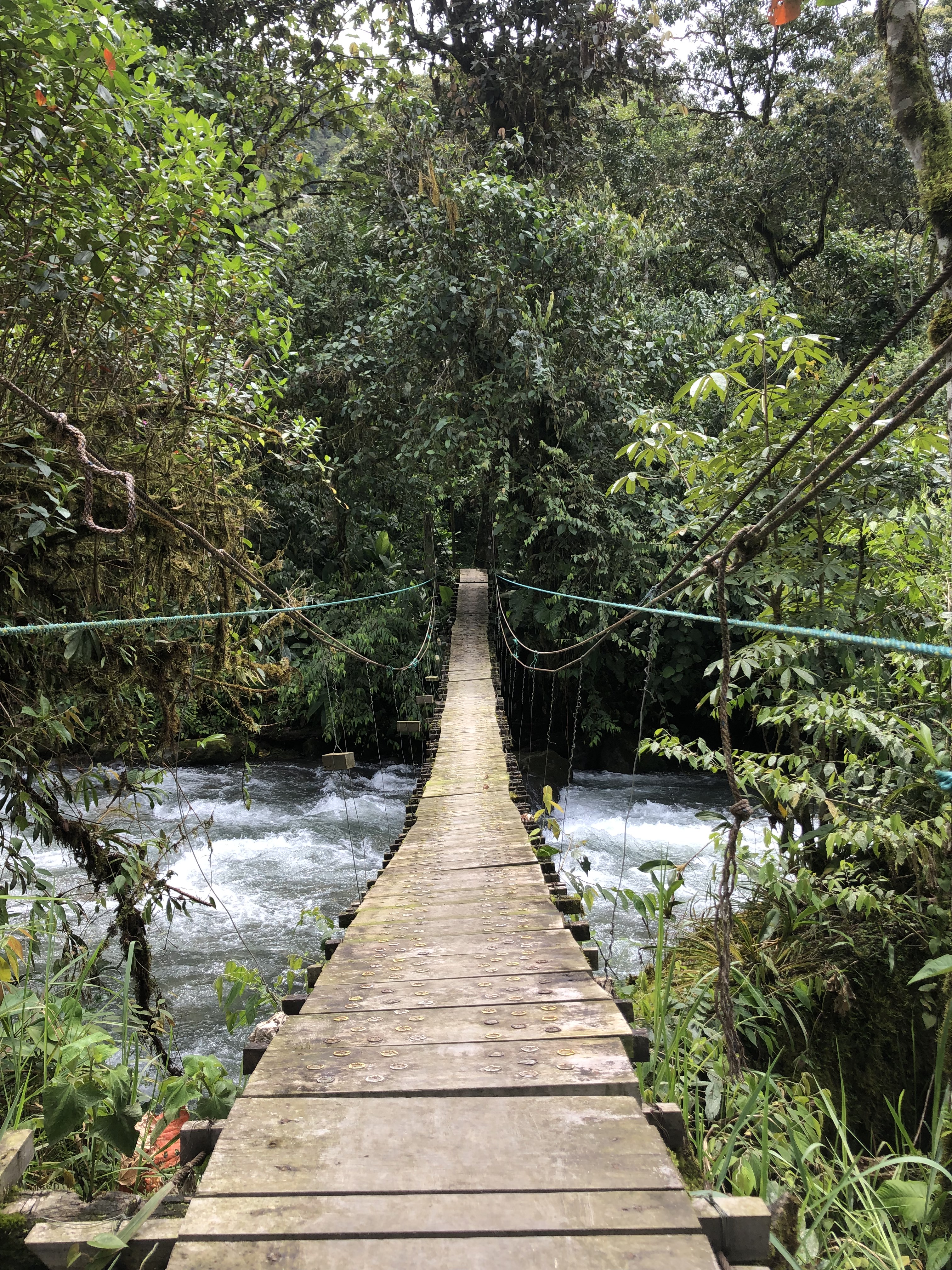
(The bridge to get to the reserve — haven’t fallen off yet)
Our biggest issue so far has been dealing with the external water heater, known locally as a “calefon.” The damn thing broke the day Guillermo and Ayla took off, and I’m convinced that Mother Nature was testing us or something. Anyway, after 7 hours of trying to figure it out, I finally gave up and called Cesar “el maestro,” a local guy from Mindo who is known for being able to fix gadgets like calefons. He fidgeted with it for a while and determined that the ignition system — three wires with little metal elbows connected to the main battery that generate sparks to ignite the propane — was on its way out. Only one of the metal elbows still sparks, so each time we want to start the calefon, we have to manually warm up the ignition system but flicking the switch that generates sparks 3-4 times until its able to ignite the propane. At least that’s what I think is happening. My dad would normally help me out in this type of situation.
Let’s talk about something more exciting: BIRDS!!!!! The birding here is phenomenal. Since we’re located in subtropical cloud forest, the trees aren’t super tall (like they were in the Amazon), meaning many of the canopy-dwelling bird species (which include most of the species you can possibly see here) are actually visible. The diversity and coloration of the tanagers here is awe-inspiring. Look up pictures of Flame-faced, Metallic-green, Glistening-green, White-winged, and Golden Tanagers and see for yourself. I’m amazed that these rainbow-colored gems don’t get sniped by raptors more often!
Every June and December, a banding expedition comes to the reserve to band birds every day for 2 weeks, so there is an extensive set of mist-nets and banding kits here that we’ve been able to use during days when we don’t have any priority maintenance work to complete. *NOTE: we have a strong background in extracting and banding birds, otherwise we would not be attempting this! Our most recent banding outing (and the most exciting one) was focused on Andean Cock-of-the-rocks. One of the main attractions of the reserve to tourists is the fact that it holds the largest Andean Cock-of-the-rock lek in the Mindo Valley area, and many of the males have been color-banded here as part of a long-term monitoring study. Color-banded birds have two types of bands: the traditional aluminum band with a unique serial number, and several plastic bands that are a solid color. For those of you unfamiliar with leks, they are essentially a spot in the forest where males of a species congregate to display for females. Usually, they are more open areas in a forest (e.g., a dead tree with snags), but the Andean Cock-of-the-rock lek on the reserve doesn’t really look any different than the surrounding forest besides the fact that is along a ridge. Anyways, some of the younger males at the lek haven’t been color-banded yet, so we set out to attempt to capture these unbanded males and add them to the study (and to recapture males that are already banded — resighting color-banded individuals is a useful way of “recapturing” them without having to catch them, but actually catching them and reading the number on the aluminum band gives 100% certainly that it is the same individual you originally banded). Anyways, we were able to recapture one color-banded male, an unbanded male, and an unbanded FEMALE! Catching the female was super cool because it’s normally very difficult to see them. We gave the new male two green color bands and called him “the Hulk.” I thought it was kinda funny. I really wanted to use two yellow color bands and call him “Big Bird,” but unfortunately that combo was already taken… Our next banding targets are Cloud-forest Pygmy-Owls and Club-winged Manakins, both regionally-endemic species that are data deficient. We hope we can combine our banding data with existing data collected by the banding expeditions and get a few short publications.
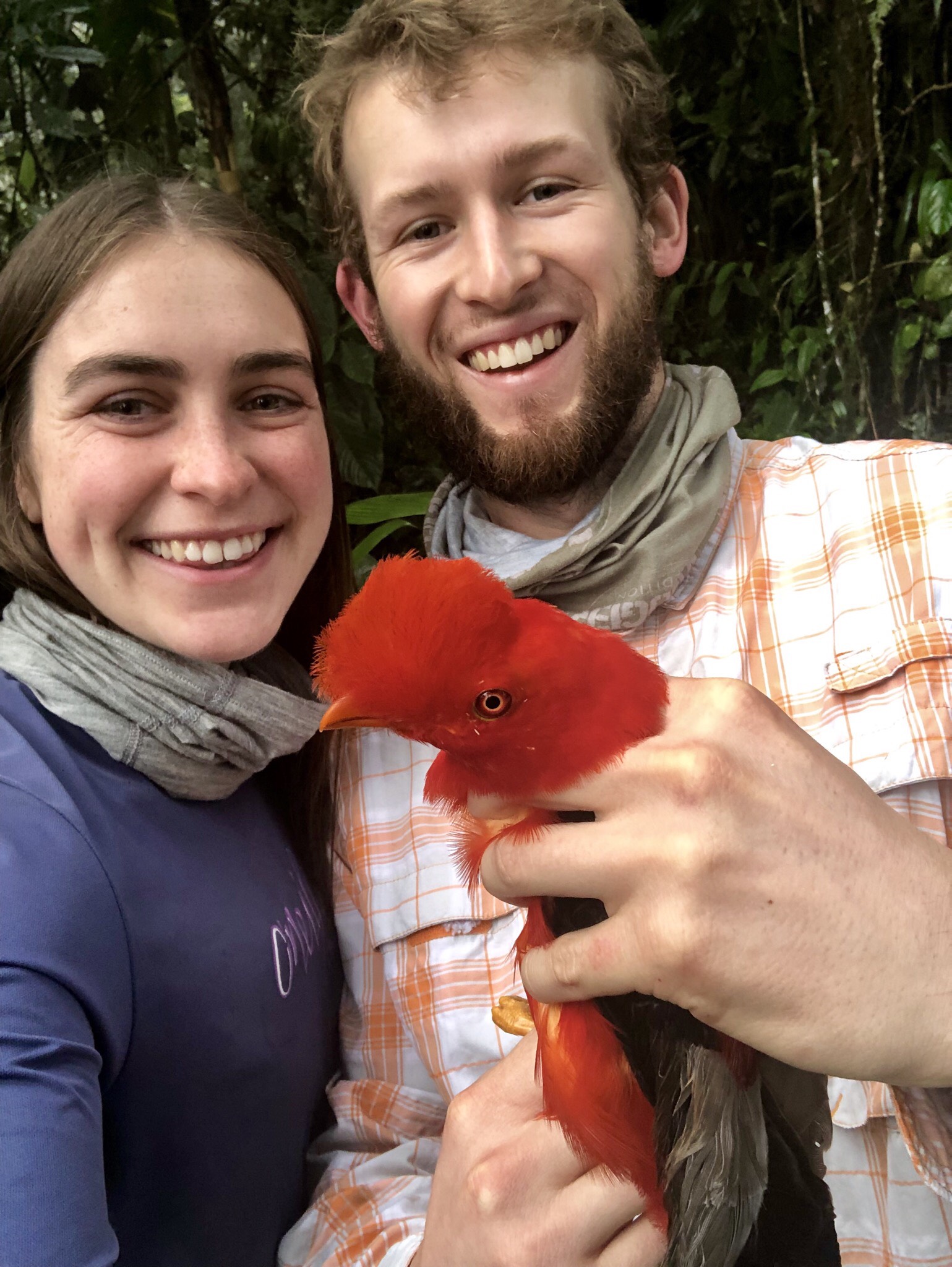
(New color-banded male, “the Hulk”)
Something we were somewhat dreading coming into the job was the ridiculous 5-km-long walk to get from the cabin in the reserve to Mindo and visa versa. But, having done it now 3 times, it really isn’t that terrible–it’s more annoying than anything, especially if it’s raining. I secretly kind of like it because it’s a great workout. Pretty much the only types of workouts we can do here are hiking and pushups/ab circuits, but we often find ourselves too tired to workout after a day of macheteing. Since we’re in the mountains on the side of a valley, we have to hike if we want to go literally anywhere that isn’t the cabin, so that’ll hopefully keep us in shape during our 6 months here.
Well, that’s all the major news here! I’m sure we’ll run into some more problems before too long, and then Bridget will tell you all about our highs and lows in the next blog post! We decided it would probably be easiest if we switched off writing each blog post, so she’ll update you all in February.
Thanks for reading! And remember — you are extremely lucky to enjoy good peanut butter and hot showers on a regular basis. And electricity in general. And refrigeration. Yeah, we don’t have that either. But we don’t have to deal with the news, so who’s laughing now?
EL ENCANTO DE LO INESPERADO (BENDITA TIERRA PICHINCHA)
Recibimos la visita de los padres de Guillermo, uno de los managers, en noviembre, y estas son las reflexiones de Beatriz, su madre, durante los días que estuvieron con nosotros. ¡Esperamos que os gusten y os animen a venir!
La nieve cubre generosa los montes de la sierra norte de Madrid. Me baña la luz dorada del otoño, y se suma a mi deseo viajero de búsqueda para añadir un poco más de savia a mis venas. Me pongo los auriculares y escucho Mother Nature y ese estribillo delicioso de McCartney, tu tu tuturu tu ru tu…
Me espera la selva impenetrable de Mindo sin que yo imagine que vaya a conquistarme como lo hace. Además del abrazo de mi hijo junto a una cabaña perdida, la espléndida morpho, engañosa como un pájaro azul y negro, me hace llorar en cuanto pongo los pies en esa selva, pies sometidos a unas botas nuevas color musgo compradas en Decathlon. Se me agolpan las sensaciones y no sé si voy a ser capaz de ordenarlas, si en mi deseo de expresarme no perderán emoción los momentos. No hay luz eléctrica y apenas puedo escribir por las noches, así que me dedico a respirar mientras escucho los sonidos de los habitantes de la reserva, de aquellos a los que les gusta expresarse entonces. La oscuridad y las emociones vividas durante el día potencian enormemente ese instante. A partir de las seis desaparece la luz y con ella un montón de criaturas diurnas.
Nos separa de la civilización un puente colgante de una inestabilidad encantadora, tanto, que sólo puede cruzarlo una persona al mismo tiempo. Cuando lo cruzamos ya anochecido, me detengo en el centro, golosa, avariciosa, y miro alrededor y huelo el agua que corre bajo mis pies. Y se me llenan los ojos de eso, de agua, al descubrir el titileo de las luciérnagas macho en su búsqueda incansable y darme cuenta de que formo parte de ese mundo en el que todo encaja sin estridencias.
A veces por la noche llueve y como chocolate artesano con un poco de café. Son pedazos delgados e irregulares que consiguen no hacerme olvidar el proceso artesanal desde el grano de cacao, desde la raíz hundida en la tierra fértil de la costa más cercana.
Me alimentan los matices de verde que la selva de Mindo ofrece, mezclados con los dorados, naranjas y ocres de un otoño ya avanzado. Cimbrean las copas de algunos arbustos cercanos a la cabaña y aparece entre ellos una mula torda cargada con dos bombonas de butano plateadas. Al animal lo conduce Simón, que habla el español cadencioso de por aquí, y que a mí me emociona comprender aunque a veces no parezca la misma lengua. La mula todavía está mojada. Ella no puede cruzar el puente y debe atravesar por el agua hasta alcanzar un sendero semioculto que Guillermo y Ayla tienen que despejar con el machete a menudo. Simón y su mula dejan en el aire una música de agua y sol y a mí me envuelve la fuerza de esa vida tan pura. Me invade una duda difícil de evadir: la belleza soberbia del lugar me hace pensar que alguien ha montado este escenario para hacérmelo creer. Allá donde mire es así: el saltamontes verde y amarillo, el escarabajo azul eléctrico, la mariposa que simula ser una hoja, la que tiene dos ojos de búho estampados en sus alas (para quien el aroma del plátano y la papaya maduros son irresistibles, y que le hace desenrollar golosa la trompa frente a mí), las treinta especies diferentes de colibríes en un radio de un par de kilómetros, que surgen bajo los arbustos cercanos a la casa zumbando como abejorros de colores disparatados… Sé que cuando regrese y recuerde estas cosas, el alma se me llenará de color y de gozo, y que recordaré al colibrí negrito (que es el primero que vi) y que el sol irisaba dotándolo de una belleza tan sorprendente como inconcebible.
Miro al cielo sin pensar y los veo. Vuelan alto los zopilotes en ese mismo instante y siento que la vida es hermosa entre buitres y colibríes, disparatada, contradictoria, pero hermosa.
Mindo me ha acercado a mi esencia a través de la simplificación de la vida cotidiana, volver a vivir con los astros como antaño, comprar sólo lo necesario, prestar atención a lo que la tierra ofrece, detenerse en lo pequeño, alimentarse de la luz, de la paleta de colores del follaje, de las libreas de los insectos y de las aves. Es una belleza que alimenta, que engrandece al planeta y a aquellos que luchan por su protección. Hermosa, linda, bella tierra pichincha, yo te agradezco.
Llegamos a la reserva después de un día largo, y agradezco con el alma la ducha bien caliente que nos damos al amparo de los sonidos de los animales nocturnos y el fragor del Río Nambillo. El único árbol cuyo nombre conozco de los que crecen ahí fuera es la cecropia, cuya sola hoja puede guarecer a tres o cuatro personas de la lluvia. Me emociona ese colchón, ese envoltorio tranquilizador de árboles de nombres desconocidos y que, sin embargo me resultan tan cercanos, un complemento indispensable de mi ser.
Al amanecer los colibríes esperan su alimento y se nos acercan a las manos sin temor. Llegamos a contar unas 15 especies diferentes de las 30 que habitan aquí. A menudo se me quedan cortas las palabras que me ayudan a expresar lo vivido. Y el momento de los colibríes es uno de ellos. De repente, aquí, en mitad de la selva, me quedo muda ante tanta belleza, y sin deseo de escribir. Sólo vivo. Cada noche hay que retirar los bebederos para que no se enmohezcan, ahuyentando primero a los murciélagos bandidos ansiosos de endulzar su cena. La verdad es que imponen, son enormes, y me da risa como les gritamos sin mucha convicción para que se larguen. Ayla grita más que nadie y eso me sorprende porque habitualmente es una mujer suave y comedida. Sin embargo no se coarta y exclama que el buffet se ha terminado, palmoteando y agitando las manos.
Estas impresiones tan fuertes que recibo, ¿serán porque no esperaba nada? No quise prepararme ni saber, para no imaginarme, para no prejuiciar.
Toca levantarse con el sol y lo disfruto mucho. Siento que nazco con el día y eso hace que me recorra una energía plena. Hoy vamos a visitar el lek del gallito de roca. Para eso hay que ascender mucho en poco tiempo y alcanzar la cumbre antes de las seis. El comportamiento es siempre el mismo. Hay una hembra de librea insulsa a la que siete u ocho machos pretenden conquistar con su plumaje rojo carmesí. Al acercarnos el reclamo es ensordecedor y enseguida los distinguimos entre el follaje tan verde, como si fueran adornos navideños dignos de La Quinta Avenida. La explosión apasionada dura apenas treinta minutos. Luego el griterío se desvanece hasta el día siguiente. En ese punto estamos a tiro de piedra del bosque primigenio donde la selva es más cerrada y exuberante, donde ningún ser humano ha osado intervenir. Tengo pena de no saber qué especies de árboles me rodean. Hay muchas epífitas, proliferan las bromelias… pero estoy tan concentrada aprendiendo aves nuevas que no puedo detenerme en el mundo vegetal. El bosque nublado parece una enorme floristería en la que todo encaja. Y este bosque virgen me transmite la esencia de lo puro, que se acompasa con el latido del corazón caliente de esta tierra. Siento que por lo menos en este pedazo de mundo todo está en su sitio. Debe tener algún tipo de aura protectora que impide que ningún ser humano venga y la fastidie (por no decir la joda). Me siento privilegiada por pisar este suelo, así que me arrodillo y lo beso cuando nadie me ve.
Llega el momento de partir y pese a la poderosa expectativa de visitar las Islas Galápagos, siento que ha prendido en mí la semilla inesperada, (por lo inesperado del viaje, quizás) de esta selva que ha resultado ser un auténtico hogar. Doy las gracias al espíritu tangara pichincha que aquí habita. Bendito sea.
Por Beatriz López Blanco.
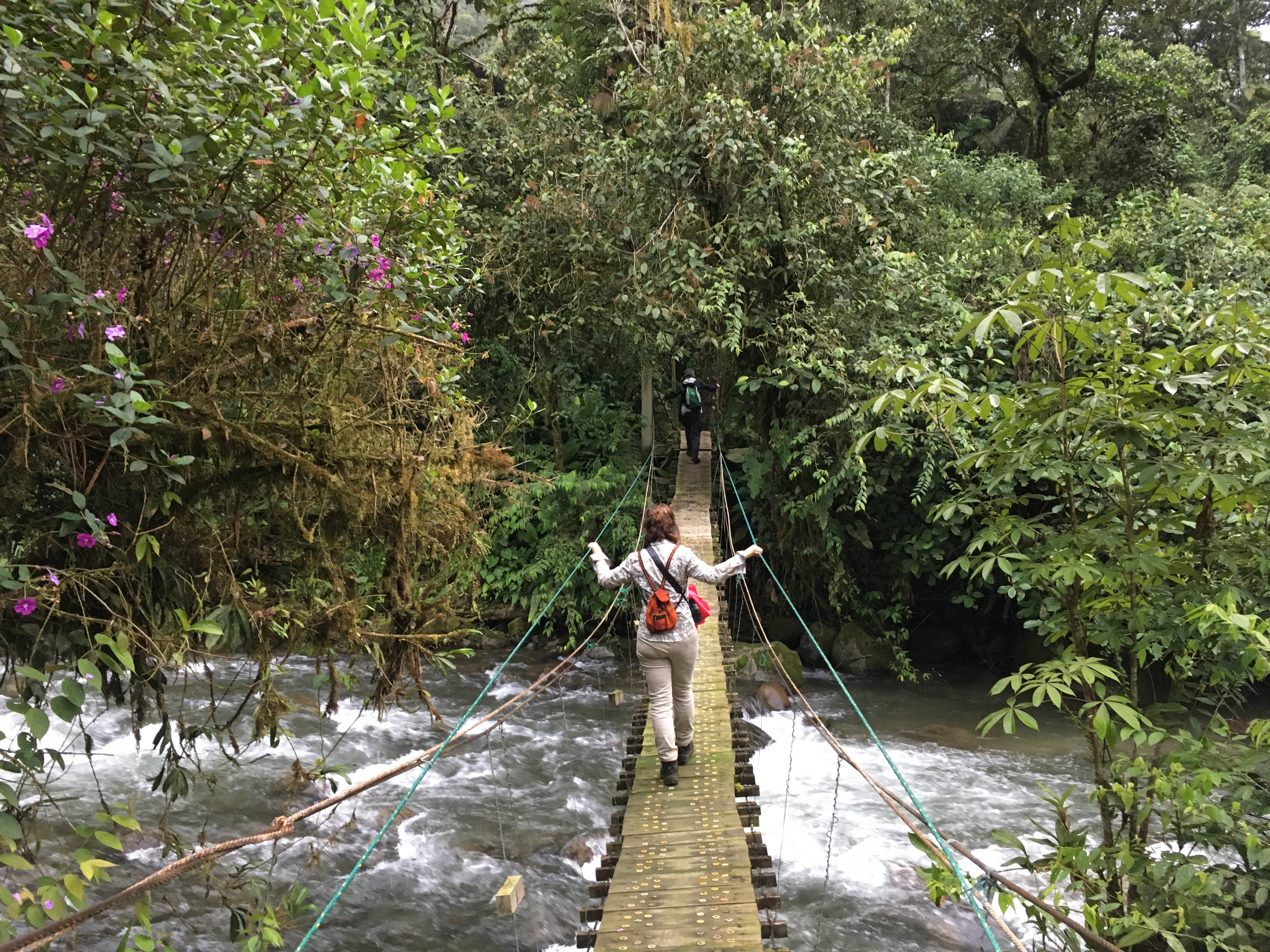

 Reserva Las Tangaras