LifeNet Bird Survey 2012
July 15th brought our first large group of visitors to the reserve with the arrival of Dr. Dusti Becker and the LifeNet volunteers for the Las Tangaras, Ecuador Cloud Forest Bird Surveys. For the next two weeks we assisted the LifeNet team with multiple bird surveys that consisted of mist netting in low cloud forest, edge netting in Yanez Pasture and second growth forest. Volunteers were trained in the construction of mist nets, safe removal of birds from the nets, and the proper techniques for data collection and entry.
Our mornings were spent manning the nets, after which we were always rewarded with a hearty and delicious almuerzo (lunch) by our talented chefs Jessica and Alicia. Following lunch came siesta, always a favorite, where some chose to nap, swim or simply lay in the hammock and read a book. Afternoons varied with data entry, hiking the lovely trails of Las Tangaras and collecting data on the infamous Andean Cock of the Rock. In the evenings we were treated to another hot meal and occasionally surprised with a delicious homemade dessert. We were constantly amazed with the women´s ability to create such flavorful and diverse dishes in the rustic cabin, with no electricity or refrigeration.
The other half of LifeNet´s Ecuadorian staff is comprised of Mauricio and Pascual. These men proved themselves invaluable to the team on a daily basis. Pascual assisted Dusti with the bird banding, and showed great patience while explaining fieldwork techniques to the volunteers. We dubbed Mauricio ¨El Professional¨ due to his ability to safely remove even the most tangled of birds and bats from the nets. We extend our utmost gratitude to these couples for all of the insightful advice they shared that has helped us to live more comfortably on the reserve.
Too much happened in those two weeks to record with words, but some of the more memorable moments were captured on camera…

Pascual making friends with an Andean Cock-of-the-Rock
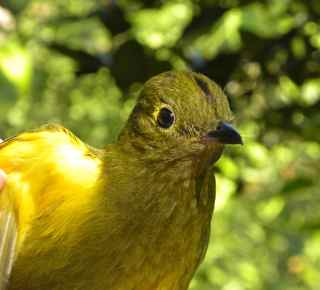
Olivaceous Piha, a new bird for the las Tangaras list!

Mauricio after working his magic with a Rufous-throated Tanager.

LifeNet Volunteers, Genavieve, Margaret, and Larry
We would like to thank Dusti, the LifeNet team and the volunteers for the opportunity to assist in the fieldwork. It was a great learning experience for the both of us, and we´re happy to have met and shared memories with so many wonderful people.

Lifenet, las Tangaras Team 2012
Summer in the Cloud Forest
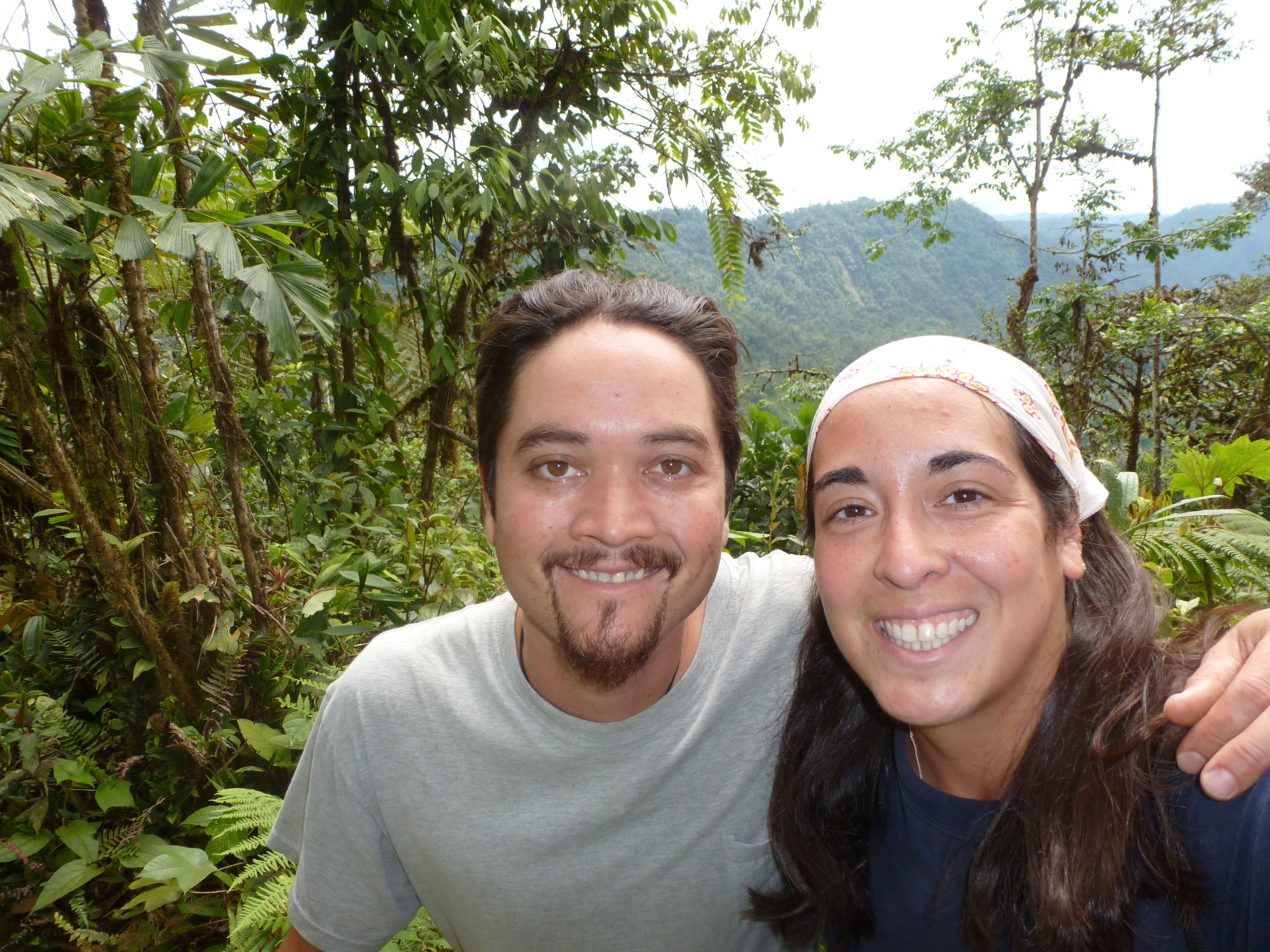
Shyama and Amanda, on a hike in their new back yard.
Greetings from the new managers at Reserva Las Tangaras! Amanda and Shyama hail most recently from Southern California and are thrilled with the opportunity to join LifeNet´s team in the cloud forests of Mindo. We both have a lifelong passion for travel and environmental preservation that has been cultivatd over the years, and now continues to grow amidst the beautiful environs of Ecuador.
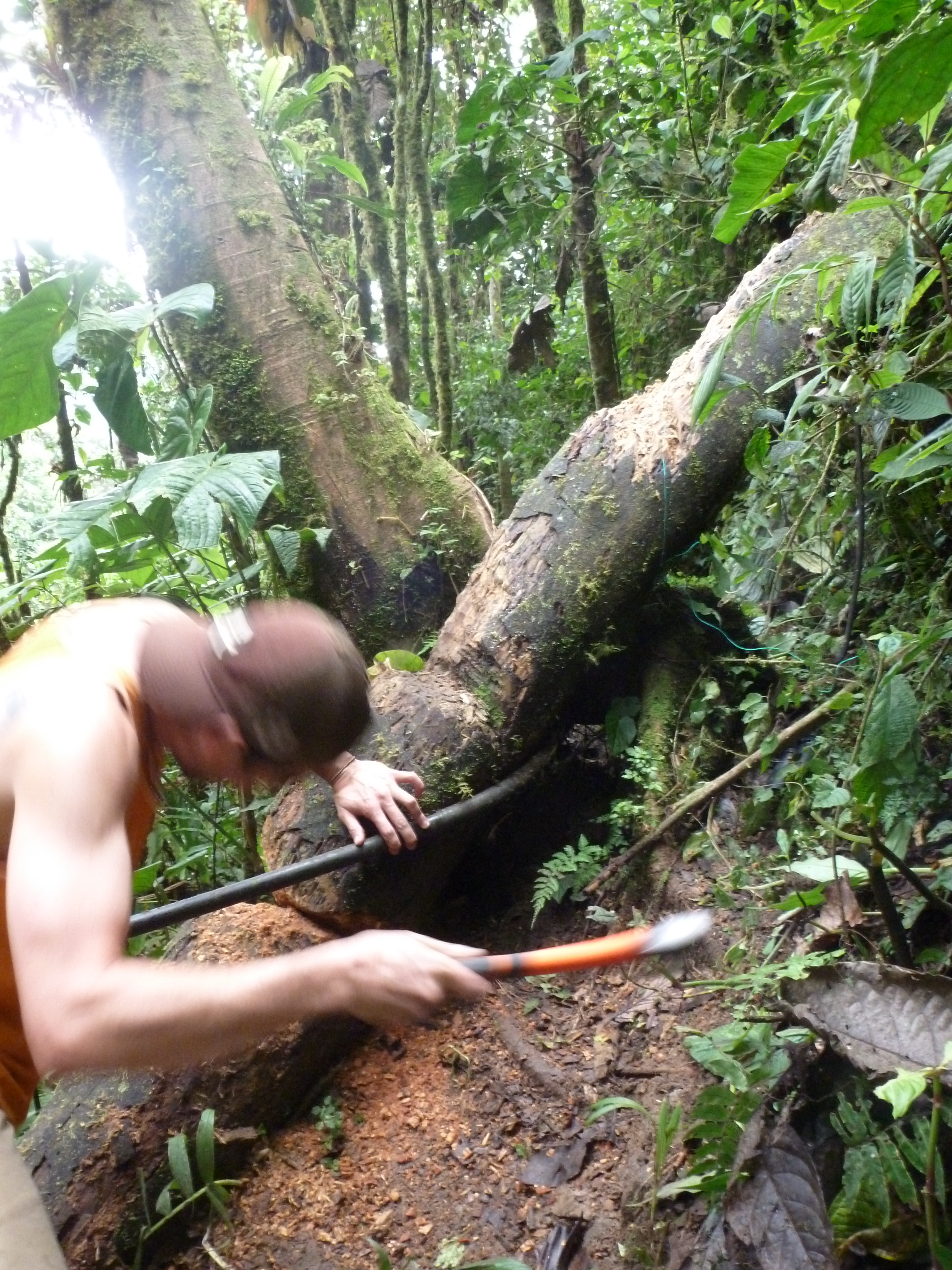
Chopping away at the downed tree.
First and foremost, our heartfelt thanks to the previous managers, Katie and Luke, for doing an excellent job of showing us the ropes and easing our transition into life on the reserve. We were lucky enough to arrive at Reserva Las Tangaras during the beginning of the dry season, and decided to take this opportunity to begin several trail maintenance projects that weren´t as feasible during the rainy months. We began by clearing all of the trails, then proceeded to work on a few rough patches of the Guillermo Trail. This is a scenic trail that meanders through the forest, following the Nambillo River, and gives access to a pair of enticing swimming holes. The first task was to reinforce an eroded section of trail that had grown narrow from heavy rain and small landslides. We went on to create a series of steps over a steeper part of the path, making the hike less strenuous for visitors.
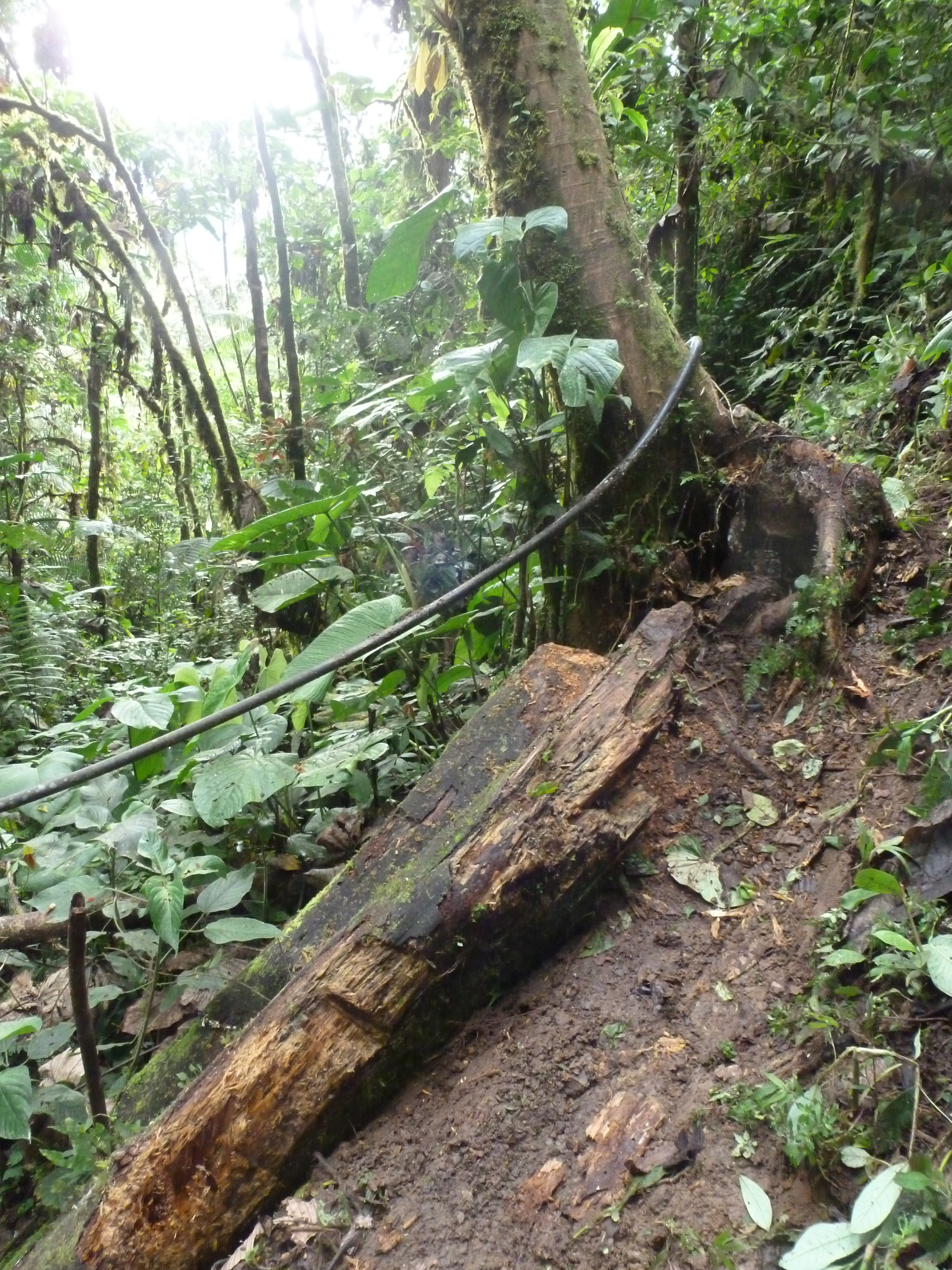
The final product of our labors on Sendero Fuente de Agua.
Our next project was along the Fuente de Agua Trail, which follows the cabin´s water line high up a mountain stream to the source of our fresh drinking water. A downed tree had fallen against a standing one some months ago, pinching the water line and restricting the flow. We went to work with the handsaw, sweating away amidst one of the most beautiful settings we´ve had the privilege of residing in. We took turns going at the downed tree, alternating between handsaw and hatchet, with a Tawny Bellied Hermit constantly distracting Amanda by swooping down and drinking from a trickling spring beside us. It took most of the afternoon, but 4 hours later, with a growing mound of swatted mosquitos at our feet, we looked on proudly at the tree we´d sawn in half. Of course now we were faced with the prospect of moving this 8 foot long, water logged tree trunk off the trail. So with many a “heave ho!”, and lots of “don´t let it roll on your foot!”, we finally pushed that big lug off the trail. A small, exhausted celebration ensued and there were at least 2 high-fives that I recall. To say we were perhaps a bit overly proud of our accomplishment would be putting it mildly. We ate well that night, and slept even better.
And so our term at Las Tangaras has begun. It´s magical to witness, on the rare occasion, a sunrise over the cloud forest as the Andean Cocks of the Rock perform their daily raucous behavior. It continues to be a learning experience identifying the new hummingbird species that have begun frequenting the cabin´s feeders as the season changes. So for those intrepid travellers, avid bird watchers and nature enthusiasts who read this, we strongly encourage you to visit this cloud forest paradise. When you can see the cabin and catch the scent of fresh banana pancakes or homemade tortillas, you´ll know you´ve made it.
Sometimes we see things (Part III and IV)
Part III

White-Necked Jacobin eggs rest inside a perfect nest. This is most likely made of only plant fiber and spider web–quite a feat to achieve perfection in the midst of the spring rains!
After more than two solid months at the reserve, heading into Mindo for provisions and computer time becomes just another activity that you do without much thought. You usually sweat through Yanez
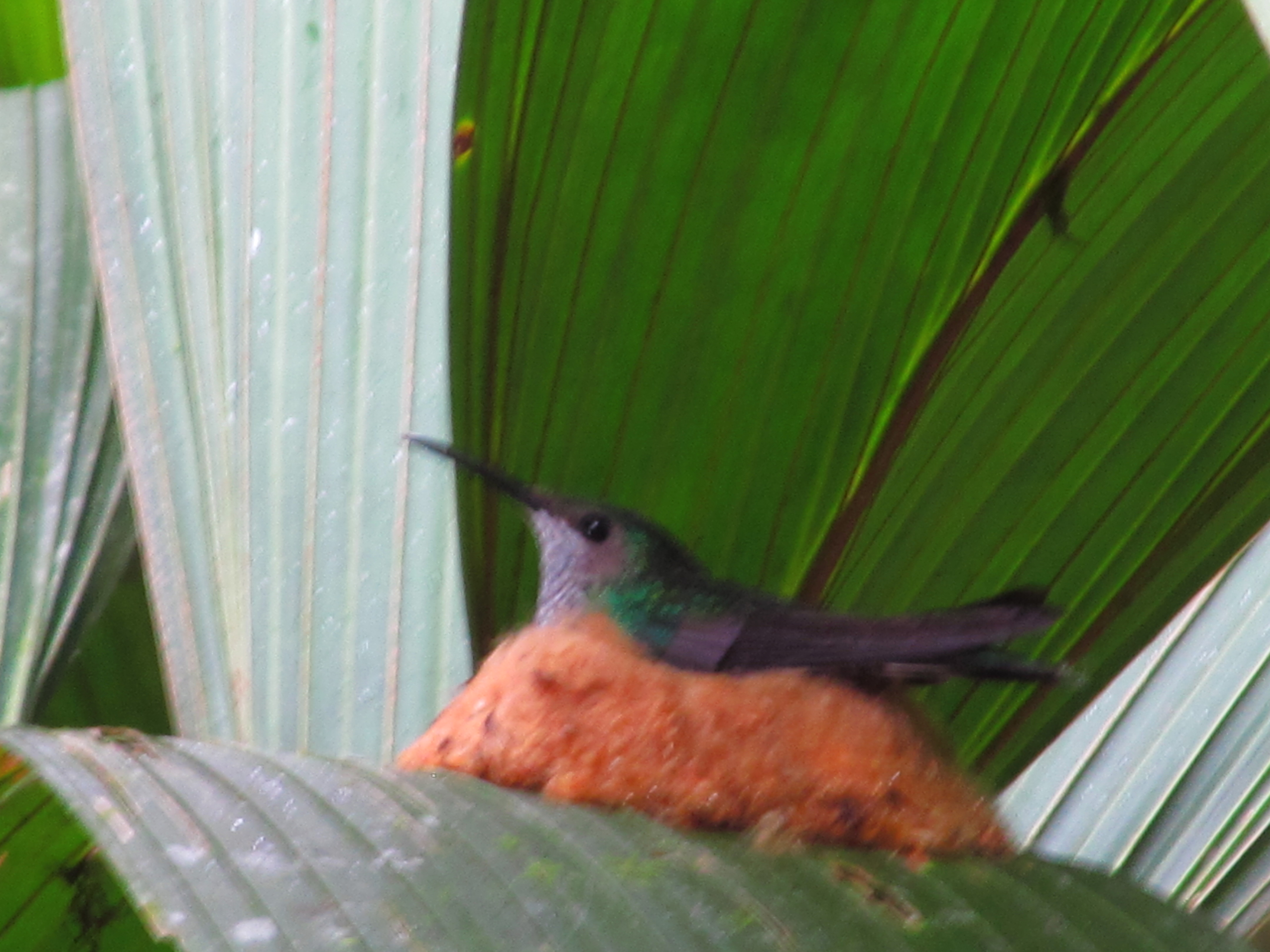
The female White-Necked Jacobin rests on her eggs before they’ve hatched.
Pasture and enjoy the views once you’re up on top. You relish in reaching the shade and occasional cooling breeze of the forested part of the entry trail. You check on signs and make sure they are still readable for the guests who might be happening to hike in. You may clear a downed tree or two with your ever-present machete. You might even add in a little excitement by looking for Crimson-Rumped Toucanets, Crested Guans, or the ever-evasive Golden-Headed Quetzal.
Just like every other trip, this was how our hike to Mindo began on May 28. The one change to our town itinerary for this day included a stop by the bus station to pick up o

Two sleeping baby White-Necked Jacobins rest quietly in the nest while their mother is out looking for food.
ur friend Donovan from Los Angeles and his traveling companion, Marne. Knowing that we had friends who were coming to the reserve for a couple of days gave Luke and I some excitement and we walked to town this day with a little extra pep in our step.
Luke, being 4 inches taller than me and a power hiker, was, as always, hiking ahead of me on the entry trail out. And, like always, we were birding and enjoying the silence of the forest before we headed into town for the day. As a Biologist with a very practical emotional side, Luke doesn’t get too excited about much. But, on this day, as we rounded the last stretch of cool, moist forest before the road to Mindo, he froze in front of a large Elephant-Ear plant stretching 3 and a half feet above the ground. His mouth dropped agape and eyes twinkled as if he was a five year old standing in front of the tree on Christmas morning. He said nothing. He just pointed… right at the leaf.
Being that my legs are not as long as his, I had a bit of catching up to do in order to get to the mesmerizing leaf, but I was certain I was about to see another of the little bright green frogs we can occasionally catch resting on these leaves. I did think to myself “why is he so excited about another frog?” That was until my eyes caught site of the perfect little yellow volcano resting on the top of this leaf.
Having never seen one of these little yellow volcanoes before, I wasn’t sure what to expect upon approaching it and peering inside. To my amazement, resting inside, were two little white eggs. Hummingbird eggs. To be more specific, White-Necked Jacobin eggs. And they were tiny and perfect and the nest was perfect too. This was yet another moment where nature really surprised me. This female Jacobin had created her little nest out of some kind of plant fiber and spider webs and it seemed quite durable and impressively without lumps.

Now with their eyes open and mouths begging, the babies begin to resemble their mother. It’s quite incredible that their initial feathers match their nest so well.
As our time at Reserva Las Tangaras passed, we got to watch the eggs hatch (somehow we were lucky enough to hike to Mindo on hatch day). We watched them as little featherless wigglers with big eyes lying silently in the nest, and then even got to see them grow into fuzzy yellow babies (matching surprisingly well with their nest, natural selection at its best?) with mouths open, begging for food. Unfortunately, we had to leave Ecuador before the baby Jacobins fledged. But we passed the task off to the next managers to watch them and take lots of pictures as they grow!
This was by far one of our highlights of life in the cloud forest. It’s not every day you get to see something as incredible as baby hummingbirds! And it’s even more amazing when you get to see them again and again, despite being at waist-level on an open hiking trail and hatching just days before a week of heavy and cold rains. This mother Jacobin was a fine example of good parenting and it was wonderful to get to learn about the life cycle of hummingbirds by actually seeing them up close.
* * * * * * * * * * * *
Part IV

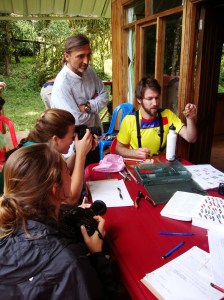 Luke demonstrates the proper way to hold a bird while taking morphometrics as National Geo students look on (and take photographs).
Who would have thought that one of the final things we get to see while at Las Tangaras is a group of American high school kids??
As representatives of Las Tangaras, we had the privilege of hosting students with National Geographic Student Expeditions for three days in the middle of June. As a group, they were looking for experiences with scientists doing scientific research in the Mindo area and visited us to learn about the work of mist netting.
Luke, with years of mist netting experience, taught the students (high school sophomores, juniors and seniors) about biological morphometrics, proper mist netting techniques, the purpose of collecting data on birds, and encouraged them to pursue studies in science. As an educator, I worked as a facilitator with the groups and demonstrated proper data recording.

National Geographic Student Expeditions students are all smiles while helping repair our entry trail at the cab
We had a really great time with the students and their adult leaders on their days of mist netting, catching everything from Gray-Breasted Woodwrens to Orange-Billed Sparrows to Spotted Barbtails and even a Broad-Billed Motmot! But, we had even more fun with them on their final day of visiting us, as they volunteered to help us clean up the campground, repaint trail signs, and dig steps on our entry trail. We are convinced that the kids enjoyed hammering, sawing, and digging more than they enjoyed anything else on their visit to our reserve!
But, in the end, the truly important matter was getting kids out in nature—observing it, enjoying it, and hopefully working to preserve it in the future. And we feel as though our experiences with the National Geographic Student Expeditions will encourage future generations of Americans to love Ecuador as much as we have come to love it.
* * * * * * * * * * * *
This serves as our final blog entry as managers of Reserva Las Tangaras. On June 24th, we handed the duties over to the new managers, Amanda and Shayama. We were sad to say good bye to all of the lovely people in and around Mindo and even sadder to say good bye to the beautiful property that is Reserva Las Tangaras. We spent our last few mornings rising before the sun in order to enjoy the beginnings of the day over in Yanez—watching the sun come up over the hills and the birds dart through the tree tops during their morning feeding. We formed many incredible memories… hopefully enough to last us until we can visit Ecuador again!

Good bye from Katie and Luke!
Sometimes we see things (Part II)

Again, we have no photos of the mammals discussed. BUT, we do have this wonderful picture of a Neglected 88 butterfly. Diaethria neglecta.

- A Double-Toothed Kite (Harpagus bidentatus) visits the yard to snack on an unidentified reptile.

Why did the Red Brocket Deer cross the yard?
On may 10 I was giving my jeans a well-needed washing while simultaneously keeping an eye on the forest and garden behind me. Marble-faced bristle-tyrants perched on the Heliconia and fed on unsuspecting insects. A parade of brilliantly colored tanagers moved methodically through the tree tops. All seemed to be as it always is here at Las Tangaras.
But as I washed the less than fashionable jeans I began hearing an unfamiliar noise. I sort of forced and desperate sounding whistle. Having already spent well over a month on the reserve I was well accustomed to strange and new sounds but this one seemed to attract my ears in particular. Turning off the tap so as to hear the forest over the slapping of water on the concrete, I tuned in my senses to the thick vegetation.
I heard the noise again, this time even closer and then, unexpectedly something sprung from the forest. Small brown and dappled with light buff-colored spots, it was a young red-brocket deer (Mazama americana), and it was running at full speed as though the devil him/herself was chasing the young ungulate. I had been seeing the deers prints along Sendero de Amor (the trail of love) for several days and was hoping to see the actual beast itself. My wishes were granted, and the streak of brown flashing across the grass was a rewarding sight.
However, the procession of new mammals at Las Tangaras was not over. As I had noticed the deer seemed rather in a hurry, and I certainly was not the cause of the rush. Once the small, shin-height, deer was half way across the “backyard,” I saw the cause of fear. In hot pursuit of the Red-Brocket Deer was a Tayra!
Tayras are large, dog-sized weasels, and apparently they hunt deer. The tayra (Eira barbara) is an animal I had previously encountered in the Andes of South America, but never in this context. Never did I expect to see one actively hunting and if I were lucky enough to see this natural act I certainly did not expect it to hunt a deer! While the tayra is large the deer appeared to be more or less a similar size. This was a brave weasel. Or perhaps desperate. Either way I knew Katie wanted to see both of these creatures. It was all happening so fast the only way I could think to get her out to the back of the house in time was to shout her name. I did so and upon shouting her name, not surprisingly, the tayra heard me. The dog weasel, as I call it, stopped cold in it´s tracks. This I had not expected. We commenced to stare at each other like slack-jawed yokels each caught off guard by the others presence.
The deer, however, did not stop to take stock of the new situation and take a leisurely look at the third and similarly dangerous mammal Homo sapiens. It kept it´s pace and was now clear of the yard and back into the thick and seemingly un-navigable forest. As me and the Mustelid remained transfixed by each other the deer was putting as many kilometers as it could between the staring carnivore and omnivore. The tayra snapped out of it and looked in the direction of the now long gone deer. It looked back at me, as though I had stolen its lunch. It again looked, futilely, in the direction of the deer, back at me, then sprinted back in the direction it had come.
I was now alone, gaping at the now empty yard and forest when Katie finally ran out to the back porch; “What is it!?” It was too late, the only mammal present was an awestruck primate.
Sometimes we see things…
This begins the first part of a four-part series…
Night(s) of the Kinkajou
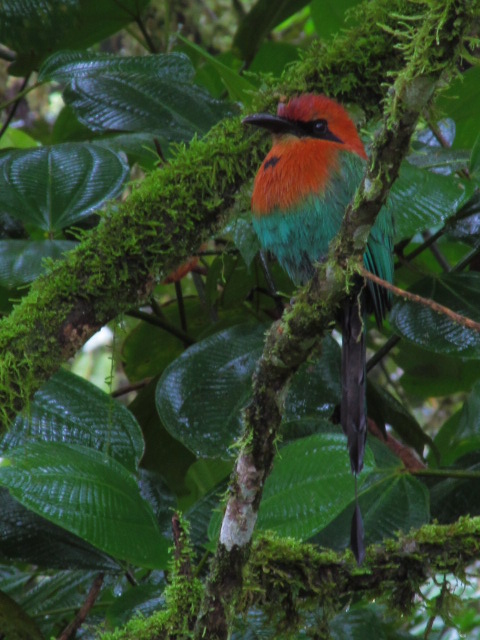
Having no photos from our several ecounters with the Kinkajou we are forced to present you with a lovely photo of a Broad-billed Motmot perched in front of the cabin.
Early in May, I decided I wanted to show Katie the Kinkajou (Potos flavus) I had recently stumbled across in the forest. So we tried to tempt it to the “tanger feeder” which is yet to feed a tanager. This did not bring the Kinkajou. However it did attract a hungry Andean White-eared Opposum (Didelphis pernigra). Moving on from the tanager feeder, I took inspiration from Juliet and Yvan´s accidental encounter with a Kinkajou while they managed Las Tangaras (see previos blog entry). Thus was created the “Banana Bell,” a fancy name for a hanging banana tied to a hanging spoon placed inside a Buen Dia coffee jar. When the banana is grabbed by any banana grabbers present in the surrounding forest, the spoon emits a melodious bell-like tinkle in the jar.
The contraption was successful. Sometime after midnight a furious tinkling was heard. Shaking off our sleep, we dashed to the front of the cabin to see a timid Kinkajou looking back at us from the steps leading to the front porch. It gazed back at us, its eyes reflecting our head lamps´ bright xenon light. The banana had already suffered its Kinkajou-y demise. Deciding we were not in fact a threat, the Kinkajou climbed up onto the railing and conducted a thorough survey for more bananas. There were none to be found. However it spent the rest of the night crashing about the cabin exterior searching diligently for free bananas.
I deemed the “Banana Bell” a success, but due to the lack of sleep it led to, we decided to retire the contraption.
A few nights later, around 1:30am there was a loud crash on the metal roof of the cabin followed by loud footsteps. While laying there hoping the footsteps would cease, and the calm sounds of nocturnal insects, amphibians and the river would again dominate the soundscape, they continued on. Something was on the roof and intended to take a leisurely stroll about the noisy substrate. Eventually the cacophonous ambulating stopped. As I drifted back into the warm bosom of a well-deserved slumber, I was suddenly aroused by the sound of a plastic chair being pushed along the upstairs floor. I too was upstairs, but usually Katie, myself, a bat, and a few tarantulas are the only wildlife. Unless the tarantulas got exponentially larger over night and were re-arranging the furniture, there was something up there with us.
Finally emerging from my blankets, using my head lamp, I scanned the second story for the late night interior designer. My light fell on the glowing eyes of the Kinkajou. It was awkwardly balanced halfway up the 4 foot wall that leads to the forest, its prehensile tail groping the wood for a good hold. We proceeded to stare at each other for what seemed minutes. During this silent confrontation, the furry creature decided we had come to the conclusion that it was welcome to peruse the contents of the cabin. I knew this by its slow deliberate movements back down the wall to the stairs that lead down. Once downstairs, it would find the motherload of free bananas and other delicious fruits. While the Kinkajou is adorable and resembles a strange mix between a monkey, cat, and a weasel, I, too, wanted the fruit. The only thing I could think of doing was to declare, “huh uh! No you don´t!” With innocent eyes it paused and looked back at me. After another delirious starring contest it took another dainty step down, while watching me to see how this next step would register with the two-legged beast that seemed so set on keeping her from her bananas. I then had to chase to long-tailed banana bandit from the house. With lighting speed and grace (belied by its earlier rooftop bout) it bolted up the wall and into a nearby fruit tree than disintegrated into the dark cloud forest.
So ended the night of the Kinkajou. On occasional nights, if sleep does not come, we still sometimes hear the Kinkajou dancing on our roof. While it keeps us up, it is nice to know she is out there always on the prowl for a delicious meal.
The Cloud Forest On a Cloudless Night
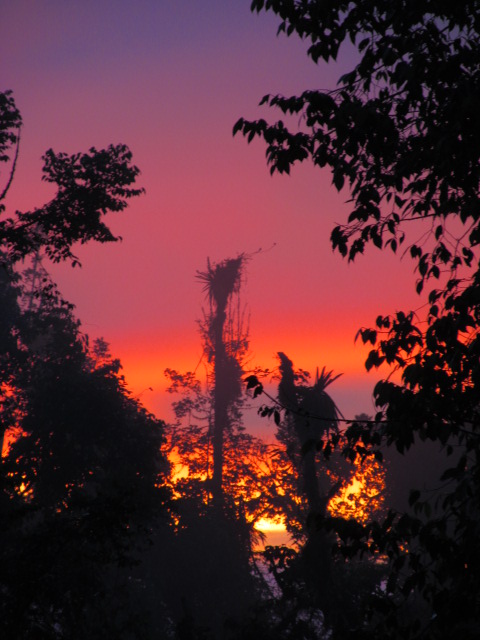
Fog competes with the sun´s last rays for space along the horizon.
Most days we spend with a ceiling of heavy grey clouds overhead. There is a certain smallness created in your world when you live in a valley nearly always socked in with clouds. It is a smallness that makes your corner of the forest feel safe, comfortable, and well-known. Not in the sense that you really know all there is to know here… just that, perhaps, you feel a sort of familiarity with being closed in.
It began with a car ride with Eriberto Bastidas–a warm-hearted man who has known the reserve managers of Las Tangaras for many seasons. He pointed out an Agouti along the road, watching us as we drove by. Then, a Broad-Billed Motmot flew by in front of his truck.
The fog began to set in at the trailhead, which is at nearly the top of the hill that descends into our valley.
We unloaded from our taxi ride to the trailhead and watched a pair of Chestnut-Mandibled Toucans preen each other in the setting sun and saw a Crested Guan–a large, prehistoric-looking bird–perched high in a tree. This was only the beginning to the most breathtaking views we´ve had since arriving here.
As the sun set, the rays competed with the low-lying fog for space along the horizon. Palms lit up in the pink glow and towered over many of the other trees. As we walked the trail that we´ve used to get home many times, the sun began to set in entirety… and we realized the night was a cloudless one! The first we´ve had since being here. Our ceiling had lifted!
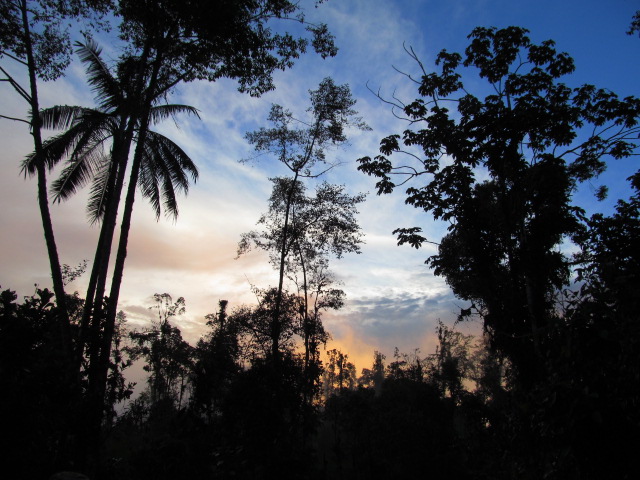
The clouds lifted shortly after this.
A regular caller on a moonlit night is the Common Potoo. And we heard one just as it became dark. Somehow, in whistling back at it, Luke was able to call it in to us… and it perched 10 feet about our heads on a dead trunk and sang its mournful song in the dark. But it wasn´t really dark. The night was illuminated by hundreds of southern hemisphere stars!
After our encounter with the Potoo, we walked another few hundred feet until we came to a clearing. Turning off our headlamps, we looked up and around and behind us… at our world with endless sky. It seemed so big, so foreign, so exotic.
The Milky Way ran across the sky in utter clarity, claiming its space like a highway overhead, and the trees were outlined along the very tops of the hills. And the hills seemed so enormous–as if they had taken on a life of their own.
To make the experience even more awe-inspiring, flashes of lightning appeared out of the southeast. On a cloudless night! At one point, we even thought we saw another hiker on the trail ahead of us. Until we realized the fireflies had come out in full force in the evening´s darkness.
This moment of standing in the forest as the sky opened up over us, reavealing the stars and the noises of night, is one we will never forget. It´s easy to go a great long time without seeing something so beautiful that it really moves you. And on this night, we were both only capable of saying “oh, wow.”
We walked the rest of the way home in mostly contemplative silence, putting our provisions away when we arrived back at the cabin and cleaning up. Within an hour, we stepped back outside and our ceiling had returned. And, just like that, life in our cloud forest returned to normal.
****************************************************************************************************************************************
In other news, the end of April graced us with our first visitor– a good friend of Luke´s from New York named Nick Stevens who came to spend a few days with us and help us clear some trails and enjoy the birds. We had a great time with him!
Katie began reclaiming the garden (nicely fenced from the last managers) from the forest and we´ve been working to repaint some of the trail signs around the reserve.
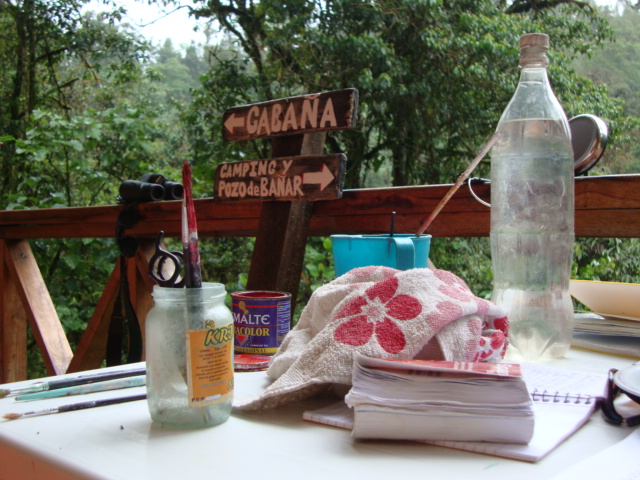
Repainting trails signs during the rain.
Luke saw two Cappuchins on the water trail a few days ago and last night we were visited by Pablo, the Nine-Banded Armadillo.
At the Rerserva Las Tangaras, life keeps keeping on… and we get to enjoy our short time here, keeping on with it.

A male Purple-Bibbed White-Tip, who we affectionately call “Pip,” perches on the deck next to the feeders.
Early Spring at Reserva Las Tangaras

Birding along Sendero Gallo de la Peña.
Hello from your new Reserva Las Tangaras reserve managers! We arrived in Mindo on March 28th where we met Juliet and Yvan and marched four-strong into the forest through a proper cloud forest welcome- rain and mud. Bidding farewell to time well spent at Las Tangaras, Juliet and Yvan left us the following day for their next great adventure. And thus ours began…
We are Luke Bloch and Katie Crossman of Eugene, OR and Butte, MT respectively. Luke is a biologist with over seven years of experience working in the field, primarily with birds and will be heading to Berkeley in the fall to earn a PhD in Integrative Biology. Katie is an educator with a passion for the environment and will be heading to Colorado State University in the fall for an MS in Environmental Sciences. We have lived many places… Luke in Panama, Venezuela, Hawaii, and San Clemente Island, and the two of us in the Bay area, Seattle, and most recently Los Angeles.
It was a bit of an adjustment going from sunshine and dry climes to the moisture-laden life of the cloud forest, but we´ve adjusted and have had an excellent half month of life among the trees, birds, and tarantulas! As you might have guessed from the previous posts, we are in the midst of the rainy season here! Some say it will start to dry out a bit as we move into May, but looking at the previous rain records for the reserve, we aren´t so certain! So far, our rainiest day was this last Wednesday with 68 mm total (and most of it was while we were sleeping!). The rain often brings beautiful lightening and thunder storms in the evening and it´s been interesting watching the fireflies dance in the dark periods between flashes of lightening.
We´ve seen 115 species of birds so far, getting late afternoon visits from the famous Andean Cock of the Rock in the trees in our front yard and Torrent Ducks swimming in the river just down the hill from the cabaña. We have counted 18 tanager species, 14 hummingbirds at the feeders and 2 more in the forest, and we´ve seen Andean Dippers near the source of our drinking water. We also have, just across the river from us (at the beginning of a place we call Yanez Pasture), a tree we´ve labeled the Mammal Tree. In this fruiting tree, we´ve had evening visits nearly every evening for a week from a little oppossum (Caluromys lanatus?) we´ve named Maurice. One evening, instead of Maurice, we had a visiting Kinkajou (Potos flavus).

We have no idea what this is. But it´s beautiful and only occurs in a small patch of the forest.
Pablo the Armadillo has only been spotted once on the trail, but he is still around. And the fence for the garden seems to be doing what it´s supposed to– keeping him and his friends out.
We look forward to our remaining time here… It´s so much fun to wake up every morning and wonder what new animal, plant, bird, or insect we might see. The other day, while hiking a trail for a bird count, we stumbled upon a microenvironment along a hillside that had the most incredible flowering plant. It was an epiphyte, growing in the sun spots through the breaks in the foliage, and it was pink and pointy, but blossomed into the most beautiful purple flower (you can tell we´re birders and not botanists!). Then, a few steps down the trail, it was gone! The forest can be mysterious like that. What makes that spot the only place in the forest this flower can grow? It´s so fascinating… What else might we see like this?
Thanks for reading our blog and we hope you enjoy our updates as we include them! Please feel free to request certain subjects, as there is much to tell about life here!
A sneak peak at the Trail Guide
And, just like that, our time at Las Tangaras is almost complete. Katie and Luke will soon be taking over manager duties, and we will depart for a colder (and probably no less rainy) summer in Scotland. Our Reserve rain totals so far, for those of you keeping score at home: 740 mm for January, 590 mm for February, and 610 mm and counting for March.
At the moment, we’re focusing on our reserve “legacy” and finishing up ongoing projects. The garden fence, made of lianas woven through bamboo posts, is now complete enough to deter Pablo and the peccaries. The lek blind and back porch are freshly varnished. We’ve installed the beginnings of a nature trail, numbering several of the more conspicuous plants and trees along the paths. This has required us to learn plants: for a pair of ornithologists, conquering the phone-book-sized woody plant guide is no small feat. However, the contribution we are most proud of is our trail guide.
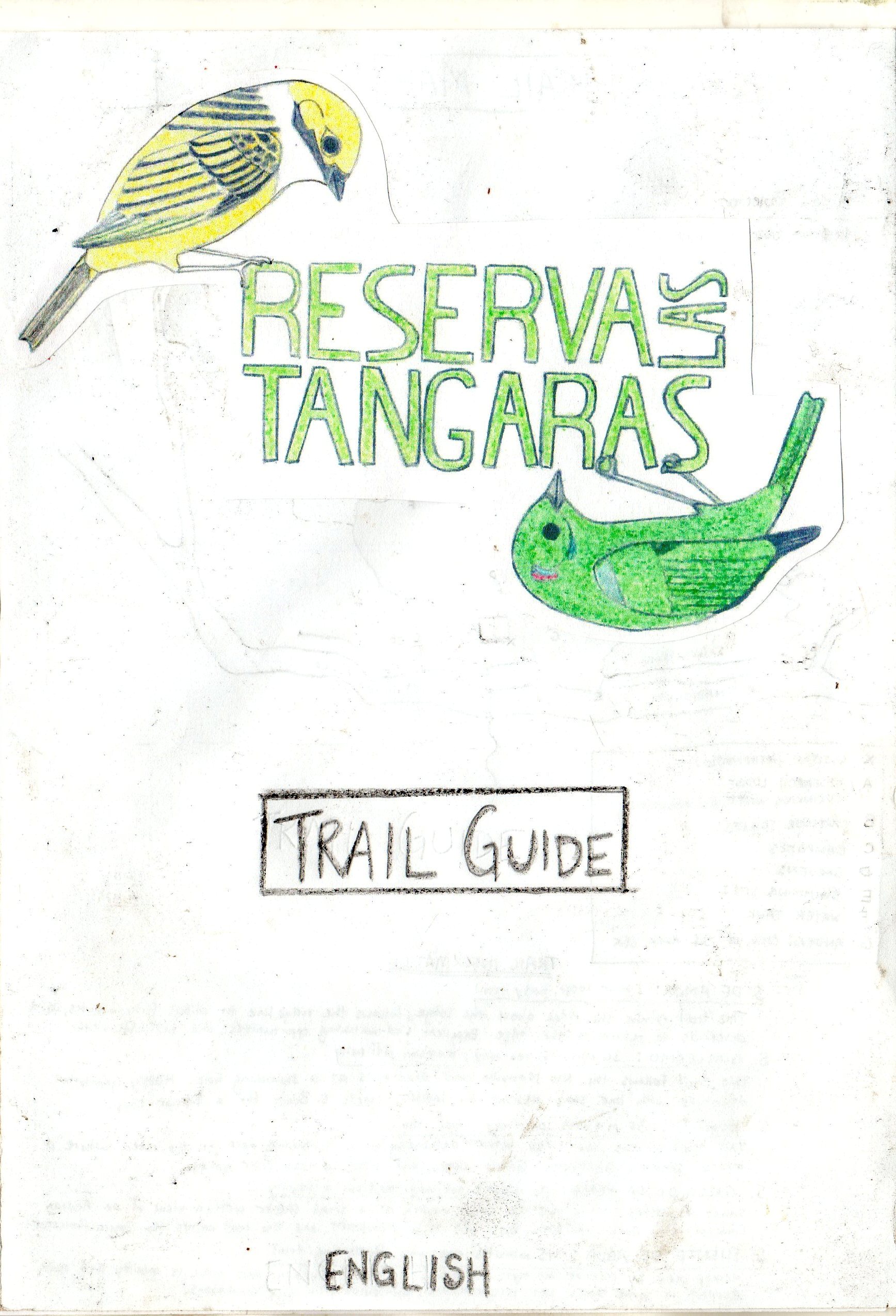
The guide is ten pages long and includes trail maps, descriptions, walking times, and all the logistical information you could wish for regarding LifeNet and the reserve. In addition, there is a guide (complete with original illustrations courtesy of Yvan) to the most common wildlife and plants found around the reserve: bird species and families, mammals, insects, a handful of reptiles and crabs, and plants, numbered to correspond with the trail markings.

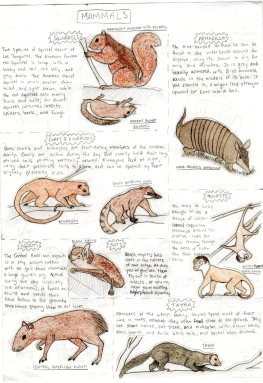
Thanks-but-no-thanks to the copy machines of Mindo, which have formed a syndicate specifically to amputate about one inch from the left side of any page and to change clarity at random, we will be leaving behind laminated copies of the guide in English, French, and Spanish, which visitors can take with them on the trails. We will bring the originals back with us to the States in hopes of making some clearer copies that can be made available for purchase at the reserve.
So that’s our guide– or, at least, a few pages of it. For the rest, you’ll just have to come visit Las Tangaras. In the meantime, we will head out of our jungle lair and back into the real world, carrying with us the memory of a wonderful few months in a wonderful place. My sister, Susanne Lamb– another talented artist– said it best in the Valentine she sent me last month:
 Goodbye, Las Tangaras. We Ecu-adore you.
A post for Pablo
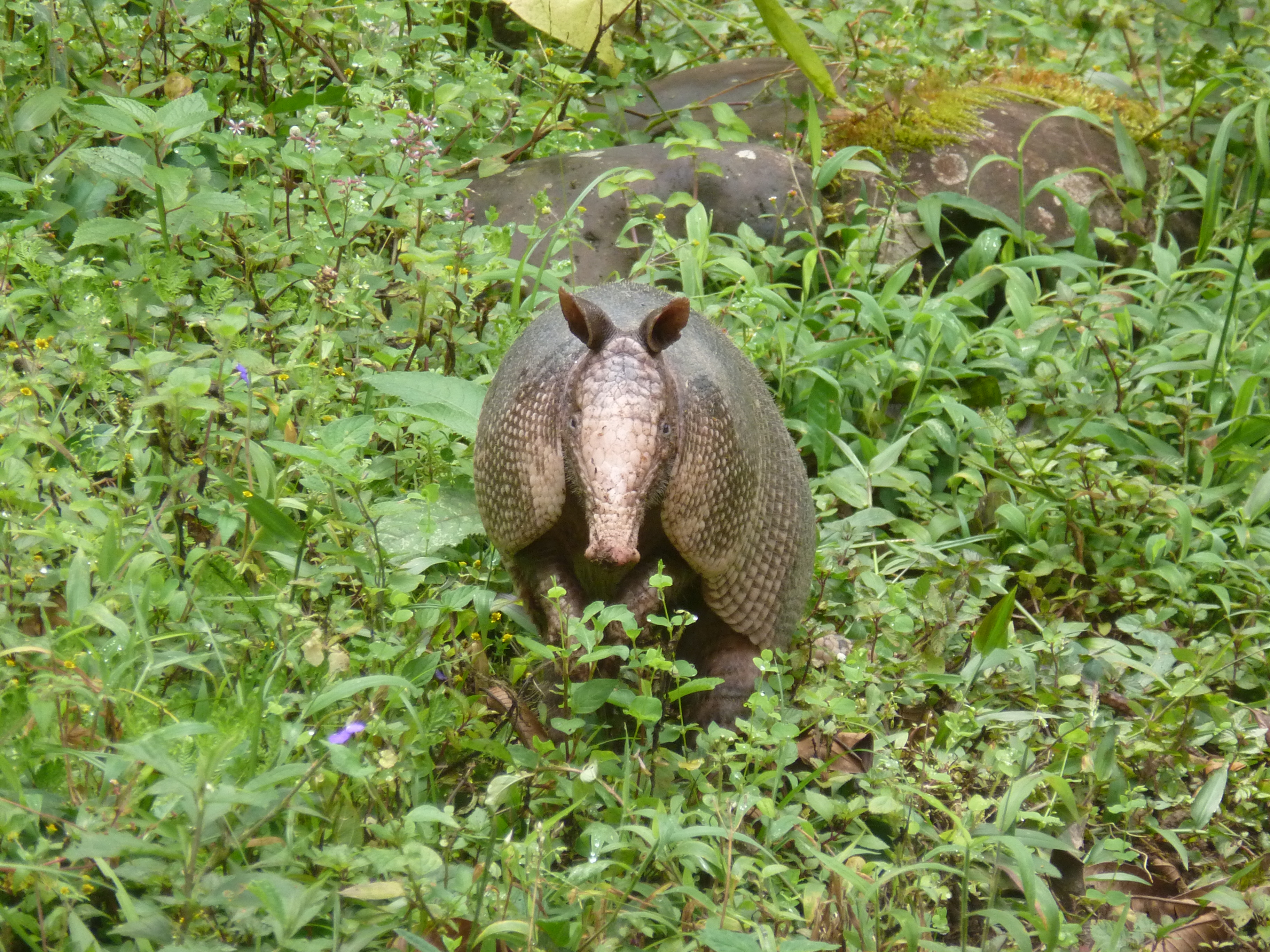
Pablo, in all his glory
For the most part, we observe the wildlife around Las Tangaras with a scientific mania for classification and understanding. In a few cases– particularly the hummingbirds, whose species-specific quirks and soap-opera-style interactions entertain us during rainy afternoons on the front porch– we stray a little from strict objectivity and start to imagine personalities and histories for the individual birds. However, there’s nobody quite like Pablo the Armadillo, the only animal on the reserve that has his own name (and, now, his very own blog post!).
We named Pablo because, unlike most of the birds, lizards, butterflies, and mammals we see, he is identifiable by sight. In much the same way as a CSI detective identifies his victim, we can identify Pablo by the massive scar on his right side: a relic of some predator’s fruitless attempt to tear through Pablo’s impressive armor. Clearly, he is a survivor. Though his scar commands respect, Pablo himself is unassuming: cat-sized, composed of an ugly grey hill of plated flesh topped with a scaly conical head, leathery ears, peering eyes, hairy feet and a lumpy trail scraggling to a point.
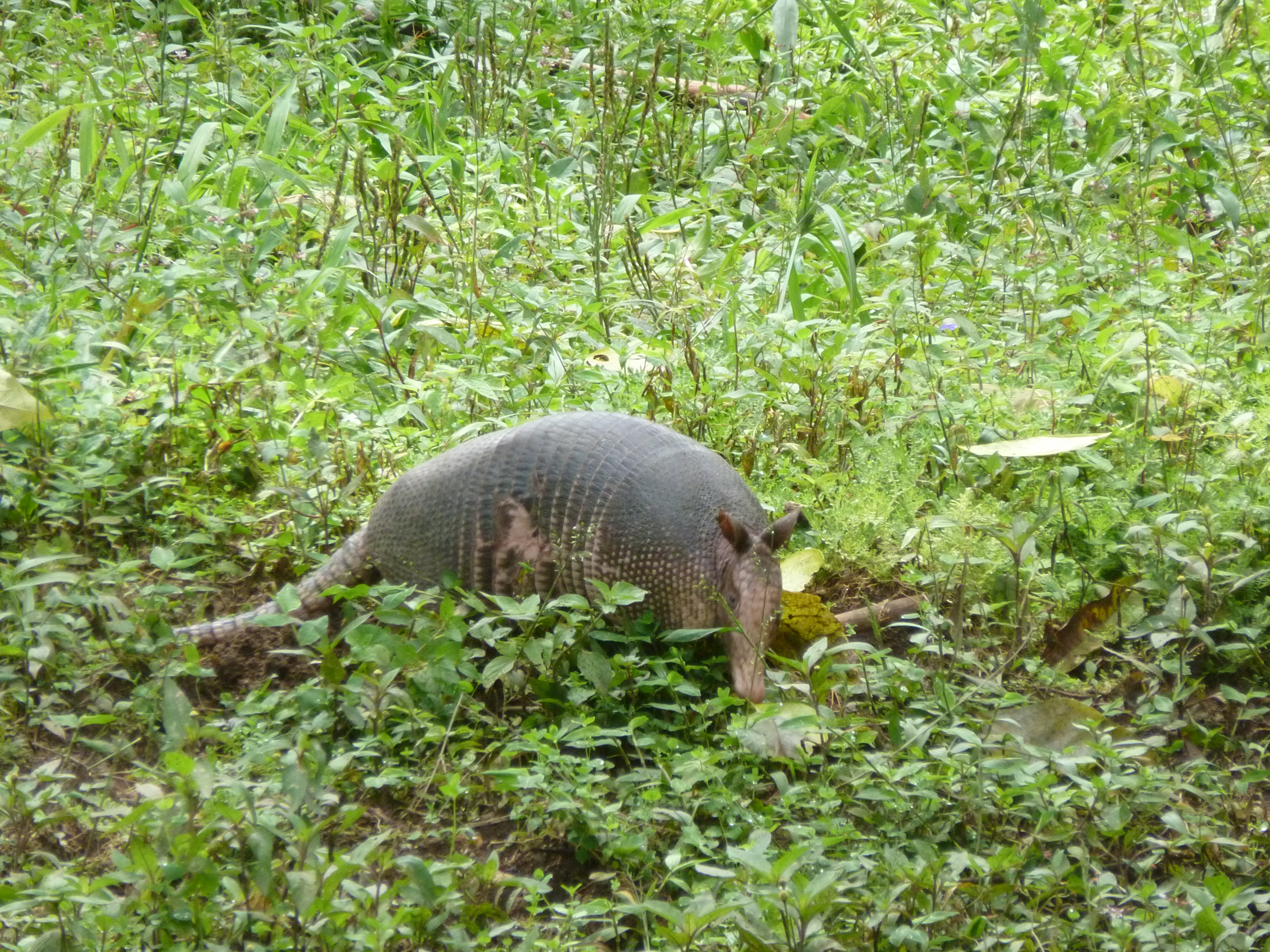
Pablo's battle scars
The other day I came across Pablo foraging in a trail near the river. I stood still, and he continued his imperturbable quest for insects, making his way down the trail toward me. Reaching me, he poked his snout around the sole of my boot, and I lifted my foot a few inches to let him probe underneath, Satisfied and seeing nothing amiss, he continued his slow passage. It occurred to me then that maybe Pablo, despite his formidable survival skills, is not the brightest crayon in the box.
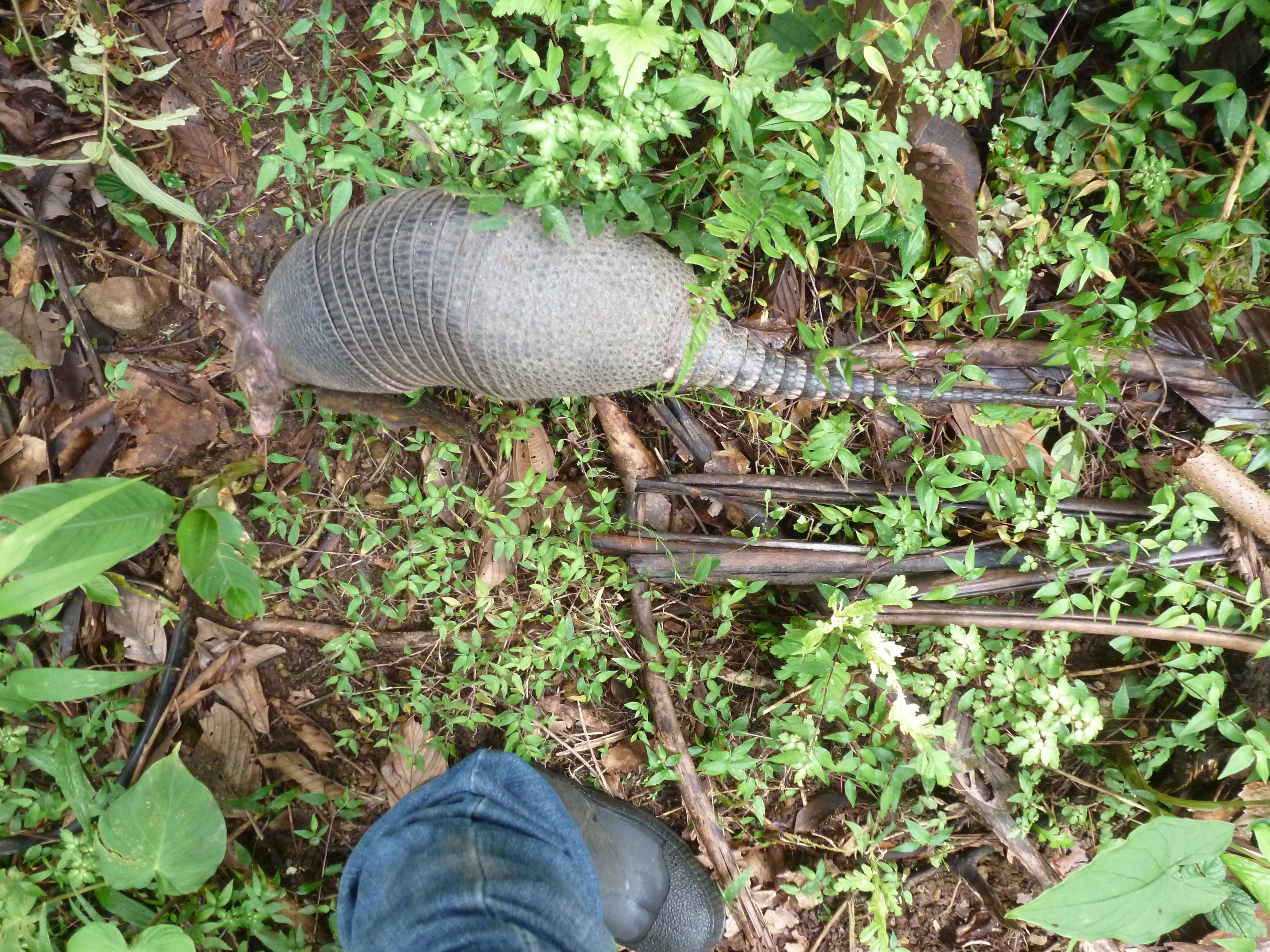
Close encounters of the armadillo kind
As humans, we tend to value quickness, whether in the functioning of our own lightening-fast brains or the spectacle of a cheetah chasing a gazelle across the Serengheti. Looking at Pablo’s scar, though, I can’t help but wonder if we underestimate the value of thickness. In the cloud forest, where the dense vegetation makes speed somewhat less of an advantage than on African plains, why not just curl up into a ball and let your armor do the work? Looking at the broad pink slash across Pablo’s belly plates, I can’t help but think he would agree.
Bird Count Fridays

- Andean cock-of-the-rock

Patterns of rainforest life tend to exist independently of human timekeeping, and for the most part we follow a schedule based on weather and daylight rather than calendars or watches. We wake up when the birds start calling– sometimes, a more insistent flycatcher (we’ve yet to identify the species, since when we see it it is always backlit and we are always half-awake) will perch on the bedroom window and tap a quick reveille. We go to bed when the candle burns out. At dusk we check the rain gauge. In good weather we work outdoors maintaining trails, buildings, and gardens. When it rains, we work indoors, watch hummingbirds, and pass the downtime with reading, baking, Spanish card games, or music (between ukulele, harmonica, and French horn, we have the makings of a very weird jug band).
Nevertheless, human time continues to pass, and we’ve made a few concessions to the weekly patterns of non-rainforest life. Our week orbits elliptically around two foci: Town Tuesdays, when most of the stores are open and there aren’t too many tourists to elbow aside, and Bird Count Fridays.
Bird Count Fridays begin with a 5 a.m. wakeup, followed by a twenty-minute uphill climb to the Andean Cock-of-the-Rock lek. We have learned from experience that saying “cock-of-the-rock lek” to most people will get you either a blank stare or a snicker, and the reality is even odder than the odd-sounding name. Cock-of-the-rock (“cock” because of their crowing calls, and “rock” because of the boulder screes that comprise their nesting habitat) are some of the strangest birds you will see in an Ecaudorian rainforest– bright red, with puffy head-crests and almost-invisible bills. Their mating system requires male birds to gather in a certain area of the forest canopy, called a “lek”, and conduct mass displays involving calling, flapping, preening, and fighting. Female birds then come to the lek site and, based on these formidable shows of masculinity, choose which male to mate with. We’ve yet to get a good video of the phenomenon, but there are a few good ones on YouTube.
The lek at Las Tangaras commands a beautiful view across a river valley, and from the relatively sheltered confines of the refugio– a tin roof propped over a wide bench– we watch misty Friday dawns cohere as the noises of night insects give way to the chattering of cicadas and wood wrens. Attendance at the lek is patchy during the rainy season, but even if the birds don’t show up, it’s hard to beat watching a cloud-forest sunrise with tea, cinnamon rolls, and juicy plums. If they do, we re-sight color bands and record behaviors of displaying males.

Sickle-winged guan
The lek visits always put us in a birding mood, so we’ve started keeping a bird list each Friday. Ordinarily, we record only new or unusual species that we notice in the course of our other work, but Fridays are a chance to direct our attention specifically to birding. Coincidentally (or not), many of our best sightings have been on Fridays. Last Friday, for instance, we saw a pair of toucan barbets (spectacular, large barbets whose presence in Ecuador is restricted to a small section of the Northwest), a barred puffbird perched sumo-wrestler style on an exposed branch, a rufous-chested nighthawk flying overhead, a red-billed parrot munching on large berries, an immaculate antbird foraging around the roots of a fallen tree, and two torrent ducks swimming in the river. Other Fridays have brought us crested guans, plate-billed mountain toucans, variable hawks, Cappuchin monkeys, and land crabs– Bird-Count Fridays don’t discriminate. We usually see about 70 species in the course of the day– a modest number, but usually with a few new-for-us species to make it exciting.

Masked trogon
During the rest of the week life moves on, rain and sun, river swims and armadillos, building and research, and we always keep an eye on birds. If we had to pick a favorite day, though, it would definitely be Bird Count Friday.

 Reserva Las Tangaras