Nests, More Nests, a “Graduation” & a Mother’s Note
We have been seeing a lot of nests around the Reserve in May. It began in late-April with a Silver-Throated Tanager nest. Though they have since fledged, we still see the family of 4 around the cabaña plantain feeders each day.
We have so many different styles of nests throughout 2025:
- Hummingbird nests with small, soft materials including some colorful flowers
- Andean Solitaire nests built into an earthen wall
- *Orange-Billed Sparrow nest built on the ground with a roof made of sticks to cover it & make it inconspicuous
- *Thick Billed Euphonia nest built so high we can’t monitor it’s progress, but we can see the “parents” flying in and out throughout the day
- *Slaty Spinetail nest built into an orb of sticks that you cannot see into
- *Yellow Throated Chlorospingus nest is made of moss and uses the naturally growing foliage and moss as a part of the nest
- Silver Throated Tanager nest covered by moss and fiercely guarded by the “parents”
- *Red Faced Spinetail nest is inside of foliage that is hanging from a branch in a tree
*indicates currently active nests
Though we would love to share pictures of every nest, we are trying to keep our distance to ensure the nests have the best chance at success. However, we are actively documenting the progress of each nest at the Reserve with our other science data. If you’re planning a visit in the next 3 weeks, we will happily point them out to you from the cabaña!

A “Graduation”
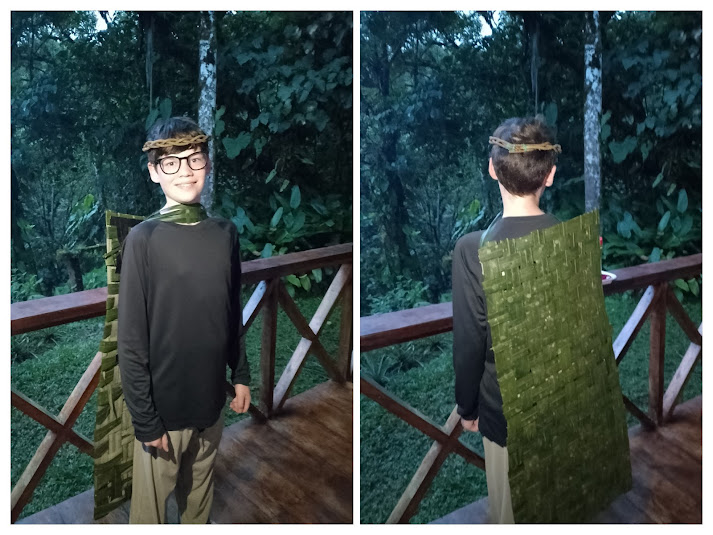
May brought the close of homeschooling for our resident 5th grader, Parker. Parker will move on to 6th grade in August which is the start of “Middle School” where we live. We conducted a fun “graduation” ceremony for him where he got to parade around the house to a graduation song of his choosing. Joshua made him a cap and gown and Danielle conducted the ceremony and gave a speech.
We wanted to get a final interview from Parker to get his thoughts!
How has your experience been at RLT?
Great. There were sometimes where I wanted to leave and didn’t want us to be on the job. After a while, I kind of grew into this place and I will miss it forever, to be honest.
What is your favorite thing about RLT?
Nature, the birds. There are a variety of birds and doing outside work sometimes was fun and sometimes was annoying. I got to see some cool birds and some enormous birds like the Crested Guan, which is my favorite. We got to see some mammals like the Central American Agouti and Nine-Banded Armadillo in the yard!
What is your least favorite thing about RLT?
No internet!!! (he asked for 3 exclamation marks in particular) It is nice because it forces you to look outside but sometimes, I wonder stuff or have questions and have to wait until we go to town to look it up.
What was your favorite part about homeschool at RLT?
There were less classes and after school, if it wasn’t science, I could just chill.
What was your least favorite part about homeschool at RLT?
Math.
What was your favorite subject in school this year?
Reading and Writing. Plus, a little bit of science.
What are you looking forward to in 6th grade?
Not being overwhelmed by the people and to be an average student.
What are you looking forward to when you get back to Utah?
Internet, being able to flush toilet paper, good showers, other people I can talk to that aren’t just my mom and Joshua isolated together.
Any Final Thoughts?
I have found my love for a lot more animals here at Reserva Las Tangaras. My favorite animal was the Nine-Banded Armadillo but now is the Central American Agouti “It’s so cute OMG”. I didn’t really have a favorite bird before but now it’s the Andean Cock-of-the-Rock. It is so cute; it looks like an alive stuffed animal.
I enjoyed just waking up and seeing the sunshine on the leaves and hearing the birds chirping. You don’t know what you’re going to see that day. Every day is magical here.
A Mother’s Note

Happy Mother’s Day! I wanted to take a moment to note my experience as a mother with a child at Reserva Las Tangaras.
Thinking back, Joshua & I were worried that since we had a child that would need to accompany us, we wouldn’t be eligible for this once in a lifetime opportunity. Dr. Becker was excited to hear we would be accompanied by an 11-year-old, and we were able to let out a sigh of relief. When I was 10/11 years old, I never would have imagined an opportunity like this. At that age, I recall being a great big ball of confusion and emotions (OH THE EMOTIONS). This was an amazing opportunity for us as a family.
Before coming to RLT, I was a hard-working mom navigating the world and trying to create a great life for Parker. My personality-type centering around ambition and perfectionism, I didn’t realize that I was actively missing out on Parker’s life. I was overworked and exhausted. Proposing movie and pizza nights instead of building Lego or drawing comics. I was a tired, overstimulated ball of stress.
For nearly 5 months now, the 3 of us have been spending a lot of quality time together, learning together, exploring together and acclimating together. Adjusting to a remote lifestyle after a lifetime of living in the city has been incredibly enlightening, to say the least.
Now that I have had time to slow down, I realize what I’ve been missing, but most importantly I realize what I’ve been present for since we arrived in Ecuador on 31 December. I have been able to watch my little boy grow into an adolescent. He has gotten taller, his face has taken shape and he exudes happiness daily. The best part was that I got to watch it all happen, I got to watch every moment. Thinking about what comes next: friendships, first love, new hobbies, High School, planning for adulthood, etc. I am so grateful to have been able to intentionally slow things down at this stage of his life and realize it’s importance, so I don’t miss out anymore. It is important, it’s not just a part of life.
My most prized takeaway from this experience is remembering what is most important to me, what truly brings me joy: my little family. We now know we can live on an ultra-tight budget, we can hike miles to get to the nearest services, we can tolerate only seeing/talking to each other for up to 2 weeks, we can help each other through different struggles, we can have the difficult and awkward conversations, we can learn new skills together and much much more. We can do all of this AND wake up happy every day. No busy city life, constant stimuli or job can take that away from us now.
Conservation & Vist Us at RLT
April was a quiet month here at Reserva Las Tangaras. Even though it has been a rainy month, we are beginning to see the changes in the birds, the trees and plants preparing for Summer. The calm before the proverbial busy season storm, perhaps?
What’s New?
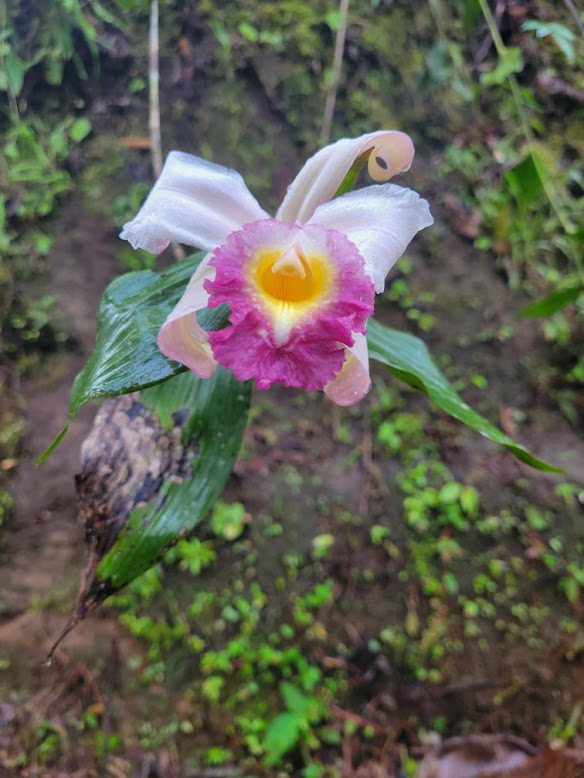
Throughout the grounds of RLT, we are seeing new flowers blossom, a rotation of birds that we haven’t seen since January and some bird visitors we haven’t seen all year! We are also seeing more snakes which is, surprisingly, more exciting than it is terrifying.
Playa de Las Ranas has been prime for swimming and is in our top 2 favorite swim spots right now. Parker, our resident 5th grader, has found a slick rock that is fun to slide down and leads you right into a rapid that pushes you straight to a shallow place to stand up.
Conservation
In the spirit of Earth Day, we wanted to talk a bit about our experience here and conservation. We have come to learn that it is not always glamorous but it is work that is worth doing.
We have had the pleasure of watching a handful of nests being built, eggs laid, hatchlings growing and even experienced the sad truth of nesting in the wild. Unfortunately, most of the nests we have observed were unable to fully raise their young.
We did our part by ensuring we kept our distance and didn’t touch anything. We even planned to stay away once the young were close to fledging but haven’t gotten to that part just yet. Chatting with our neighbors, friends, visitors and Dr. Becker, we understand that this is just the natural order of things. Our dedication to conservation outweighs the desire to create a support for a shifty looking hummingbird’s nest that inevitably collapsed overnight. It’s still hard to see even when you anticipate the outcome.
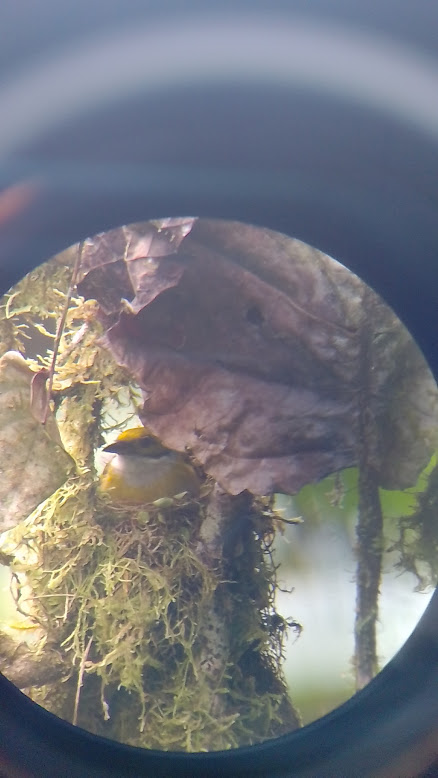
On a brighter note, we have been extremely fortunate to have a sturdy Silver Throated Tanager nest high in a tree near the RLT cabaña. The male and female pair are FIERCE in protecting their nest. We have observed at least 5 occurrences where a bird or squirrel got a little too close to the nest and both parents took immediate action in getting these animals out of the area. We have watched for nearly a month as the duo built their nest and have even been able to observe them swapping out to take turns sitting on the eggs and now, feeding hatchlings. The nest is high, and we can’t see inside, but we have been able to see two wide-open mouths pop up from the nest from time to time.
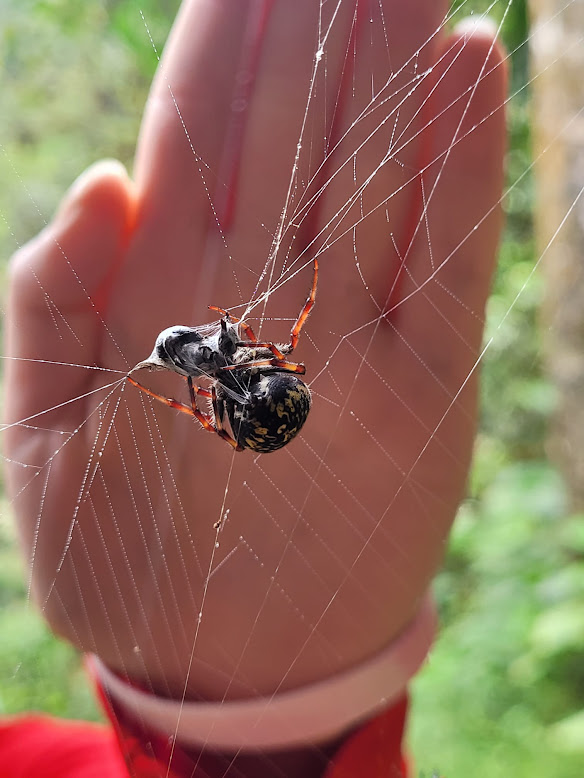
The longer we spend exploring the grounds of RLT, the more we appreciate the opportunity to care for such a beautiful, protected area. We are used to the hustle and bustle of the city life. Never wondering what existed before the roads, Walmart Super Center or before the neighborhoods were built. Here we can see the riparian zone move into secondary forest turning into primary forest and the changes that unfold as you work your way deeper into the Reserve. Since January, we work to relocate unwanted visitors in the cabaña (a nice way of saying “humongous spiders”), leave spider webs alone unless we absolutely have to, clean up after the bats who like to poke around the porch at night, allow the prized tree stump to get overgrown with moss and fungi and more. The beauty in not interfering, and not feeling the need to interfere, is relaxing. It’s all as it should be.
We hope that the work of RLT and Life Net Nature continue for years to come because Reserva Las Tangaras is a truly special place in the cloud forest of Mindo, Ecuador. What an amazing opportunity to be able to share this with our 11-year-old. We hope that he truly understands how important places like this are to flora and fauna alike. One day, it will be up to his generation to pave or protect.
Visit Us at Reserva Las Tangaras
Lodging at the Reserve will not close for bird banding this year. This means a few extra weeks of opportunity for you to come and check it out for yourself. Money paid for daily entry, lodging, camping and tours go right back into the Reserve so we can continue to maintain the property.
Day Visits are $5/person
Private Tours, including Cock-of-the-Rock Lek, are $25/person (no guest minimums)
Overnight Stays in the Cabaña $25/person, including breakfast
Camping $10/person or $10/tent + one-time $5/person Entry Fee
Reach out to us via WhatsApp +593 099 054 7084, social media or email lastangarasreserve@gmail.com for questions about your upcoming visit or to book your stay.
March Updates & Chef’s Corner
Rainy March tends to be slow for the Reserve. However, we were quite busy with tours! Joshua has started guiding “general” birding tours and it has been very successful! We enjoy sharing our excitement and experience of all things RLT with visitors from around the world.
We have been monitoring 3 Andean Solitaire nests that are built into the muddy earth about 4 ½ feet above the ground. We know that these are Andean Solitaire nests as the bird quickly flies out of the nest each time we walk by. Of the 3 nests, two were somewhat covered by dangling leaves and the other was completely visible with a little vegetation. 1 nest never had any eggs, another nest lost its’ 2 eggs and appears to be abandoned, but the final nest currently contains 2 hatchlings just starting to get their feathers. Interestingly, the nest that was completely visible is the nest that contains the hatchlings.
While monitoring the Andean Solitaire nests, we also found 2 hummingbird nests. 1 Western Emerald nest that took about 3 days until an egg appeared and 1 nest that is a bit too high for us to see inside but we will be keeping an eye on it. The Western Emerald nest (pictured below) is about 3 ft from the ground on a leafy vine that is suspended in the air by a series of downed branches. The other nest we are still working to identify the hummingbird but we believe she is a Crowned Woodnymph. She’s so fast it’s hard to get a peek!

We have finally settled into the “groove” of things here as we close out the month of March. We have started to slow down and appreciate the small wonders throughout Reserva Las Tangaras. This has certainly contributed to our findings…Hummingbird nests are SO SMALL!
WHAT’S NEW?
We have been working on updates to the Cabañas interior by treating the wood against rot and wear in the kitchen and guest sleeping quarters.
The bridge is now free of slippery moss and covered with fresh bottle caps. Though there is nothing we can do to make it appear safer with the raging Rio Nambillo beneath your feet especially during rainy season! But trust us, it’s very safe!
Our plantain feeders have gotten a face lift including a more natural look with moss and bromeliads, perching branches and now includes nails made of wood to secure the plantains. This will ensure a safer snack, free of metal contaminants for our bird visitors.

CHEF’S CORNER
Danielle here! I thought it would be fun to share some tricks we use here in the RLT kitchen to provide a delicious variety of dishes packed with flavor. We do not have electricity for refrigeration here, so we mostly stick to a vegetarian diet. Fortunately for us, I was a vegetarian for 11 years. Vegetarianism sparked my curiosity and passion for the culinary arts and the flavors/techniques used in cuisines around the world. I kept this fact close-to-the-vest while I was in culinary school and still tried all meat and seafood because I wanted to be a well-rounded Chef first and foremost. Even did an apprenticeship at a whole-animal butcher shop while maintaining a vegetarian diet. For me, what I preferred to eat at home never got in the way of my desire to learn.
A week ago, I wanted to make Pineapple Fried Rice as I had some leftover pineapple and an ají chile that needed to be used.
THE DISH: Pineapple Fried Rice THE CHALLENGE: We haven’t purchased any soy sauce as, I feel, it is too expensive for the quantity you get and, until now, it hasn’t been necessary. Additionally, I didn’t have any ginger, scallions or sesame oil. THE INGREDIENTS: 1 Red Onion, 1 ½ cups Fresh Pineapple, 1 Sm. Green Bell Pepper, 1 Large Carrot, ½ Ají Pepper (Use a full one if you like it spicy!), 5 Garlic Cloves (I was running low and only used 3), 3 TBS Panela (a sort of “brown sugar” commonly used here in Ecuador that is not as sweet), Salt, 1-1½ cup water, Veggie Oil, 3 cups of cooked rice and 3 eggs
THE PROCESS: Dice your first 4 ingredients and chop the ají pepper and garlic cloves. Add 2 TBS veggie oil to a skillet and heat until the oil is shimmering then add ½ the onion, all of the ají pepper and all of your pineapple. Saute until the onion is a pale-pink then add the panela to the pan. Stir just until you see that the sugar has dissolved. Allow the pineapple mixture to simmer for at least 3 minutes. Add 1 tsp of salt to the pan and stir the mixture until the pineapple is coated well. If your sauce is getting too thick, add a small bit of water. We are imparting a sort of spicy, salty caramel flavor into the pineapple and don’t want it to be too runny. This sauce is your soy sauce substitute. Once your sauce coats the pineapple, remove from the heat and taste. Add more salt if it is too sweet. If your pineapple is very ripe, you can add a couple dashes of vinegar to add more flavor. Allow the mixture to cool then transfer to a bowl.

Replace your skillet onto the heat and add your water (DON’T WASH THE PAN FIRST!). As the water heats, stir and scrape the pan diluting all the gooey bits with the water. This is your make-shift soy sauce. Once your pan is clean, add to a separate cup or bowl so it can be slowly added while cooking the rice as a “seasoning”. Add 3 TBS of veggie oil to your skillet (it is fried rice after all) and heat until shimmering. Add your remaining onion, carrot and bell pepper cooking until the vegetables have softened. Add the garlic and cook until fragrant.
TIP: Leftover rice is best but fresh is okay too! You want your rice to be on the drier side (being dry helps it to absorb more sauce/more flavor). It’s super humid here so I laid the rice out in a thin layer and stirred/turned it over a few times to let the water out as best I could.
Add 1 TBS of oil to the sauteed vegetables, half of your cooked rice and 3 good spoonfuls of your sauce. Stir the mixture to combine and allow the mixture to sit on medium-high heat undisturbed for a minute or two. As your sauce is absorbed by the rice, stir and add more sauce by the spoonful. After about 5 minutes, add the rest of your rice and additional spoonfuls of your sauce. Allow the rice to cook until heated through and flavorful then add your pineapple mixture. Mix well and allow to cook for 2-5 minutes to heat the pineapple. Taste and add more sauce and salt to your liking. Push the rice to the outer edges of your pan, creating a well scraping up any stuck rice or veggies. Add a small amount of oil just to coat the pan then add your 3 eggs, scrambling them and moving them around the well until cooked mostly through. Begin slowly stirring and incorporating your scrambled egg into the rice and remove from heat.
BUEN PROVECHO
Getting Settled In & Juvenile Mammals!
We are getting settled into the Reserve and have been hosting so many folks from around the world! We have begun planting in the greenhouse that was built last year. We have radishes, lettuce, onions and carrots going. We have also started seedlings for beets and snap peas! We were really surprised by how quickly things began to sprout. We live in Salt Lake City and it typically takes quite a bit more time for us to see such progress in our garden at home. It’s very exciting!

We are so grateful to have made so many connections in Mindo already. We have been able to get taxi rides for guests at odd hours ahead of early morning tours, posted flyers for a Valentine’s Day event in over 5 locations and vendors that will help Chef Danielle out with food supplies up the hill! We are learning so much about the possibilities available to us and it makes the next several months even more exciting.
This month, we have noticed a shift in the birds activities near the cabaña. Our plantain feeders have slowed down a bit, the rain is getting heavier (and sideways?) and we have been able to see some juveniles!
We have seen a family of 6 Nine-Banded Armadillos that have been rooting around different areas of the grounds. We caught this photo of one juvenile rooting around near the greenhouse as we watch from the porch in “awe”.

One day, by complete surprise, we saw a juvenile Central American Agouti cautiously crossing the yard. This was our only sighting to date.

In addition to juvenile mammals, we have been seeing some juvenile large birds. A Crested Guan adult and 1 juvenile have taken a liking to a large tree in the backyard. The juvenile Crested Guan has done a great job of hiding within the leaves of the tree and isn’t as easily spotted as the adults. They have been visiting often in the morning and afternoon.
Additionally, we have seen a Choco Toucan juvenile with 2 adults twice around the cabaña but they’re too quick to get a decent photo.
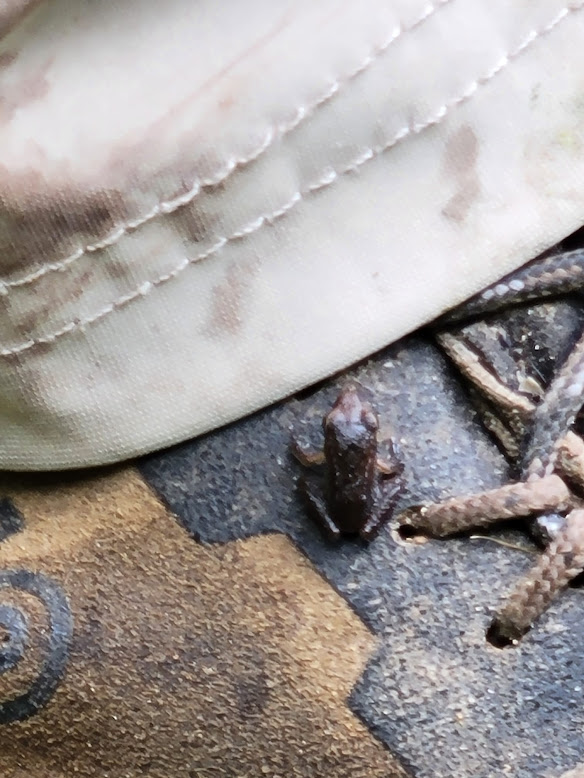
Lastly, we have been seeing lots of little Pasture’s Rainfrogs especially on a nearby road. We learned from a herpetologist that these little guys never go through the tadpole stage. This little guy hopped onto Joshua’s boot while we were hiking one day.
Introduction: New Managers 2025 Jan
We are your new managers: Danielle, Joshua and Parker!

Danielle is our hospitality guru while we are here. She has over 10 years of experience running commercial kitchens, 2+ years in Operations, 7 years working for non-profits in Utah, USA and a year as a Chef/General Manger where she learned her Marketing skills. She enjoys waking up to the sound of the birds in the morning and ensures the birds (and humans) are well-fed. She will be covering our social media a few times per week, keep an eye out for updates!

Joshua is our scientist and adventurer. With a degree in Zoology with Minors in Botany and Spanish, he is prepared for the ins and outs of everything Reserva Las Tangaras. Joshua has been to all 7 continents and visited dozens of countries during his time in the U.S. Navy. He has his work cut out for him getting his two city-folk companions into wilderness-living! Joshua is excited about all of the exploring and research opportunities our time at RLT will provide. He hopes to find a position doing field-research in the near future.

Parker is our 11 year-old adventure guide! He is becoming increasingly curious about everything at the Reserve down to the smallest insect. He is in the 5th grade, conducting homeschool from the Reserve for a few hours each day. He has grown up in Salt Lake City and is quickly adjusting to our new life at the Reserve. He is very excited to meet other kids and show them around the grounds!

We had a rough beginning with some car troubles heading to Mindo from Quito, found a large tree blocking the road to the Reserve and some replacements were needed with our water source to prevent future problems. They say things like these come in threes and We-Three were ready to hit the ground running!
Things were a bit behind on trail maintenance so we immediately started working on them. Now guests can enjoy clear paths for their exploration of the grounds.
We hosted several overnight guests this month who enjoyed vegetarian faire while we work out ways to introduce more meat, chicken and fish dishes for guests.
Our first event of 2025 will be 14 & 15 Feb. We can’t wait!

Ciao!
Our time here is coming to an end sadly, so we’re going to keep this last one short and sweet since we’d rather be enjoying our final days here outside than typing on a computer.
Yes, we have amazing nature hikes and big adventures you can do around the reserve, as you saw in our last blogpost (consult your guide before embarking on any of these adventures). But what else do we do outside of these adventures when you’re resting your aching muscles or sore back from tubing down jolting rapids of the Rio Nambillo all day? First, we’ll take an adventure into the cabana. Kick off your shoes and step onto the porch and stretch out those knots with a relaxing yoga session with the relaxing sounds of hummingbirds rapidly flapping their wings and the river flowing in the background. After you found your vinyasana flow and are feeling nice and relaxed, hit the library and pick up the plants de Mindo book. Try your hand at identifying some edible plants around the yard. One of our favorites is called the Cana Adria or Costaceae Costus, which you can suck the sap of the red fruit as a refreshing drink.
Now we’ll take an adventure into the town of Mindo. Here we are greeted by familiar smiling faces of our friends we’ve made over the last 6 months. And of course we stop by Guillermo’s place Babylonia Pizzeria for the best pizza and to hangout with his family and practice our Spanish. If you remember we worked together to build the new camp structure a few months back and we’ve been great friends ever since. We have him down to the reserve to work with us whenever we can and practice a lot of Spanish, hopefully we get our diplomas soon. What really makes Mindo so special is the people. Any interaction we have in town, like asking someone for directions or going to our favorite restaurant, someone is always trying to have a conversation. And sure enough, since it’s a small town, you’re bound to see them again and get hit with a buenos dias and a genuine smile. This has really put the cherry on top for us since gaining new perspectives from people abroad is the best thing to do while traveling and it leaves a lasting impression for both you and the other person.
Ok, bye for now and maybe forever! It’s been great showing you all of our adventures and we hope it inspires you to visit Reserva Las Tangaras, or just take a break from all of your busy daily lives.
Your Reserve Managers, Matt and Arthur



Las Tangaras Adventure Menu
Disclaimer* Do not attempt without first consulting your Guide
Fuente Falls
Hybrid Forest/Aquatic
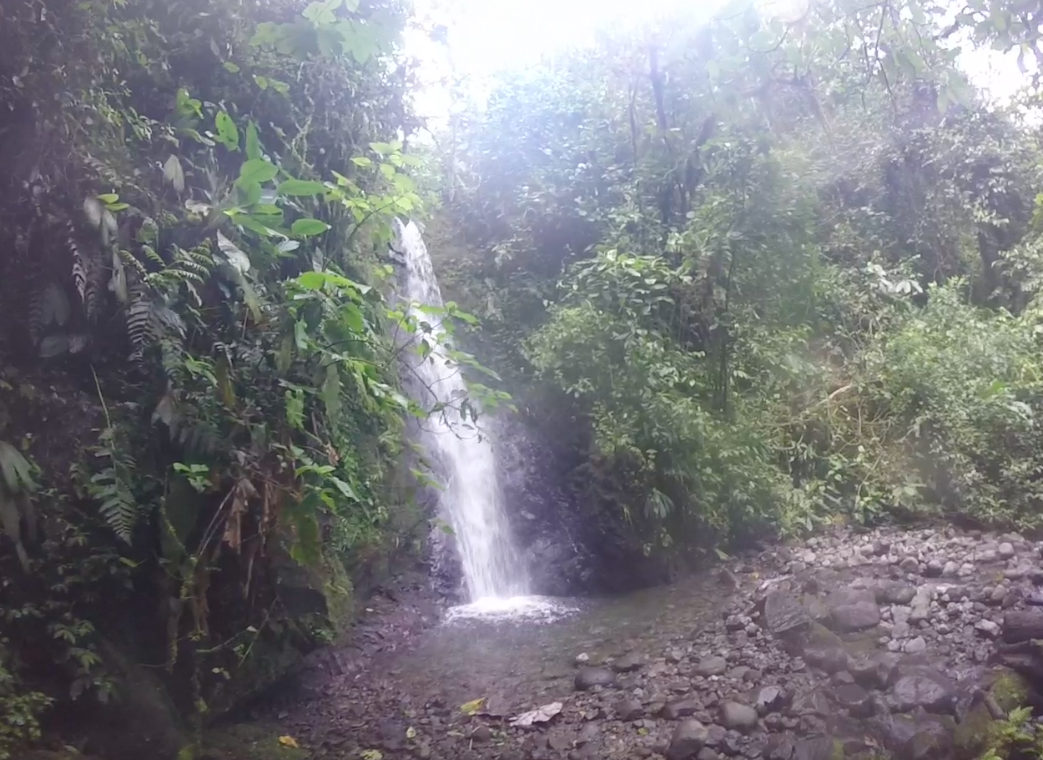
The trail to the reserve’s dry season water source is not for the faint of heart, but if you’re willing to push yourself a few turns up the river further, the reward is always worth the work. There are two routes one can take to the famed waterfall we’ve dubbed fuente falls, after the river that it calls home.
The first option is to take the tres tazas trail to the fuente river, and climb up for some time from there. The second involves a bit of a shortcut on the trail we use for the water line, which drops you off at the fuente a little higher up. From there, you take the well worn route of past managers climbing over rocks, up waterfalls, and rope-climbing up cliffs until you reach the beautiful waterfall that our water source sits atop. At this point, you are usually soaked to at least your chest if you didn’t bite the bullet and dunk under in your clothes and boots as soon as you got to the fuente.
From there, its more of the same past two more really nice falls. Extra points if you shimmy up the fallen tree to get up the last one. The wind coming off the falls hits you first. It would be a disservice to try to describe it with words, so a low-quality gopro photo will have to do.
Bubble Baths
Aquatic
Bubble baths is a river adventure into untouched areas of the Nambillo. Water shoes recommended.
You start at the gorge, a breathtaking hallway of flowing water off the end of Momotos. From there you’ll swim/trudge your way up towards the confluence, a big waterfall at the end of Sanctuario.

You push forward, fighting the current for a few more turns of beautiful river and cool geology. This is where you find bubble baths, a uniquely oriented set of falls that come together to churn the water into a wonderfully disorienting sea of white foamy bubbles. Who needs a jacuzzi.
For the extremely brave, again, do not attempt sans-guide, you can climb your way up the gut of one of these falls to the calm, expansive pool directly above bubble baths. Squarely in the middle of this pool, in the deepest section, is a huge boulder perfect for practicing your cannonball.
The real treat about bubble baths is that you can float most of the way back (at least when the river is low). Just make sure to keep those feet pointed downstream.
Buena Vista
Forest
Buena Vista is a Forest adventure best undertaken before first light. Bring snacks, water, and binoculars.
This excursion begins before sunrise with a trek up to the Andean Cock of the Rock lek. As the sun rises, you get to sit here and enjoy the welcome respite from the uphill hiking while watching some of the most interesting birds the Reserve has to offer.
As the lekking dies down, you saddle back up for a trek into the deepest and highest parts of the reserve. Keep an eye out for the Ecuadorian Capuchin, which likes to hang out up here. You notice the subtle change of the flora and fauna as you feel the air getting more crisp on your neck. Not long after passing the “giant’s throne” tree, you’ll find yourself at the sign telling you “Ruta no matienen mas alla de aqui”.
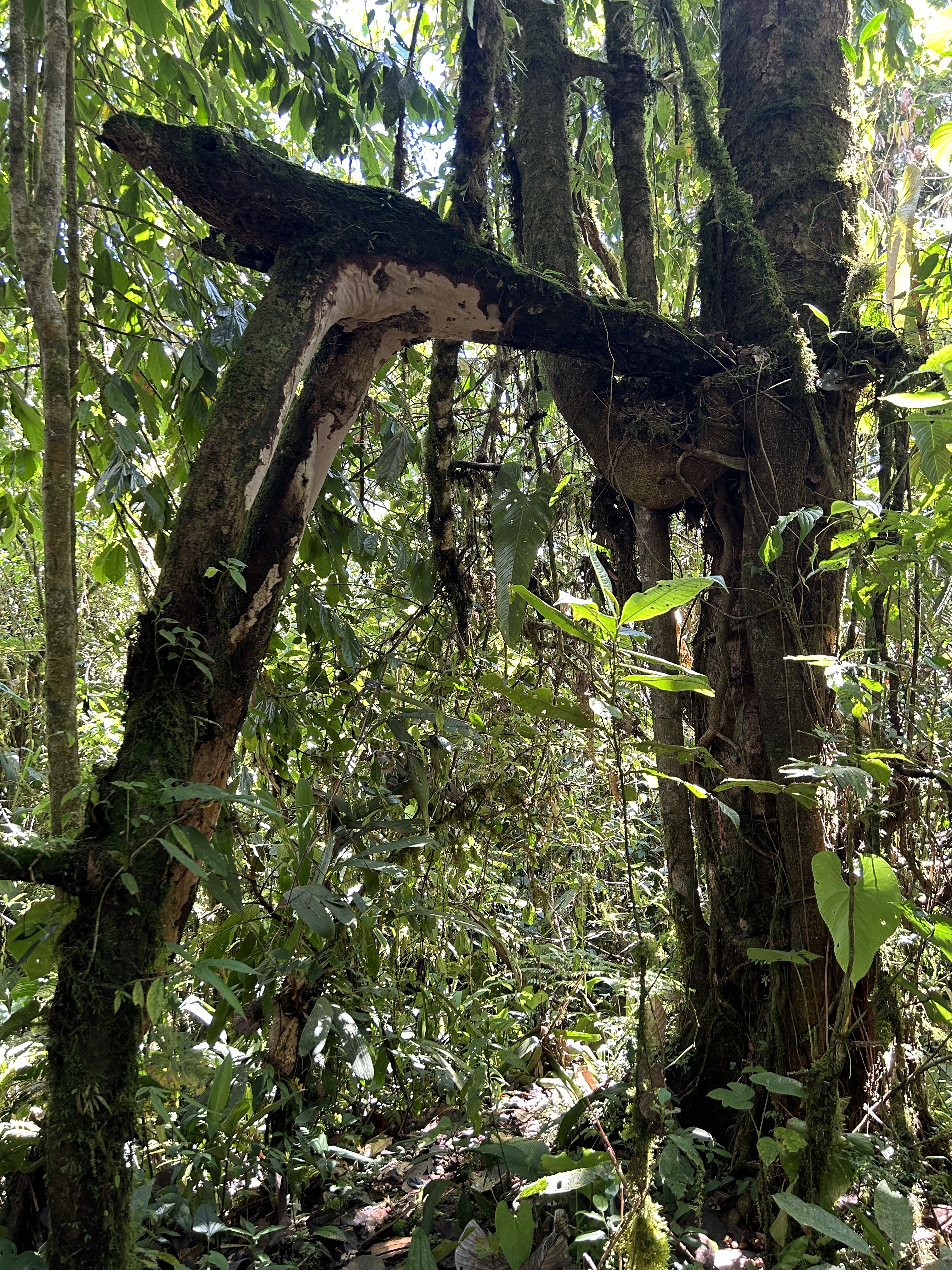
Do not despair, my friend, we’re just getting started. You’ll let your machete guide you up to the top of the ridge, which is always just one section of near-vertical woody shrubs further. When you decide to turn around, take 3 steps forward and you’ll find yourself looking at one of the best views in the Choco-Andean.

Sanctuario XTreme
Hybrid Forest/Aquatic
If you’re looking for the waterpark, look no further. We’ve got the best slide in the rainforest.
The Hike to Sanctuario is great any way you slice it on its own. You’ve got beautiful jungle trails culminating in an oasis so pretty you’d think it was cliché if you saw it in a movie.

For the curious adventurer, however, it gets even better. Swim through the pool and climb the waterfall to find a world of smooth stone harboring luges of clear water. Keep going to find friendly cascades that are great for practicing your climbing skills without consequence.
After a few twists and turns, you’ll catch a glimpse of the biggest cascade yet, with a well placed rope waiting for you to scale the side. After checking the depth and finding it to your liking, you will climb said rope, feeling like quite the adventurer, position yourself above this waterfall, and push yourself down the slide that ends in a 6 foot dropoff. Repeat as needed.
The creatures of Reserve Las Tangaras
Sometimes you hear strange noises living in the rainforest; actually you always hear strange noises living in the rainforest. Most of the time we can try and guess and make ourselves feel safe by assuring, “oh it’s just a branch falling.” However, that could just be a lie, and a big jungle cat is waiting to eat you. With the coverage of the night many creatures become active and some of these are venomous and dangerous, but some can be as cute as a nine banded armadillo. Besides noises you will also wake up to many small holes in the ground in the yard, or the tail of a small cat running into the bushes. As we know, the birds are the main attraction at Reserve Las Tangaras with the Golden-headed Quetzal, all the beautiful hummingbirds and of course the magnificent Andean Cock of the Rock. However, there are also many magnificent mammals, reptiles and amphibians. This installment is a dedication to them, the creatures living in this Chocolate-Andean Rainforest paradise.
Here we have the Margay. A small jungle cat that likes to hang at the road into the reserve. They can run down trees headfirst and their ankles can rotate 180 degrees to accommodate hanging from branches and being super agile. They can eat birds and bird eggs (sorry fellow birders) as well as reptiles and fruit. These animals are mainly active at night, we luckily encountered this special cat at 5am as many nightjars led us up the road, flying away and landing as our headlamps reflected off of them. These cats used to be heavily exploited for their very soft fur, so they are classified as near threatened. Margays are monogamous and form pairs for mating as well as copulate in the tree tops, in true jungle cat fashion.

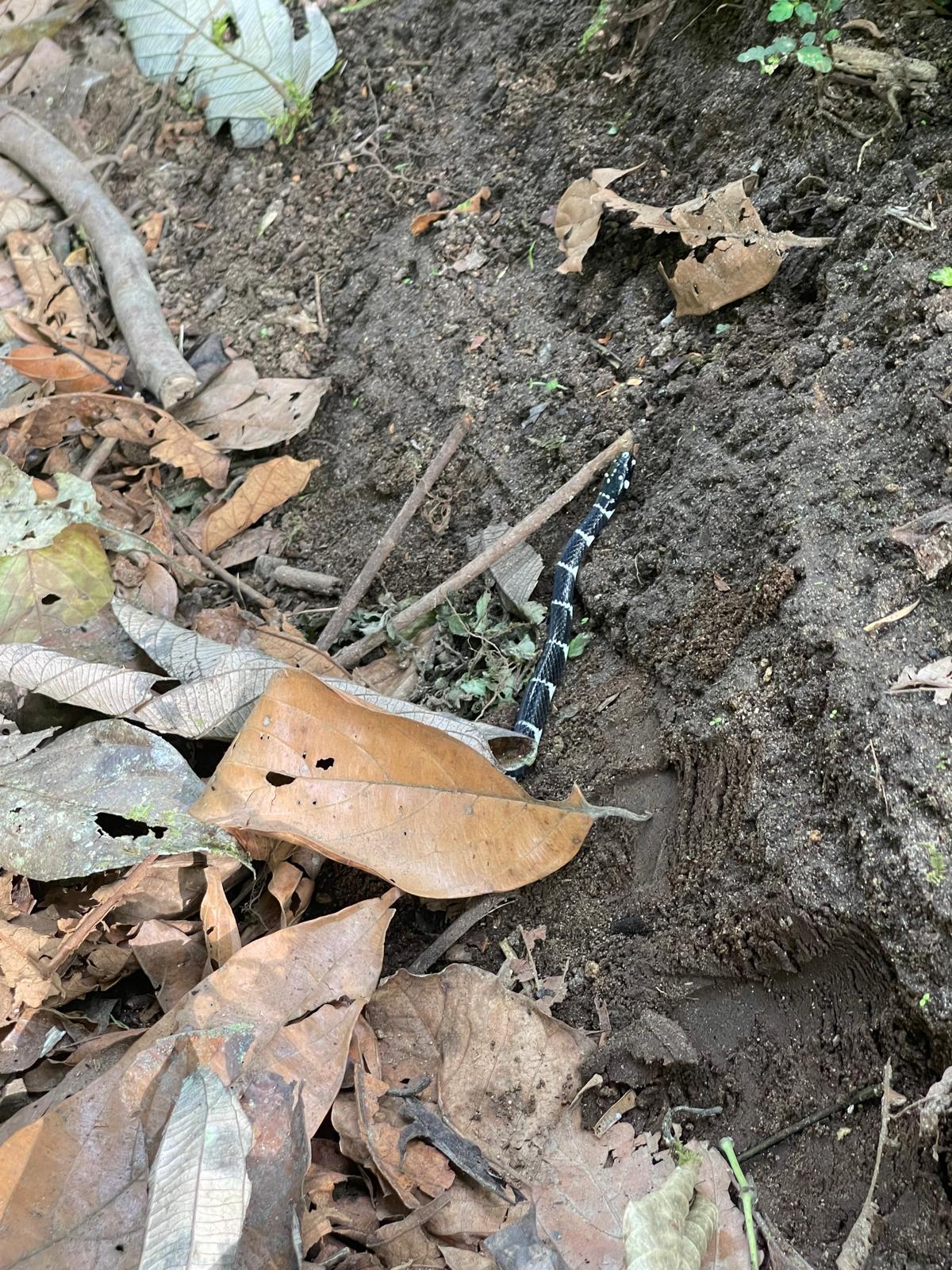
Next, we have the culprit of the hundred little holes in the yard. The nine banded armadillo. With its long nose it searches for grubs and insects in these little 1 inch wide and deep holes. Their shells are very unique since they are the only mammal with a shell, this is made of thick, hard skin and bony plates. For the nerds like me, his shell can withstand 20 Mega pascals which is 2900 PSI! He isn’t great for the lawn, but he’s got a special place in our hearts. How could you be mad at the face!
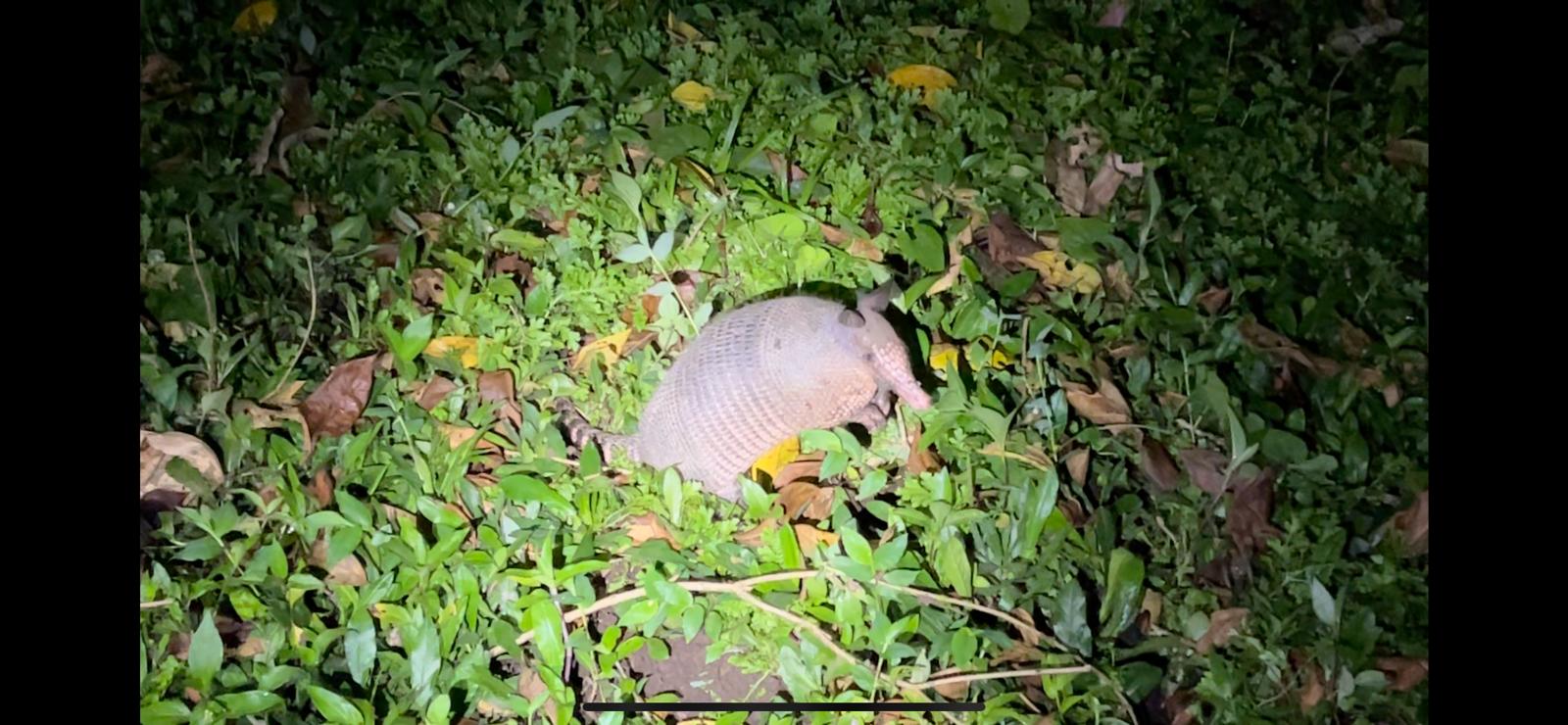
While walking the trail up to the Cock of the rock Lek, I saw movement under a leaf pile. I investigated with a long stick, knowing it could be an aggressive snake. However, this snake was friendly and small. I later identified as a halloween snake, Pliocercus Euryzonus. We haven’t seen many snakes so far, never mind an aggressive snake. However, our herpetologist friends at Mindo night walk showed us a large poisonous viper that they have been rehabilitating. We are happy we don’t have to encounter this at our reserve and it is just in captivity. We also have the Red Brocket deer here at the reserve which we had a long encounter with. Its eyes feel like its staring through your soul but also blushing while doing so. This deer can swim across rivers and are extremely agile to avoid predators. This deer reminds us of the white tailed deer which we have in New Jersey. However, the red brocket have much larger ears and have the beautiful under eye patches that add a lot more complexity to this special mammal.

Next, we saw the western Basilisk, run across water like Jesus! Which was something we have both wanted to see since seeing the National Geographic documentaries on them as kids. Later on the small river beach which we saw the Basilisk on we were trying to relax on the beach and soak in some afternoon sun. We started to uncover some large rocks to make a nice spot on the sand. We then saw about 6 white, similarly, looking rocks and realized we accidentally uncovered a clutch of eggs. We believe they are basilisk eggs, but a bit more circular than other photos we saw. If anyone knows about lizard or reptile eggs leave us a comment and let us know.

More on the river sector, we have been fishing a bit and having some luck. Our biggest competitor for fishing isn’t other fishermen, like in the states, but it is the river otter. These apex predators love to hunt for fish and can hold their breath for up to 8 minutes! Enjoy the photo of a true jungle fish, with extremely sharp teeth (which we of course ate and thoroughly enjoyed).

Lastly, we have the most common visitor at Reserva Las Tangaras, the Agouti. This little rodent is always making trouble around the yard but we love to watch him scurry around the yard curiously looking for food to eat. These animals are great seed spreaders so they are known as jungle gardeners.

New Camp Shelter Project
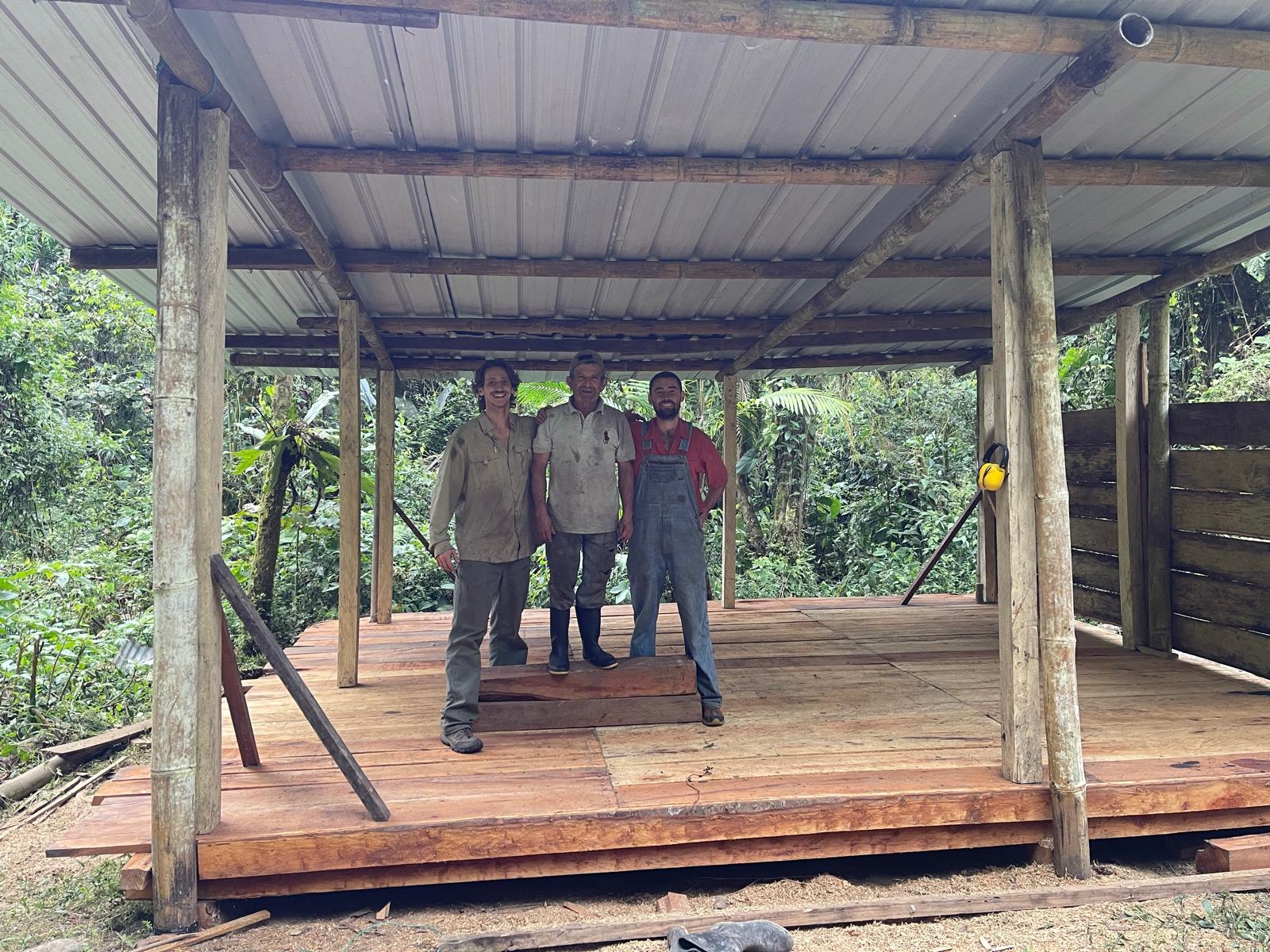
There is no alarm clock quite like the loud “OJO!” of a 74 year old Ecuadorian man at 6:30 in the morning, knowing he was up over an hour ago and he’d walked all the way from town.
Once Guillermo “Vaca” hits you with a “buenas tardes”, realizing you’d just woken up, he’ll ask what’s for breakfast.
By the third day of this, he’s in the kitchen making sure breakfast is up to his liking, because he can’t trust the gringos to put enough salt in anything. Rice with peanut butter-onion sauce and bananas became the winning breakfast in the end, and its actually really really good.
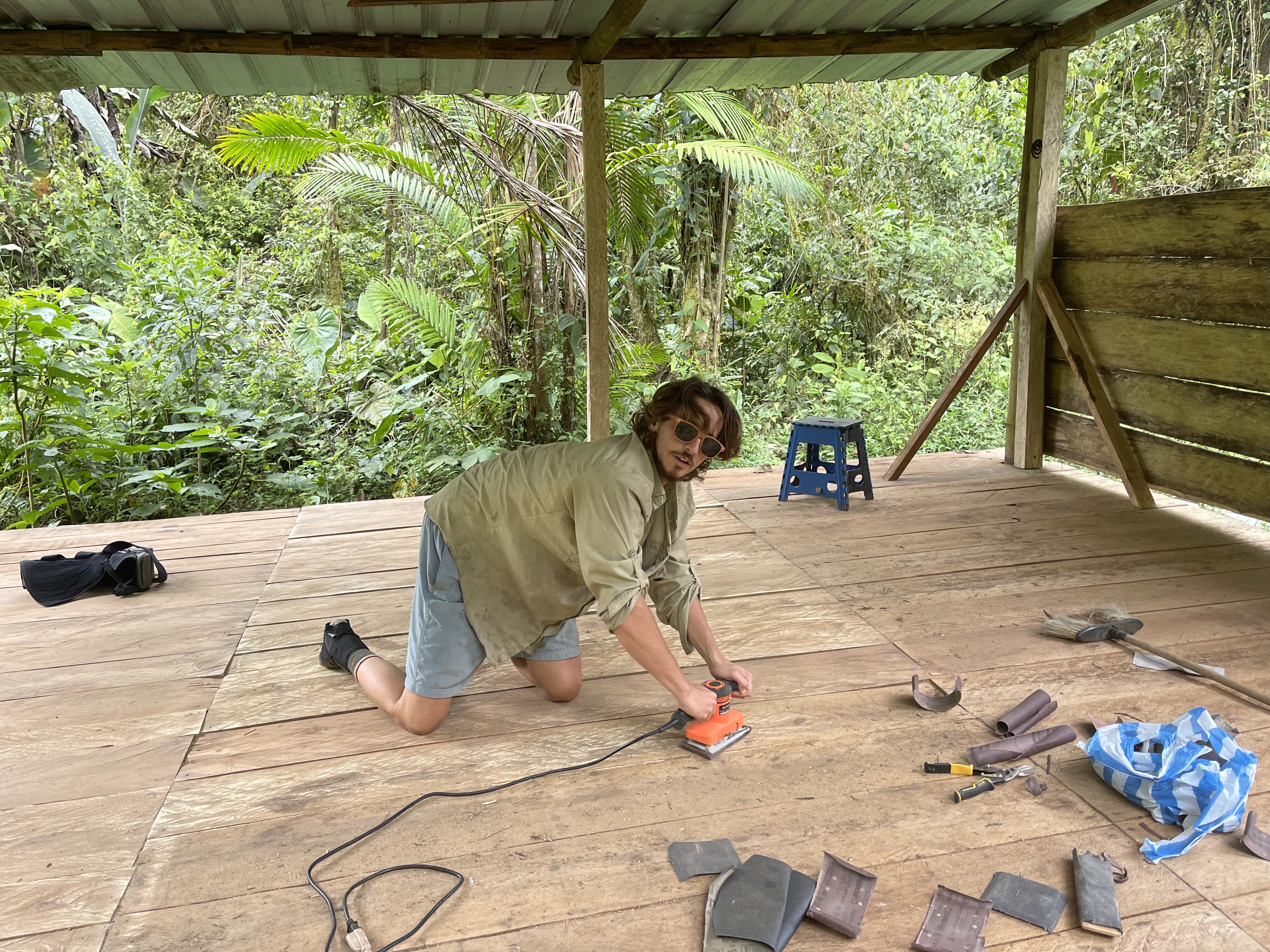
After some smack talk and coffee over breakfast, it’s time to get down to business. We spent the day building a new camp shelter, hauling wood and hammering nails. If we start getting on Guillermo’s nerves with our endless questions and adjustments, he starts asking for almuerzo. It’s gotta have meat, it can’t have mayo, and the rice can’t be too “duro”.
At this point you can usually distract him with a banana or a handful of raisins in order to hold him over until lunch. If he catches you walking towards the house in this time frame, you are likely to hear a “Mas Chorizo” yelled over the saw.
We met Guillermo in town, sitting in an insanely beautiful restaurant/house made entirely of wood. Our friend said that his dad built it, and pointed to the man chopping wood outside. We were looking for a carpenter and so we talked to him.
Turns out Guillermo is 74 and is still doing construction and trail building weekly. He says work is “Buen por salud.” We also learned that he built all of the trails at the reserve over 20 years ago. He is a wealth of knowledge of everything at the reserve; some things are just meant to be.

He told us that he’d be at the reserve at 8:30 the next day, and that he had no phone. We heard our first OJO at 7:00 the next morning, and the rest is history.
We spent the back half of August working with Guillermo to build the camp shelter. Our days went like this: OJO, Breakfast, work, lunch, more work.
When we weren’t grabbing hot sauce, salt, or sugar, we were grabbing nails and other tools, and never hammering in exactly the place he wanted. The afternoons were a chorus of “Clave! Empujar!” and lots of other words that we don’t know the real meaning of, but we know what part of wood to hit when he says it. If you messed up, you’d get the glare. After a few days, though, we learned that you could counter the glare with a “Mal ayudante!”

It was a really great experience for three reasons. One, the floor we built looks really awesome, like artsy airbnb level awesome. Two, we learned a ton about carpentry and woodworking from an absolute expert. We were even saying that we would have paid for the experience we were gaining. Third, we’ve gained a great friend in Guillermo. We would spend the whole day working but also laughing and joking in Spanish, learning a lot of words and phrases that will not be included in this blogpost.

Now, when we go into town we stop in at Guillermo’s and spend some time with him and his family. We have sweet bread and a fresh cup of a tea-oatmeal thing that isn’t quite either, but it’s delicious.
A Day at the reserve
We like to hit the ground running every morning at the reserve, yet some mornings are admittedly slower than others, sipping hot tea on the porch with a beanie and sweatshirt on while monitoring hummingbirds for an hour. This day in particular, was not a tea sipping morning for us. It started with the weekly Andean Cock of the Rock Lek monitoring. This is a magnificent bird, and one of the coolest ones we have on the reserve, in our opinion. Their display in search of a mate is a daily grind for them, which we have the honor of monitoring and collecting data. Believe me when I say it these birds are for lust, and not love. When a male asserts dominance, he will mate with as many females as they can.

Andean Cock of the Rock
A monitoring day entails waking up at 5am and hiking up the bosque trail with our headlamps to arrive by 5:45. I’ll spare you the long description as you have heard it in past manager’s blogposts, but it is a harrowing experience not knowing if the stick you are stepping on is a snake just hiding in the shadows of the early morning. Once we got to the Lek, we monitored these birds putting on their daily display. We also get cell service at the Lek, of course we have to text our parents/ girlfriends we haven’t talked to in a week.
We continued hiking up the bosque trail machetes in hand, backpacks stocked with hammocks, peanut butter, our fresh reserve grown bananas and last night’s rice stir fry. What can we say? We get hungry up there and we know how to relax, sue us. Food aside, we were clearing the upper part of bosque trail, which had been reclaimed by the jungle. Bosque is our favorite trail since it takes you as deep and as high as possible into the cloud forest at the reserve. Noticing new flora and fauna appear as we hike is also one of the best aspects of the trail. We continued hiking on for about 25 minutes past the lek and encountered our first tree fall. We hacked away with our machetes clearing the small branches and vines first to reach the main log. After, one of us would hack away at the log, until they got tired and would tag in the other to start unleashing whatever anger they had pent up over the last 10 years. Macheting really is great therapy.

On the Bosque trail
We continued for another few hours, losing the trail and finding it again, and taking in the old growth trees and the out of this world bugs that comprise the beautiful Andean cloud forest. Bit by bit we continued clearing away more and more trail. Until we heard a distinct and strangely cute sound in the trees above us. We began to scan canopy above us with our binoculars searching for the perpetrator of the sound. Arthur then proclaimed he saw a monkey! It took Matt a second to decipher the small fuzzy creature about 75 ft above them perched in a tree. We walked the trail keeping our eyes on the creature to find a good viewpoint. As we walked, we saw 2, 3 and eventually 8 monkeys running and jumping across trees! We began watching them in awe, groom and communicate with each other.


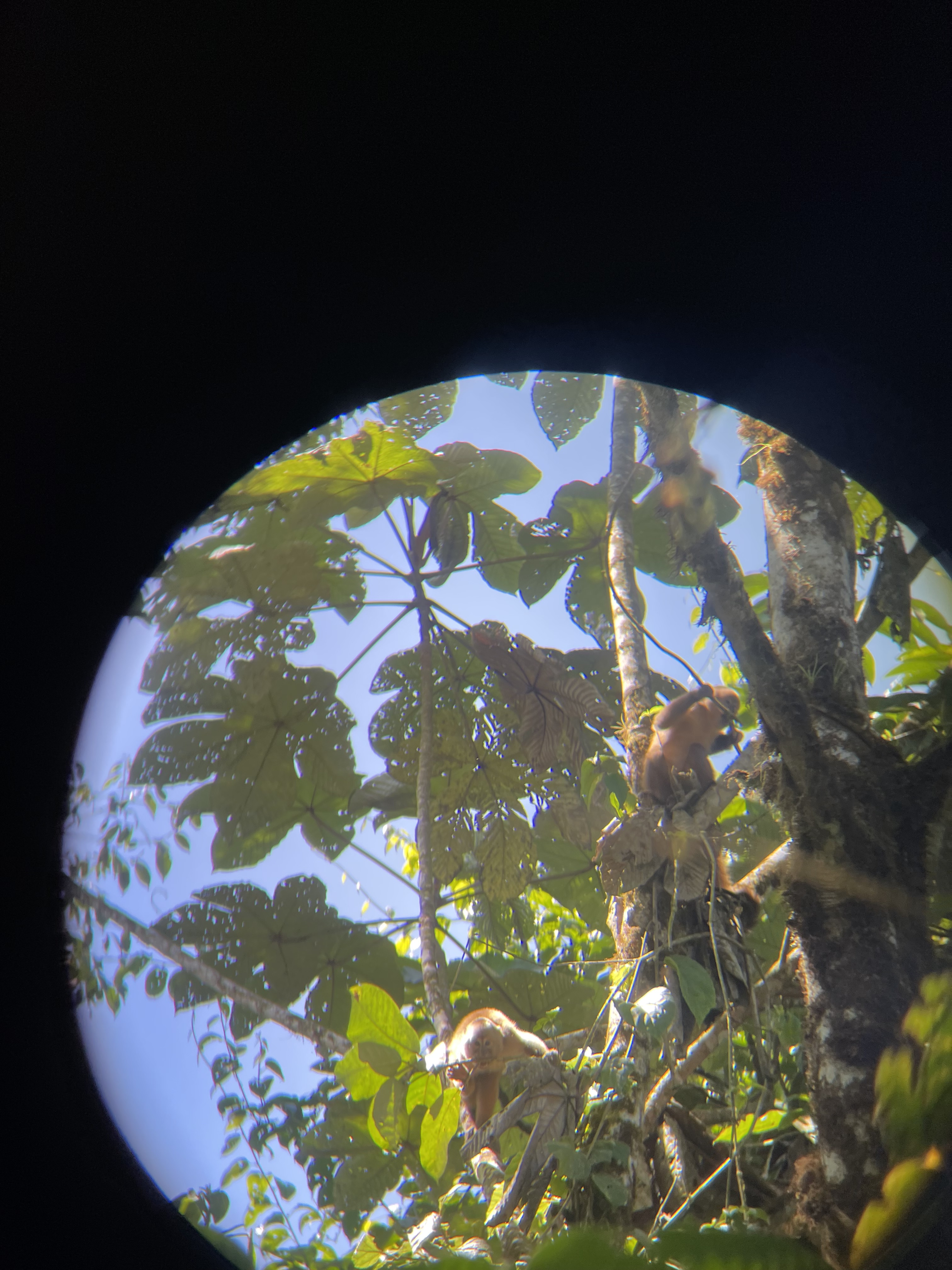
Capuchin Monkeys (via phone through binoculars)
We realized these are Ecuadorian capuchin monkeys. They are critically endangered due to habitat loss and hunting. Over 90% of their habitat has been destroyed and places like Reserva las Tangaras are the last frontiers for these magnificent creatures. They are also known to be one of the smartest species of monkey, employing tools like leaves as cups to drink water. However, their behaviors are not very well studied, since they are rare and usually very elusive. We hungout with the monkeys for a while and took a bunch of pictures, as one does when they see an endangered monkey deep in the Ecuadorian cloud forest.

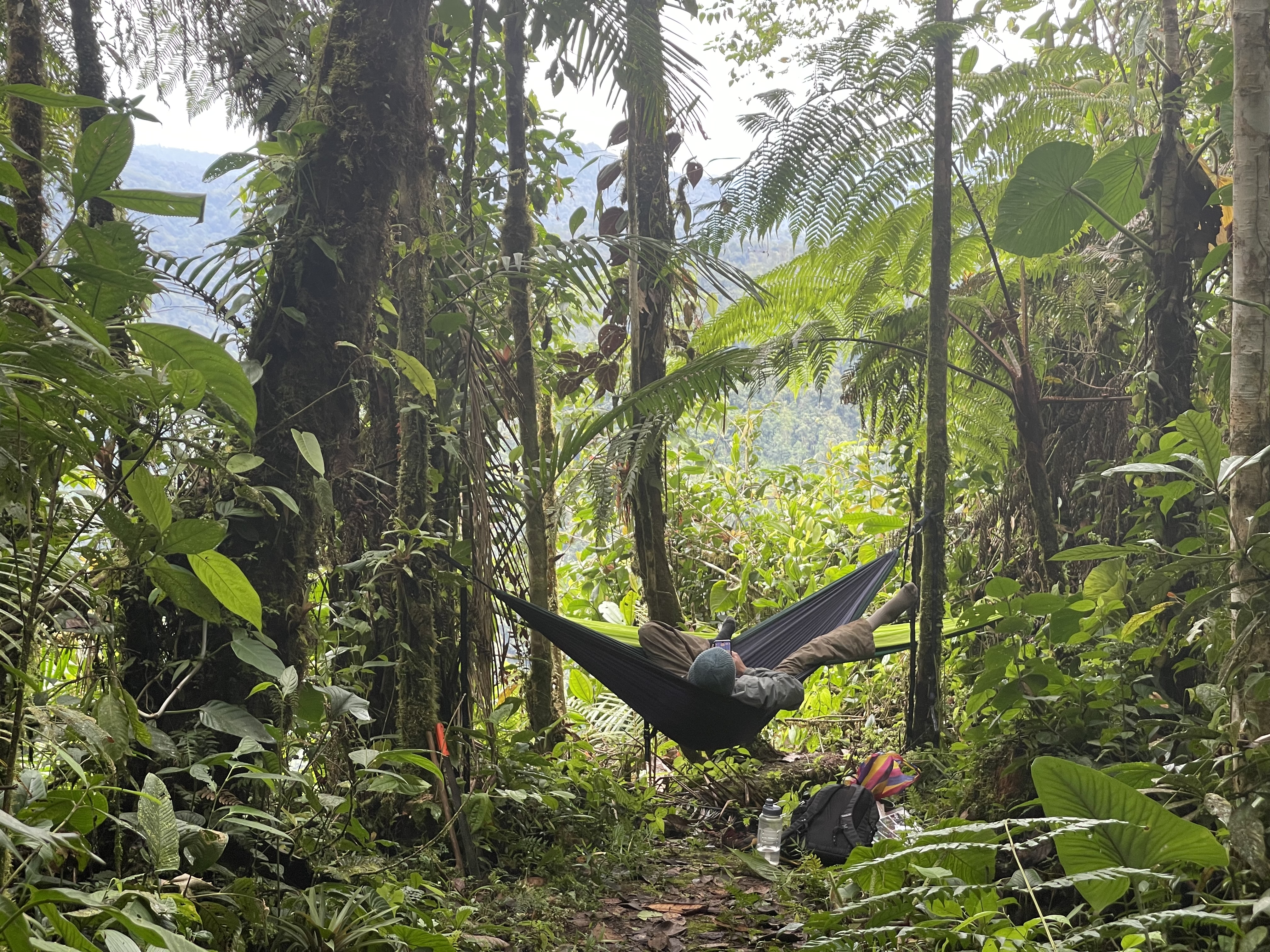
Hammock Break
The next part of the day was not quite as Tranquil. After moving on from watching the monkeys, we came to a sign in the trail that let us know “Ruta no matienen mas alla de aqui” Not until now it isn’t. It was a bad day to be a treefall blocking what we thought could maybe at some point have been a trail to the top of the ridge.
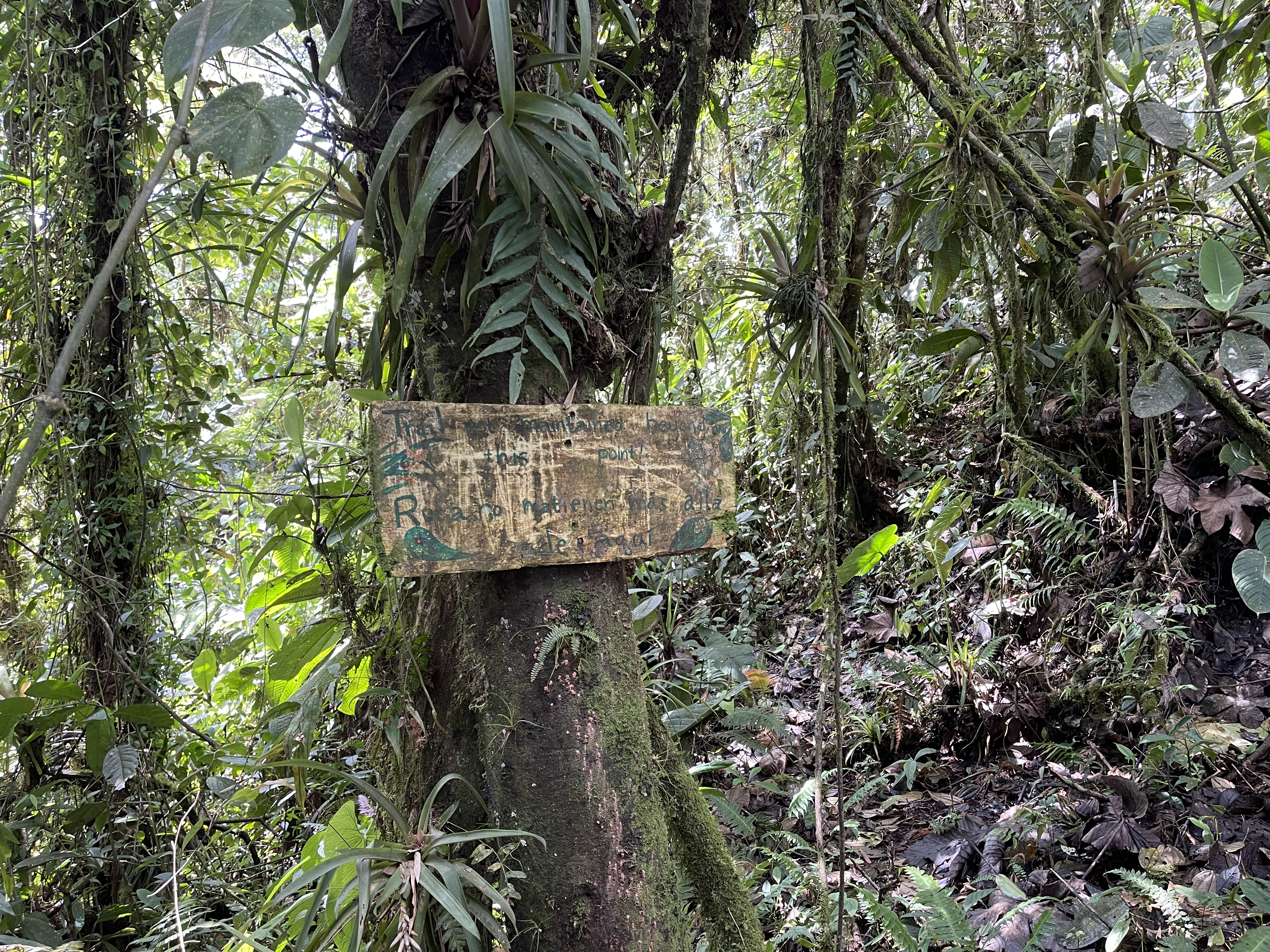
End of Trail Sign
We spent hours walking, climbing, and crawling up the ridge with our machetes leading the way. Often, we would look down and realize we were standing on fallen branches and logs which were 8 feet in the air and not on the ground. At a certain point anything that remotely resembled a trail was completely gone, and we’d catch ourselves yelling “found it” and start hacking away if we could see the ground at all. Now this was proper bush whacking. It was awesome.
I’d never really considered the accuracy of the term bushwhacking until right now. Because that’s almost exactly what it felt like we spent the rest of that morning doing. Whacking bushes and trees in an upward push to the top of a ridge that seemed to be getting further and further away. Once you were finally birthed out of the bramble at what you originally thought was the top, you’d see that there was a higher point just a bit off, and we wouldn’t settle for second best after coming this far. Maybe that area was a bramble free oasis ringed with Verbena flowers we thought.
When we finally did reach the top, that wasn’t the case, but the view made up for it tenfold. Describing it won’t do it justice, so we’ll just drop a picture of it below. This view combined with last night’s stir fry, well earned, was a match made in heaven.

The top of Bosque

 Reserva Las Tangaras