Remember to Forget
There seem to be certain fundamentals to happiness which, at least in my experience, need to be realized over and over again. We tend to lead hectic lives, so it follows that we forget these fundamentals from time to time. And when I say “happiness,” I’m not talking about some vague concept of getting all of the things you want in life. I’m talking about a mental calm in which you’re perfectly content with whatever happens to be occurring at the moment. It’s wanting what you have, rather than having what you want. Of course, this is not an original thought. If it were, it wouldn’t be very fundamental. Also not surprising is that as time goes on and technology advances, it becomes more challenging to find situations in which those fundamentals are easily remembered. If such a situation exists, surely it should be at an off-grid cabin in the mountains of Ecuador. It turns out, though, that where there’s a smart phone, there’s a way.
The concept I’ll discuss here has been gnawing at me for a long time. Its image in my head, and sometimes in crude diagrams, has gone through various phases in my effort to appropriately capture all of its elements in one metaphor. I still don’t think I’ve done that, though this may be the closest I’ve come. I should also say that I’m under no illusions that this is a groundbreaking idea, or that it’s difficult to understand. It just takes some space to lay out in its entirety. Likely, others have already neatly figured it out. As the saying goes: Everyone is the unconscious proponent of some philosopher.
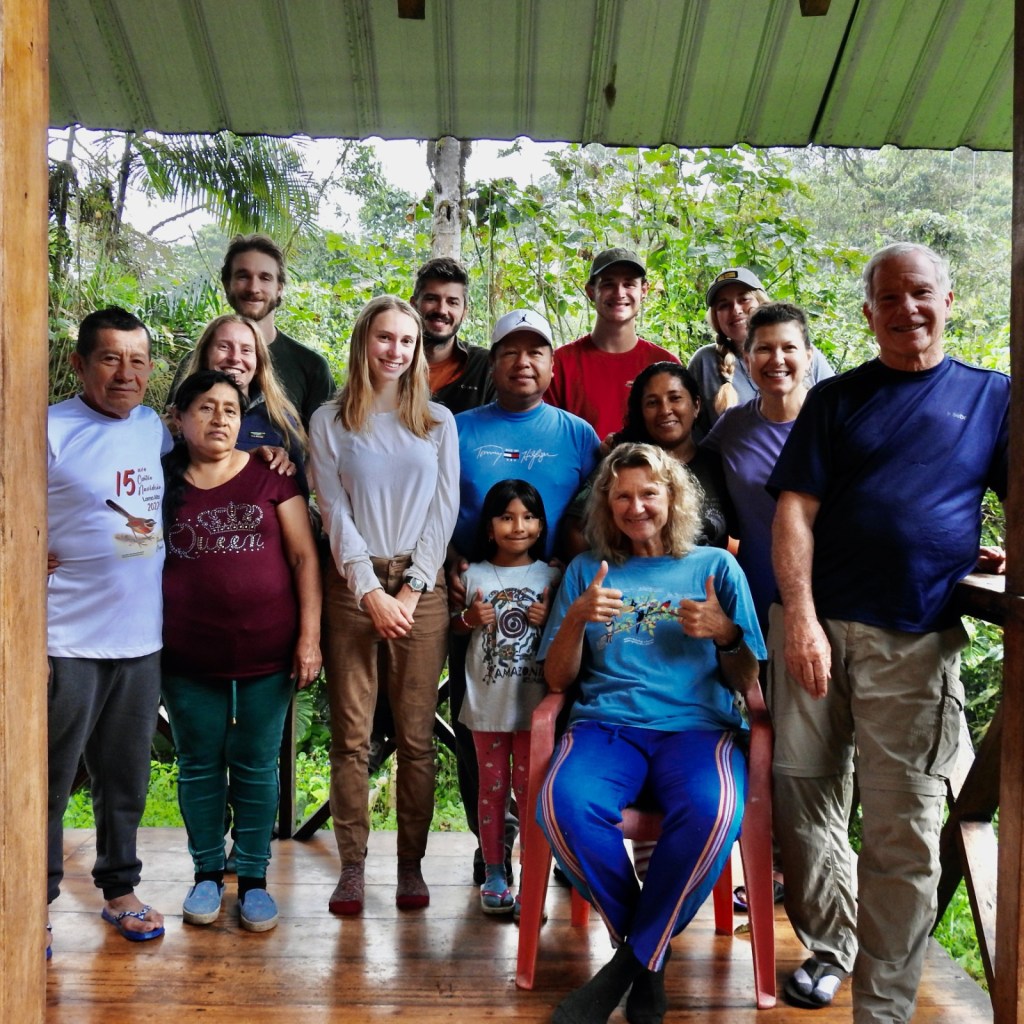
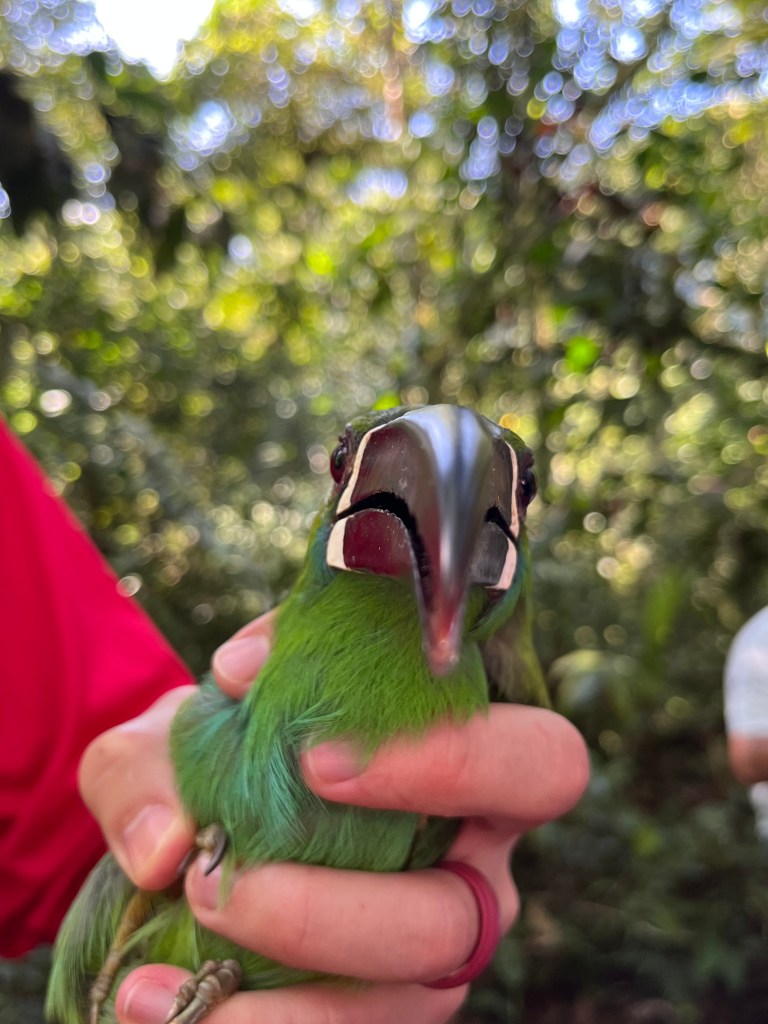
Most recently, my thoughts on this topic have been reignited by the August 2023 bird banding workshop here at the reserve. This is a two-week event that we have here twice per year – once in the winter (the wet season) and once in the summer (the dry season). Participants come out to gain experience, either for personal or professional reasons, with mist-netting and banding birds. Emily and I were fortunate to be able to be a part of it, and to get to know a very cool group of people from around the U.S., as well as a warm group of Ecuadorians who come to help run each workshop. We had the opportunity to handle and band some unique birds, and to solidify and expand our identification skills.

What sparked this post, however, was something in the background of all of that: silence. As I said before, one would think that excessive distraction by technology would be a small concern here – to be sure, it’s far easier to manage here than back home. But smart phones are amazing devices capable of storing huge amounts of content. Since the events of the last few years, Emily and I have been pretty plugged in. Mostly, we listen to a lot of podcasts – and there’s a lot to listen to. Besides shows concerning current events, we like to keep up with shows about science, history, and anything that interests us. There’s always more to learn. I think we both expected that we would be forced to take a couple of steps back from all of that during our time here, but that hasn’t been the case. We can download the latest episodes when we have cell service about twice per week, and we still don’t make it through everything new. The thing about something like a two-week banding workshop, though, is that it demands that you disconnect from your normal routine and fully drop into your current situation. That means that keeping up with the latest episodes – or any episodes – of your favorite podcasts isn’t really an option. The result: the restoration of a sustained inner calm that I haven’t felt for some time.
Before I dive into the analogy, I should say that I don’t expect everyone will relate to this. It seems to be a problem of a certain set of personality types. Emily, for instance, isn’t afflicted by this. I think the underlying principle may be universal, but the abuse of the machine is not. Only some abuse the machine.
Picture the mind as a biological cell. (That’s the “machine” which I just mentioned.) It’s sitting in a medium of information – sounds, colors, wind, temperature – everything in the outside world. Right now, for instance, the medium in which my cell sits consists of a light breeze, swaying banana leaves, the agitated song of a Red-faced Spinetail, a large bee steadily descending through the air while staring at a tree, etc. Inside the cell are thoughts, feelings, ideas, and quite possibly an infinity of indefinable bits that make up human consciousness. We can think of these bits, together, as a kind of cerebral SCOBY – a Symbiotic Community of Bacteria and Yeast.
The cell membrane, as the cell floats within its medium, is acted upon by two opposite pressures – pressure pushing inward from the medium, and pressure pushing outward from within. The pressure pushing inward fluctuates according to the amount and power of the stimulation coming from the outside world. A quiet forest at midday (when there is very little animal activity) exerts little pressure. A dense podcast about the biochemical actions of a medicinal plant exerts great pressure. Pressure from the inside is generated by fermentation. That is, the cerebral SCOBY ferments information which makes it through the cell membrane from the outside. Think of information like nutrients for your SCOBY. It takes them and uses them to grow and reproduce, at the same time producing waste – a cerebral gas, much like the carbon dioxide waste produced by an actual SCOBY.* Thus, this exerts an outward pressure.
Now we have a picture of a cell in a medium, with pressure pushing both in and out, and we understand the source of each pressure. What we’re missing is the moderator; what regulates the membrane’s response to these two pressures? The answer is focus. Just like a real cell membrane, our metaphorical cell membrane is semipermeable, meaning it can selectively allow things to pass through it by actively transporting them from one side to the other through channels. We’ll call those active channels. It also has passive channels, through with information passes without effort, or even consent. More on that later. The active transport of information across the active channels is regulated by focus. When we focus on something, we are selecting that thing to cross into our cell. For example, we may focus on that podcast about plant medicine and, in doing so, select various pieces – likely as many as we can – of biochemical and natural history information to travel across the membrane and enter our cell.
While we are focused, fermentation activity by our SCOBY decreases. We are adding information to be fermented, but the fermentation can’t start until our focus on the outside medium subsides. Because fermentation slows while we are focused, inward pressure pushing out decreases. Meanwhile, the pressure pushing in has actually increased, which is the very reason we are busy focusing. In response, the cell shrinks, leaving less room inside for more information to enter. The longer we focus, the smaller the cell shrinks, the less room inside. Eventually, after a long period of focus, there’s no room left, and continued focus is impossible. This is part of what happens when you pull an all-nighter to complete important work. As soon as focus ceases, fermentation recommences, and the cell begins to expand again, allowing for new ideas to grow as SCOBY activity ramps up and the available space increases.
With this model in mind, it’s easy to imagine how spending too much time in a state of focus can hobble our minds. With no time allocated to fermentation, the cell remains shriveled, unable to grow. Without considering mental health, one might focus until the cell is shriveled like a raisin, relax just long enough for it to expand a hair, and then start focusing again. More personally, by mechanically trying to fill every unfilled moment with increased stimulation and forcing my mind into a state of focus, I was stunting my mind’s fermentation. The banding workshop forced me back to baseline by removing the option to fill those moments.
The three of you who are still reading may be wondering, “But if you never focus, wouldn’t the SCOBY eventually run out of food, and fermentation would stop? Then, the cell would collapse!” True, but remember that I promised to return to the passive component of the membrane’s permeability. If we picture that when the cell fully expands, its membrane stretches, and every part of its surface becomes exposed, while the opposite happens when it deflates, then this will make perfect sense. Information will always make it through these passive channels, whether we want it to or not. But consider focus as an action which flexes the membrane, opening the active, selective channels, while pinching shut the passive ones. Thus, the act of focusing reduces the amount of information which is passively received into the cell. Also affecting this is the degree of inflation or deflation of the cell at any given moment. As I alluded to above, a more inflated cell will have more passive channels open to transport information. Considering all of this, it follows that a state of ‘unfocus’ both keeps passive channels open and exposes more of them, while a state of focus does the opposite. Thus, and unfocused mind still receives information for the SCOBY to ferment, it’s just that much less of it is intentionally accrued.
The moral of the story isn’t that being focused leads to unhappiness, and we should never do it. Rather, to those of us prone to insisting on always focusing – on having a task, a goal, an object for our attention – we’ll do well to realize that our SCOBYs need room to grow. It’s okay to have a smart phone in the cloud forest. But sometimes, for our own sanity, we also need to remember to forget it.
* It’s also fun to think about how we can extend the analogy in thinking about that gaseous “waste.” In a real fermentation – like in beer – that carbon dioxide waste exerts ancillary effects on the primary product (the alcohol). A flat beer is no fun; carbonation is what gives it it’s liveliness. Plus, it affects the way the alcohol is absorbed in your body (a good or a bad thing, depending on your stance on alcohol). Similarly, the “waste” gases that our cerebral SCOBYs produce (spontaneous but unrealistic ideas and daydreams are good examples) add liveliness to our minds, and affect how we process information down the road.

 Reserva Las Tangaras